



ITK Antibody (YA3346)
(Synonyms: ITK; EMT; LYK; Tyrosine-protein kinase ITK/TSK; Interleukin-2-inducible T-cell kinase; IL-2-inducible T-cell kinase; Kinase EMT; T-cell-specific kinase; Tyrosine-protein kinase Lyk)
Based on 1 Customer Validation
ITK Antibody (YA3346) is a Rabbit-derived and non-conjugated IgG monoclonal antibody, targeting to ITK.
-
Host:
Rabbit
-
Isotype:
IgG
-
Application:
WB, IHC-P, FC
-
Reactivity :
Human
-
Formulation:
Supplied in rabbit IgG in 10mM PBS, pH 7.4, 150mM sodium chloride, 0.05% BSA, 0.02% sodium azide and 50% glycerol.
-
Conjugation:
Non-conjugated


To place orders, for customer services and technical support, please contact: MedChemExpress USA
Tel: 609-228-6898 E-mail: [email protected] [email protected]





Applications
| Application |
WB

WB: Western Blot
|
IHC
|
FC
FC: Flow Cytometry
|
|---|---|---|---|
| Dilution Ratio | 1:1000-1:2000 | 1:100-1:200 | 1:50-1:100 |


Product Details
ITK Antibody (YA3346) is a Rabbit-derived and non-conjugated IgG monoclonal antibody, targeting to ITK.
-
Host Rabbit

-
Clonality Recombinant,Monoclonal

-
Species ReactivityHuman
-
Observed Molecular WeightObserved band size: 72 kDa
Note: Due to possible protein modifications or aggregation, the molecular weight should be confirmed by actual measurement, and the predicted value is for reference only.

-
Calculated Molecular Weight Predicted band size: 72 kDa

A synthesized peptide derived from human ITK aa1-66/620.
Endogenous
Affinity Chromatography
Non-conjugated
Unmodified
IgG


Product Properties
-
Appearance
Solution
-
Formulation
Supplied in rabbit IgG in 10mM PBS, pH 7.4, 150mM sodium chloride, 0.05% BSA, 0.02% sodium azide and 50% glycerol.
-
Concentration
Batch-dependent, Please check the COA for the concentration of each lot. Check Lot Concentration
-
Storage & Stability
Stored at -20°C for 1 year. Avoid repeated freeze / thaw cycles.
-
Shipping
Shipping with blue ice.


Verification Images
-
 Immunohistochemical analysis of paraffin-embedded human colon cancer using ITK antibody. The section was pre-treated using heat mediated antigen retrieval with EDTA (pH 9.0) for 14 minutes. The tissues were blocked in 5% BSA for 30 minutes at room temperature, washed with TBST, and then probed with the primary antibody (HY-P83601, 1/100) for 1 hour at room temperature. The detection was performed using Polymer HRP-conjugated Goat Anti-Mouse/Rabbit lgG(H&L) secondary antibody (HY-P83652). DAB was used as the chromogen. Tissues were counterstained with hematoxylin and mounted with DPX.
 -
 Immunohistochemical analysis of paraffin-embedded human pancreas using ITK antibody. The section was pre-treated using heat mediated antigen retrieval with EDTA (pH 9.0) for 14 minutes. The tissues were blocked in 5% BSA for 30 minutes at room temperature, washed with TBST, and then probed with the primary antibody (HY-P83601, 1/100) for 1 hour at room temperature. The detection was performed using Polymer HRP-conjugated Goat Anti-Mouse/Rabbit lgG(H&L) secondary antibody (HY-P83652). DAB was used as the chromogen. Tissues were counterstained with hematoxylin and mounted with DPX.
 -
 Immunohistochemical analysis of paraffin-embedded human lung cancer using ITK antibody. The section was pre-treated using heat mediated antigen retrieval with EDTA (pH 9.0) for 14 minutes. The tissues were blocked in 5% BSA for 30 minutes at room temperature, washed with TBST, and then probed with the primary antibody (HY-P83601, 1/100) for 1 hour at room temperature. The detection was performed using Polymer HRP-conjugated Goat Anti-Mouse/Rabbit lgG(H&L) secondary antibody (HY-P83652). DAB was used as the chromogen. Tissues were counterstained with hematoxylin and mounted with DPX.
 -
 Immunohistochemical analysis of paraffin-embedded human ovarian cancer using ITK antibody. The section was pre-treated using heat mediated antigen retrieval with EDTA (pH 9.0) for 14 minutes. The tissues were blocked in 5% BSA for 30 minutes at room temperature, washed with TBST, and then probed with the primary antibody (HY-P83601, 1/100) for 1 hour at room temperature. The detection was performed using Polymer HRP-conjugated Goat Anti-Mouse/Rabbit lgG(H&L) secondary antibody (HY-P83652). DAB was used as the chromogen. Tissues were counterstained with hematoxylin and mounted with DPX.
 -
 Immunohistochemical analysis of paraffin-embedded human cervical cancer using ITK antibody. The section was pre-treated using heat mediated antigen retrieval with EDTA (pH 9.0) for 14 minutes. The tissues were blocked in 5% BSA for 30 minutes at room temperature, washed with TBST, and then probed with the primary antibody (HY-P83601, 1/100) for 1 hour at room temperature. The detection was performed using Polymer HRP-conjugated Goat Anti-Mouse/Rabbit lgG(H&L) secondary antibody (HY-P83652). DAB was used as the chromogen. Tissues were counterstained with hematoxylin and mounted with DPX.
 -
 Immunohistochemical analysis of paraffin-embedded human liver cancer using ITK antibody. The section was pre-treated using heat mediated antigen retrieval with EDTA (pH 9.0) for 14 minutes. The tissues were blocked in 5% BSA for 30 minutes at room temperature, washed with TBST, and then probed with the primary antibody (HY-P83601, 1/100) for 1 hour at room temperature. The detection was performed using Polymer HRP-conjugated Goat Anti-Mouse/Rabbit lgG(H&L) secondary antibody (HY-P83652). DAB was used as the chromogen. Tissues were counterstained with hematoxylin and mounted with DPX.
 -
 Immunohistochemical analysis of paraffin-embedded human prostate cancer using ITK antibody. The section was pre-treated using heat mediated antigen retrieval with EDTA (pH 9.0) for 14 minutes. The tissues were blocked in 5% BSA for 30 minutes at room temperature, washed with TBST, and then probed with the primary antibody (HY-P83601, 1/100) for 1 hour at room temperature. The detection was performed using Polymer HRP-conjugated Goat Anti-Mouse/Rabbit lgG(H&L) secondary antibody (HY-P83652). DAB was used as the chromogen. Tissues were counterstained with hematoxylin and mounted with DPX.
 -
 Immunohistochemical analysis of paraffin-embedded human bladder cancer using ITK antibody. The section was pre-treated using heat mediated antigen retrieval with EDTA (pH 9.0) for 14 minutes. The tissues were blocked in 5% BSA for 30 minutes at room temperature, washed with TBST, and then probed with the primary antibody (HY-P83601, 1/100) for 1 hour at room temperature. The detection was performed using Polymer HRP-conjugated Goat Anti-Mouse/Rabbit lgG(H&L) secondary antibody (HY-P83652). DAB was used as the chromogen. Tissues were counterstained with hematoxylin and mounted with DPX.
 -
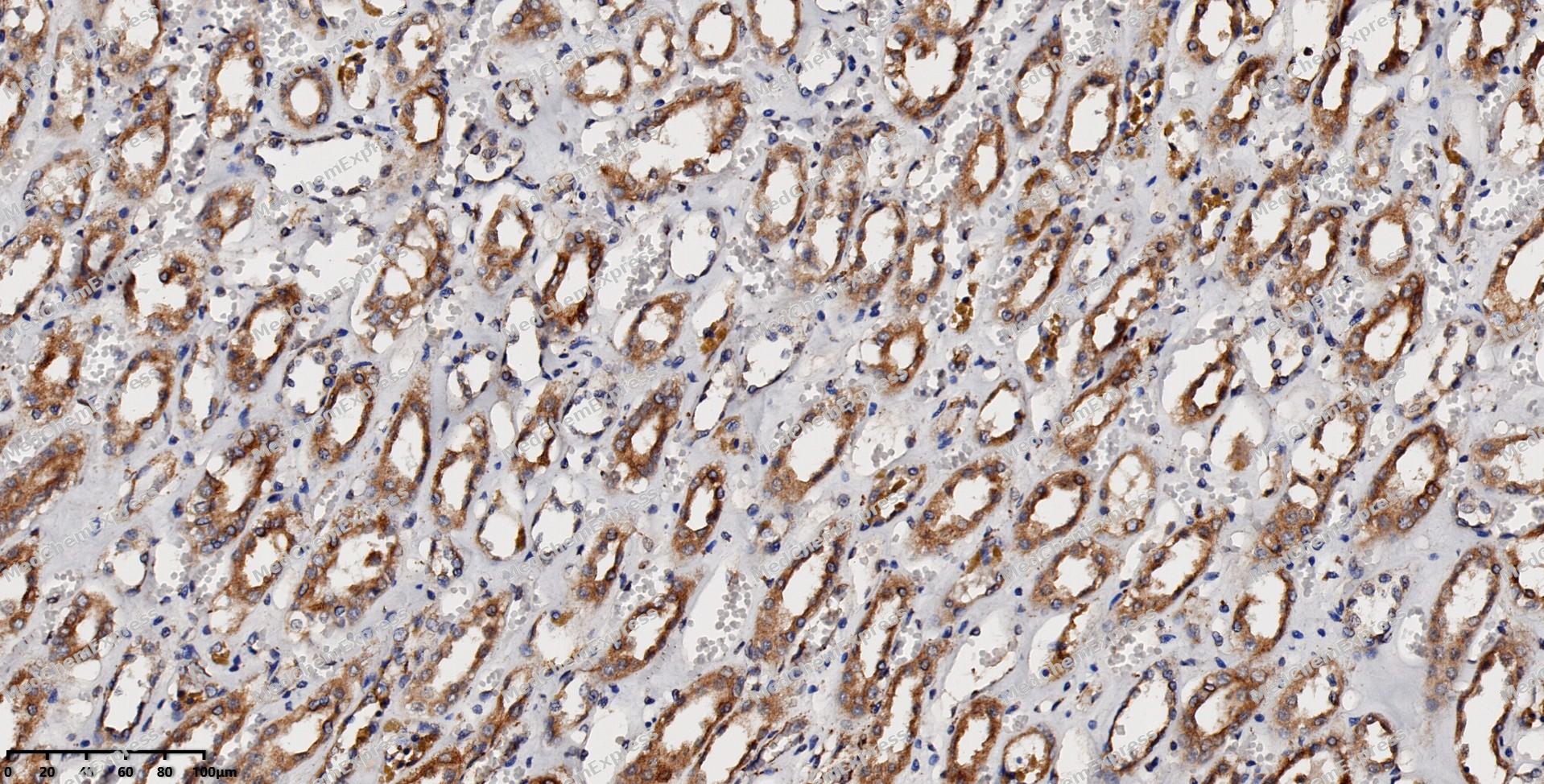 Immunohistochemical analysis of paraffin-embedded human kidney using ITK antibody. The section was pre-treated using heat mediated antigen retrieval with EDTA (pH 9.0) for 14 minutes. The tissues were blocked in 5% BSA for 30 minutes at room temperature, washed with TBST, and then probed with the primary antibody (HY-P83601, 1/100) for 1 hour at room temperature. The detection was performed using Polymer HRP-conjugated Goat Anti-Mouse/Rabbit lgG(H&L) secondary antibody (HY-P83652). DAB was used as the chromogen. Tissues were counterstained with hematoxylin and mounted with DPX.


Background
-
Function
Itk (Interleukin-2-inducible T-cell kinase) is a Tec family tyrosine kinase that mediates signaling processes after T cell receptor engagement. Activation of Itk requires recruitment to the membrane via its pleckstrin homology domain, phosphorylation of Itk by the Src kinase, Lck, and binding of Itk to the SLP-76/LAT adapter complex. After activation, Itk phosphorylates and activates phospholipase C-gamma1 (PLC-gamma1), leading to production of two second messengers, DAG and IP3. IP3 and DAG stimulate the release of calcium ions from the endoplasmic reticulum and activate Protein Kinase C, respectively. In addition, Itk regulates the development of Th2 cells and their subsequent cytokine secretion, thereby modulating the immune response. Studies have shown that ITK is involved in the pathogenesis of autoimmune diseases as well as in carcinogenesis. The loss of ITK or its activity either by mutation or by the use of inhibitors led to a beneficial outcome in experimental models of asthma, inflammatory bowel disease and multiple sclerosis among others. In humans, biallelic mutations in the ITK gene locus result in a monogenetic disorder leading to T cell dysfunction, etc. These findings put ITK in the strong focus as a target for drug development.
-
Subcellular Localization
Cytoplasm; Nucleus
-
Expression
Tissue_specificity:T cell lines and natural killer cell lines
Induction:Through a myriad of surface receptors including the TCR/CD3 signaling complex, coreceptors, or chemokine receptors -
Subunit
Homooligomerizes; this association negatively regulates kinase activity (By similarity). Interacts with PPIA/CYPA; this interaction regulates TCR signal strength via a proline-directed conformational switch in ITK. Interacts with THEMIS (By similarity). Interacts with FASLG. Interacts with VAV1; this interaction is important for VAV1 localization and TCR-induced actin polarization. Interacts with TBX21 (By similarity)
-
SwissProt ID
-
Synonyms
ITK; EMT; LYK; Tyrosine-protein kinase ITK/TSK; Interleukin-2-inducible T-cell kinase; IL-2-inducible T-cell kinase; Kinase EMT; T-cell-specific kinase; Tyrosine-protein kinase Lyk
-
Research Field
Signal Transduction


Documentation

 Powered by Bioz
