



KDM1/LSD1 Antibody (YA718)
(Synonyms: KDM1A; AOF2; KDM1; KIAA0601; LSD1; Lysine-specific histone demethylase 1A; BRAF35-HDAC complex protein BHC110; Flavin-containing amine oxidase domain-containing protein 2)
Based on 1 Customer Validation
KDM1/LSD1 Antibody (YA718) is a Mouse-derived and non-conjugated IgG1 monoclonal antibody, targeting to KDM1/LSD1.
-
Host:
Mouse
-
Isotype:
IgG
-
Application:
WB
-
Reactivity :
Human, Mouse, Monkey
-
Formulation:
Supplied in 1*PBS (pH 7.3), 50% glycerol and 0.5% BSA. Preservative: 0.02% sodium azide.
-
Conjugation:
Non-conjugated


To place orders, for customer services and technical support, please contact: MedChemExpress USA
Tel: 609-228-6898 E-mail: [email protected] [email protected]





Applications
| Application |
WB

WB: Western Blot
|
|---|---|
| Dilution Ratio | 1:500-1:1000 |


Product Details
KDM1/LSD1 Antibody (YA718) is a Mouse-derived and non-conjugated IgG1 monoclonal antibody, targeting to KDM1/LSD1.
-
Host Mouse

-
Clonality Monoclonal

-
Species ReactivityHuman, Mouse, Monkey
-
Observed Molecular WeightObserved band size: 95-110 kDa
Note: Due to possible protein modifications or aggregation, the molecular weight should be confirmed by actual measurement, and the predicted value is for reference only.

-
Calculated Molecular Weight Predicted band size: 93 kDa

Entrez Gene: 23028 Human ; 99982 Mouse ; 500569 Rat
SwissProt: O60341 Human ; Q6ZQ88 Mouse ;
OMIM: 616728 Human
Synthetic peptide corresponding to Human LSD1.The exact sequence is proprietary to MCE.
Endogenous
affinity purified
Non-conjugated
Unmodified
IgG


Product Properties
-
Appearance
Solution
-
Formulation
Supplied in 1*PBS (pH 7.3), 50% glycerol and 0.5% BSA. Preservative: 0.02% sodium azide.
-
Concentration
Batch-dependent, Please check the COA for the concentration of each lot. Check Lot Concentration
-
Storage & Stability
Stored at -20°C for 1 year. Avoid repeated freeze / thaw cycles.
-
Shipping
Shipping with blue ice.


Verification Images
-
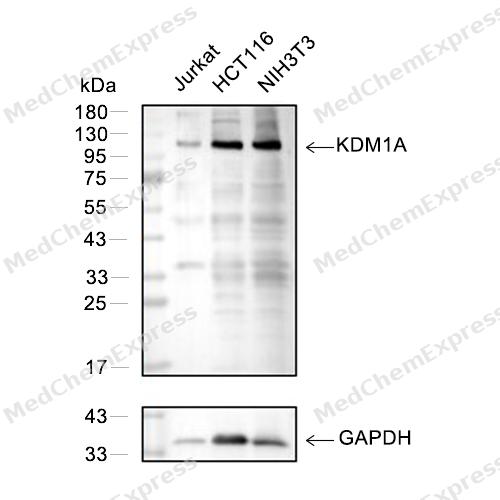 Western blot analysis of extracts from Jurkat(lane 2(40μg), HCT116(lane 3(40μg)) and NIH3T3(lane 4(40μg)), using KDM1A (HY-P80731) Mouse mAb. Proteins were transferred to a PVDF membrane and blocked with 5% BSA in TBST for 2 hour at room temperature. The primary antibody (HY-P80731, 1/1000) and Loading control antibody (GAPDH, HY-P80954, 1/3000) was used in 5% BSA in TBST at 4°C overnight. Goat Anti-Mouse IgG-HRP Secondary Antibody (HY-P8001/HY-P8004, 1/10,000) was used for 1 hour at room temperature.
 -
 Western blot analysis was performed on protein extracts (25 μg) from HCT 116 (lane 2), A549 (lane 3), HeLa (lane 4) and 293T (lane 5) using KDM1/LSD1 antibody. Proteins were transferred onto a 0.45 μm PVDF membrane using the Trans-Blot® Turbo™ system for 13 min. The membrane was then blocked with 5% nonfat milk in TBST (HY-K1025) for 1 h at room temperature. The primary antibody (1:1000) and loading control antibody GAPDH Antibody (HRP) (HY-P80954A) (1:5000) were diluted in 5% nonfat milk in TBST and incubated with the membrane overnight at 4°C. After washing, the membrane of primary antibody was incubated with HRP-conjugated goat anti-rabbit/mouse IgG secondary antibody (HY-P8001/HY-P8004) (1:5000) diluted in 5% nonfat milk in TBST for 1 h at room temperature. Protein bands were visualized using an Ultra High Sensitivity ECL detection kit (HY-K1005).


Background
-
Function
KDM1A/LSD1 (lysine-specific demethylase 1A) is a flavin adenine dinucleotide (FAD) -dependent histone demethylase that catalyzes oxidative demethylation of histone H3K4me1/2 and H3K9me1/2, thereby regulating chromatin structure and transcriptional programs central to cell fate determination and differentiation[1][2]. Mechanistically, LSD1 functions within transcriptional corepressor and chromatin-remodeling complexes, where its demethylase activity modulates epigenetic gene regulation and contributes to the dynamic control of gene expression[2][3]. Through actions on both histone and non-histone substrates, LSD1 participates in multiple biological pathways involved in development, hematopoiesis, neuronal function, and cellular homeostasis[3][4]. In disease settings, aberrant LSD1 activity supports cancer progression by regulating gene-expression programs associated with adaptation to the tumor microenvironment, epithelial-mesenchymal transition (EMT), stemness, and differentiation states[4]. Experimental studies further demonstrate that pharmacological or genetic inhibition of LSD1 can suppress EMT-associated transcriptional programs and impede tumor progression in preclinical models[4]. Compared with related isoforms, the neuronal LSD1 isoform displays distinct substrate specificity, preferentially demethylating H3K9me2 rather than H3K4me2 and promoting transcriptional programs linked to neuronal differentiation, learning, and memory[4]. This functional divergence highlights isoform-specific biological roles that should be considered when interpreting mechanistic studies and therapeutic responses[4]. For experimental applications, LSD1 has emerged as a major epigenetic drug target, and multiple small-molecule inhibitors, including tranylcypromine-derived compounds and clinical-stage LSD1 inhibitors, are being evaluated for hematologic malignancies and solid tumors, supporting its utility in target-validation and translational research programs[4][5].
-
Subcellular Localization
Nucleus; Chromosome
-
Expression
Tissue_specificity:general expression
Induction:Down-regulated during neural differentiation in neuroblastoma cancer -
Isoforms & Post-Translational Modification
O60341 has 2 isomers: O60341-1: 92903 Da (predicted); O60341-2: 95155 Da (predicted).
Acetylated by KAT8 in epithelial but not in mesenchymal cells, thereby regulating the epithelial-to-mesenchymal transition (PubMed:27292636). Acetylation by KAT8 reduces KDM1A association with nucleosomes, thereby decreasing histone H3 demethylation, leading to transcription activatio of target genes (PubMed:27292636);Polyubiquitinated by JADE2; which leads to its proteasomal degradation (PubMed:25018020). Deubiquitinated by USP38; preventing it from degradation by the 26S proteasome (PubMed:30497519) -
Subunit
Component of a histone demethylase complex with RCOR1 (PubMed:16885027, PubMed:20389281, PubMed:21300290, PubMed:23721412). Component of a RCOR/GFI/KDM1A/HDAC complex (PubMed:11102443, PubMed:12032298).
-
SwissProt ID
-
Synonyms
KDM1A; AOF2; KDM1; KIAA0601; LSD1; Lysine-specific histone demethylase 1A; BRAF35-HDAC complex protein BHC110; Flavin-containing amine oxidase domain-containing protein 2
-
Research Field
Epigenetics and Nuclear Signaling


Documentation
-
Data Sheet (261 KB)
-
SDS (252 KB)
- English - EN (252 KB)
- Français - FR (252 KB)
- Deutsch - DE (252 KB)
- Norwegian - NO (252 KB)
- Español - ES (252 KB)
- Swedish - SV (252 KB)
- Italian - IT (252 KB)
- Korean - KR (252 KB)
- Portuguese - PT (252 KB)
-
User Guide for Antibodies (1077 KB)
References
[1]. Burg JM, et al. Lysine-Specific Demethylase 1A (KDM1A/LSD1): Product Recognition and Kinetic Analysis of Full-Length Histones. Biochemistry. 2016 Mar 22;55(11):1652-62. [Content Brief]
[2]. Perillo B, et al. LSD1: more than demethylation of histone lysine residues. Exp Mol Med. 2020 Dec;52(12):1936-1947. [Content Brief]
[3]. Uniprotkb.
[4]. Kim D, et al. Roles of lysine-specific demethylase 1 (LSD1) in homeostasis and diseases. J Biomed Sci. 2021 Jun 4;28(1):41. [Content Brief]
[5]. Gill H. Lysine-Specific Demethylase 1 (LSD1/KDM1A) Inhibition as a Target for Disease Modification in Myelofibrosis. Cells. 2022 Jul 3;11(13):2107. doi: 10.3390/cells11132107. Erratum in: Cells. 2022 Dec 19;11(24):4126. doi: 10.3390/cells11244126. PMID: 35805191; PMCID: PMC9265913. et al. Lysine-Specific Demethylase 1 (LSD1/KDM1A) Inhibition as a Target for Disease Modification in Myelofibrosis. Cells. 2022 Jul 3;11(13):2107. [Content Brief]

 Powered by Bioz
