



Lyn Antibody (YA707)
(Synonyms: LYN; JTK8; Tyrosine-protein kinase Lyn; Lck/Yes-related novel protein tyrosine kinase; V-yes-1 Yamaguchi sarcoma viral related oncogene homolog; p53Lyn; p56Lyn)Based on 1 Customer Validation
Lyn Antibody (YA707) is a Mouse-derived and non-conjugated IgG1 monoclonal antibody, targeting to Lyn.
-
Host:
Mouse
-
Isotype:
IgG
-
Application:
WB
-
Reactivity :
Human
-
Formulation:
Supplied in 1*PBS (pH 7.3), 50% glycerol and 0.5% BSA. Preservative: 0.02% sodium azide.
-
Conjugation:
Non-conjugated


To place orders, for customer services and technical support, please contact: MedChemExpress USA
Tel: 609-228-6898 E-mail: [email protected] [email protected]





Applications
| Application |
WB

WB: Western Blot
|
|---|---|
| Dilution Ratio | 1:500-1:1000 |


Product Details
Lyn Antibody (YA707) is a Mouse-derived and non-conjugated IgG1 monoclonal antibody, targeting to Lyn.
-
Host Mouse

-
Clonality Monoclonal

-
Species ReactivityHuman
-
Observed Molecular WeightObserved band size: 56/53 kDa
Note: Due to possible protein modifications or aggregation, the molecular weight should be confirmed by actual measurement, and the predicted value is for reference only.

-
Calculated Molecular Weight Predicted band size: 59 kDa

Synthetic peptide corresponding to Human Lyn.The exact sequence is proprietary to MCE.
Endogenous
affinity purified
Non-conjugated
Unmodified
IgG


Product Properties
-
Appearance
Solution
-
Formulation
Supplied in 1*PBS (pH 7.3), 50% glycerol and 0.5% BSA. Preservative: 0.02% sodium azide.
-
Concentration
Batch-dependent, Please check the COA for the concentration of each lot. Check Lot Concentration
-
Storage & Stability
Stored at -20°C for 1 year. Avoid repeated freeze / thaw cycles.
-
Shipping
Shipping with blue ice.


Verification Images
-
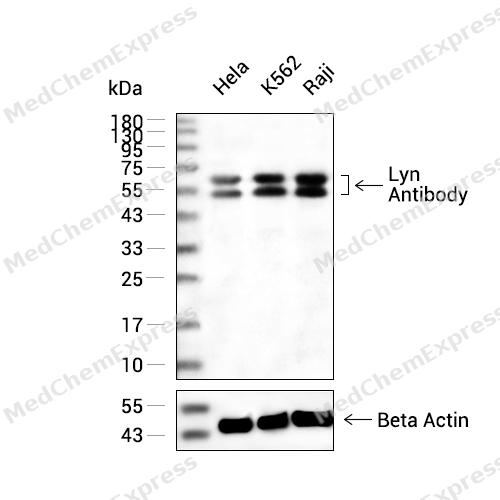 Western blot analysis of extracts from Hela(lane 2(20ug) , K562(lane 3(20ug)and Raji(lane 4(20ug) using Lyn Antibody (HY-P80747) Rabbit mAb. Proteins were transferred to a PVDF membrane and blocked with 5% non-fat milk in TBST for 2 hour at room temperature. The primary antibody (1/1000) and Loading control antibody (Beta Actin, HY-P80438, 1/10000) was used in 5% non-fat milk in TBST at 4°C overnight. Goat Anti-Mouse/Rabbit IgG-HRP Secondary Antibody (1/10000) was used for 1 hour at room temperature.


Background
-
Function
Lyn is a Src-family tyrosine kinase that relays immune-cell receptor inputs to regulate proliferation, differentiation, apoptosis, migration, and metabolism[1]. Mechanistically, Lyn phosphorylates ITAM and ITIM signaling motifs, enabling both activating and inhibitory immunoreceptor signaling[1][2]. In B-cell biology, Lyn negatively regulates B-cell receptor signaling, and loss of Lyn in B cells leads to lupus-like autoimmunity in mouse models[3]. Compared with related Lyn isoforms, LynB shows a dominant immunosuppressive function in vivo, whereas LynA is uniquely required to restrain autoimmunity in female mice[4]. For experimental applications, bafetinib/NS-187 is a dual Bcr-Abl/Lyn tyrosine kinase inhibitor used in imatinib-resistant leukemia research[5]. MLR-1023 is an allosteric Lyn kinase activator and insulin receptor potentiator used in glucose-homeostasis models[6].
-
Subcellular Localization
Cell membrane; Nucleus; Cytoplasm; Cytoplasm, perinuclear region; Golgi apparatus; Membrane; Lipid-anchor
-
Expression
Tissue_specificity:Detected in monocytes (protein level) . Detected in the placenta and fetal brain, lungs, liver, and kidneys. Widely expressed in various organs, tissues, and cell types, such as epidermal cells, hematopoietic cells, and neurons. Expressed in primary neuroblastoma. -
Isoforms & Post-Translational Modification
P07948 has 2 isomers: P07948-1: 58574 Da (predicted); P07948-2: 56033 Da (predicted).
Ubiquitinated by CBL, leading to its degradation. Ubiquitination is SH3-dependent;Autophosphorylated (PubMed:18056483, PubMed:18070987, PubMed:7935444, PubMed:9171348, PubMed:9341198). Phosphorylated on tyrosine residues in response to KIT signaling (PubMed:9341198). Phosphorylation at Tyr-397 is required for optimal activity (PubMed:16920712). Phosphorylation at Tyr-508 inhibits kinase activity (PubMed:9171348). Phosphorylated at Tyr-508 by CSK (PubMed:7935444). Dephosphorylated by PTPRC/CD45 (By similarity). Becomes rapidly phosphorylated upon activation of the B-cell receptor and the immunoglobulin receptor FCGR1A (PubMed:8064233). Phosphorylated in response to ITGB1 in B-cells (PubMed:9020138) -
Subunit
Interacts with TEC. Interacts (via SH2 domain) with FLT3 (tyrosine phosphorylated). Interacts with LIME1 and with CD79A upon activation of the B-cell antigen receptor. Interacts with the B-cell receptor complex.
-
SwissProt ID
-
Synonyms
LYN; JTK8; Tyrosine-protein kinase Lyn; Lck/Yes-related novel protein tyrosine kinase; V-yes-1 Yamaguchi sarcoma viral related oncogene homolog; p53Lyn; p56Lyn
-
Research Field
Signal Transduction


Documentation
-
Data Sheet (261 KB)
-
SDS (252 KB)
- English - EN (252 KB)
- Français - FR (252 KB)
- Deutsch - DE (252 KB)
- Norwegian - NO (252 KB)
- Español - ES (252 KB)
- Swedish - SV (252 KB)
- Italian - IT (252 KB)
- Korean - KR (252 KB)
- Portuguese - PT (252 KB)
-
User Guide for Antibodies (1077 KB)
References
[1]. Ingley E. Functions of the Lyn tyrosine kinase in health and disease. Cell Commun Signal. 2012 Jul 17;10(1):21. doi: 10.1186/1478-811X-10-21. PMID: 22805580; PMCID: PMC3464935. et al. Functions of the Lyn tyrosine kinase in health and disease. Cell Commun Signal. 2012 Jul 17;10(1):21. [Content Brief]
[2]. Xu Y, et al. Lyn tyrosine kinase: accentuating the positive and the negative. Immunity. 2005 Jan;22(1):9-18. [Content Brief]
[3]. Lamagna C, et al. B cell-specific loss of Lyn kinase leads to autoimmunity. J Immunol. 2014 Feb 1;192(3):919-28. [Content Brief]
[4]. Brian BF 4th, et al. A dominant function of LynB kinase in preventing autoimmunity. Sci Adv. 2022 Apr 22;8(16):eabj5227. [Content Brief]
[5]. Kimura S, et al. NS-187, a potent and selective dual Bcr-Abl/Lyn tyrosine kinase inhibitor, is a novel agent for imatinib-resistant leukemia. Blood. 2005 Dec 1;106(12):3948-54. [Content Brief]
[6]. Ochman AR, et al. The Lyn kinase activator MLR-1023 is a novel insulin receptor potentiator that elicits a rapid-onset and durable improvement in glucose homeostasis in animal models of type 2 diabetes. J Pharmacol Exp Ther. 2012 Jul;342(1):23-32. [Content Brief]

 Powered by Bioz
