



p23 Antibody (YA3131)
(Synonyms: PTGES3; P23; TEBP; Prostaglandin E synthase 3; Cytosolic prostaglandin E2 synthase; cPGES; Hsp90 co-chaperone; Progesterone receptor complex p23; Telomerase-binding protein p23)
Based on 1 Customer Validation
p23 Antibody (YA3131) is a Rabbit-derived and non-conjugated IgG monoclonal antibody, targeting to p23.
-
Host:
Rabbit
-
Isotype:
IgG
-
Application:
WB, ICC/IF, IP
-
Reactivity :
Human, Mouse, Rat
-
Formulation:
Supplied in 50mM Tris-Glycine(pH 7.4), 0.15M NaCl, 40% Glycerol, 0.01% Sodium azide and 0.05% BSA
-
Conjugation:
Non-conjugated


To place orders, for customer services and technical support, please contact: MedChemExpress USA
Tel: 609-228-6898 E-mail: [email protected] [email protected]





Applications
| Application |
WB

WB: Western Blot
|
ICC/IF
ICC/IF: Immunocytochemistry/
Immunofluorescence |
IP
IP: Immunoprecipitation
|
|---|---|---|---|
| Dilution Ratio | 1:500-1:1000 | 1:50-1:200 | 1:20 |


Product Details
p23 Antibody (YA3131) is a Rabbit-derived and non-conjugated IgG monoclonal antibody, targeting to p23.
-
Host Rabbit

-
Clonality Recombinant, Monoclonal

-
Species ReactivityHuman, Mouse, Rat
-
Observed Molecular WeightObserved band size: 23 kDa
Note: Due to possible protein modifications or aggregation, the molecular weight should be confirmed by actual measurement, and the predicted value is for reference only.

-
Calculated Molecular Weight Predicted band size: 19 kDa

Entrez Gene: 10728 Human ; 56351 Mouse ; 362809 Rat
SwissProt: Q15185 Human ; Q9R0Q7 Mouse ; P83868 Rat
OMIM: 607061 Human
A synthetic peptide of human p23/PTGES3
Endogenous
Affinity Purified
Non-conjugated
Unmodified
IgG


Product Properties
-
Appearance
Liquid
-
Formulation
Supplied in 50mM Tris-Glycine(pH 7.4), 0.15M NaCl, 40% Glycerol, 0.01% Sodium azide and 0.05% BSA
-
Concentration
Batch-dependent, Please check the COA for the concentration of each lot. Check Lot Concentration
-
Storage & Stability
Stored at -20°C for 1 year. Avoid repeated freeze / thaw cycles.
-
Shipping
Shipping with blue ice.


Verification Images
-
 Western blot analysis of extracts from A431 (lane2, 20μg), Hela (lane3, 20μg), SK-Br-3 (lane4, 20μg) and Mouse brain tissue (lane5, 20μg) using p23 Antibody (HY-P83386). Proteins were transferred to a PVDF membrane and blocked with 5% non-fat milk in TBST for 2 hour at room temperature. The primary antibody (1/1000) and Loading control antibody (Beta Actin, HY-P80993, 1/10,000) was used in 5% non-fat milk in TBST at 4°C overnight. Goat Anti-Rabbit IgG-HRP Secondary Antibody (HY-P8001,1/10,000) was used for 1 hour at room temperature.
 -
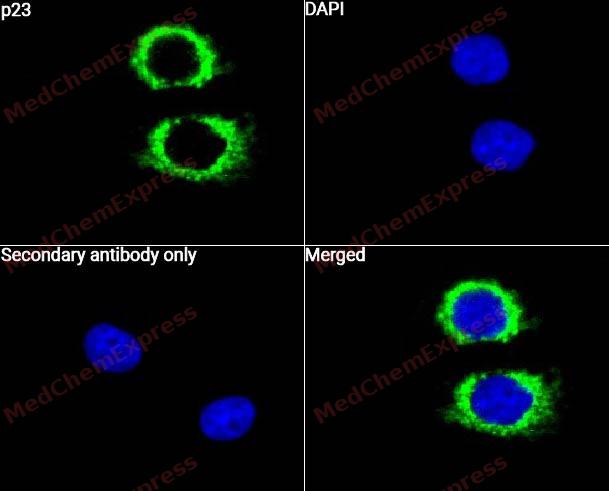 Immunocytochemistry analysis of Hela cells labeling p23 with p23 Antibody (HY-P83386) at 1/50 dilution. Cells were fixed in 4% paraformaldehyde for 15 minutes at room temperature, permeabilized with 0.1% Triton X-100 for 10 minutes at room temperature, then blocked with QuickBlock™ Blocking Buffer for Immunol Staining for 10 min at room temperature. Cells were then incubated with p23 Antibody (HY-P83386) at 1/50 dilution in QuickBlock™ Blocking Buffer for Immunol Staining at 4 ℃. Alexa Fluor® 488-conjugated AffiniPure Goat Anti-Rabbit IgG H&L(HY-P8002, Green) was used as the secondary antibody at 1/1,000 dilution. PBS instead of the primary antibody was used as the secondary antibody only control. The Nuclear counterstain was DAPI (Blue).
 -
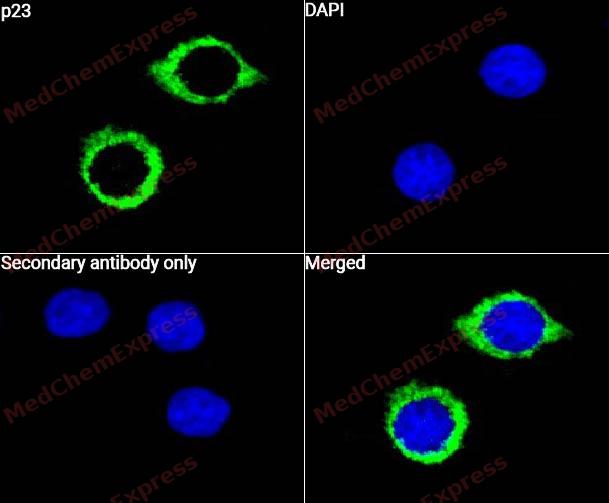 Immunocytochemistry analysis of Hela cells labeling p23 with p23 Antibody (HY-P83386) at 1/100 dilution. Cells were fixed in 4% paraformaldehyde for 15 minutes at room temperature, permeabilized with 0.1% Triton X-100 for 10 minutes at room temperature, then blocked with QuickBlock™ Blocking Buffer for Immunol Staining for 10 min at room temperature. Cells were then incubated with p23 Antibody (HY-P83386) at 1/100 dilution in QuickBlock™ Blocking Buffer for Immunol Staining at 4 ℃. Alexa Fluor® 488-conjugated AffiniPure Goat Anti-Rabbit IgG H&L(HY-P8002, Green) was used as the secondary antibody at 1/1,000 dilution. PBS instead of the primary antibody was used as the secondary antibody only control. The Nuclear counterstain was DAPI (Blue).


Background
-
Function
p23 is a Cytosolic prostaglandin synthase that catalyzes the oxidoreduction of prostaglandin endoperoxide H2 (PGH2) to prostaglandin E2 (PGE2). Molecular chaperone that localizes to genomic response elements in a hormone-dependent manner and disrupts receptor-mediated transcriptional activation, by promoting disassembly of transcriptional regulatory complexes. Facilitates HIF alpha proteins hydroxylation via interaction with EGLN1/PHD2, leading to recruit EGLN1/PHD2 to the HSP90 pathway[1][2][3][4].
-
Subcellular Localization
Cytoplasm
-
Isoforms & Post-Translational Modification
Q15185 has 4 isomers: Q15185-1: 18697 Da (predicted); Q15185-2: 14844 Da (predicted); Q15185-3: 14959 Da (predicted); Q15185-4: 16476 Da (predicted).
Proteolytically cleaved by caspase-7 (CASP7) in response to apoptosis, leading to its inactivation -
Subunit
Probably forms a complex composed of chaperones HSP90 and HSP70, co-chaperones STIP1/HOP, CDC37, PPP5C, PTGES3/p23, TSC1 and client protein TSC2 (PubMed:29127155). Binds to the progesterone receptor (PubMed:8114727). Interacts with TERT; the interaction, together with HSP90AA1, is required for correct assembly and stabilization of the telomerase holoenzyme complex (PubMed:11274138). Interacts (via PXLE motif) with EGLN1/PHD2, recruiting EGLN1/PHD2 to the HSP90 pathway to facilitate HIF alpha proteins hydroxylation (PubMed:24711448). Interacts with HSP90AA1, FLCN, FNIP1 and FNIP2 (PubMed:27353360)
-
SwissProt ID
-
Synonyms
PTGES3; P23; TEBP; Prostaglandin E synthase 3; Cytosolic prostaglandin E2 synthase; cPGES; Hsp90 co-chaperone; Progesterone receptor complex p23; Telomerase-binding protein p23
-
Research Field
Epigenetics and Nuclear Signaling


Documentation
-
Data Sheet (234 KB)
-
SDS (252 KB)
- English - EN (252 KB)
- Français - FR (252 KB)
- Deutsch - DE (252 KB)
- Norwegian - NO (252 KB)
- Español - ES (252 KB)
- Swedish - SV (252 KB)
- Italian - IT (252 KB)
- Korean - KR (252 KB)
- Portuguese - PT (252 KB)
-
User Guide for Antibodies (1077 KB)

 Powered by Bioz
