



p300 Antibody
(Synonyms: EP300; P300; Histone acetyltransferase p300; p300 HAT; E1A-associated protein p300)
Based on 1 Customer Validation
p300 Antibody is a Rabbit-derived and non-conjugated IgG polyclonal antibody, targeting to p300.
-
Host:
Rabbit
-
Isotype:
IgG
-
Application:
ICC/IF, WB, IHC-F, IHC-P, ELISA
-
Reactivity :
Human, Mouse, Rat
-
Formulation:
Supplied in 1*PBS (pH 7.3), 50% glycerol and 0.5% BSA. Preservative: 0.02% sodium azide.
-
Conjugation:
Non-conjugated


To place orders, for customer services and technical support, please contact: MedChemExpress USA
Tel: 609-228-6898 E-mail: [email protected] [email protected]





Applications
| Application |
WB

WB: Western Blot
|
IHC-P
IHC-P: Immunohistochemistry-Paraffin
|
IHC-F
IHC-F: Immunohistochemistry-Frozen
|
ICC/IF
ICC/IF: Immunocytochemistry/
Immunofluorescence |
ELISA
ELISA: Enzyme Linked Immunosorbent Assay
|
|---|---|---|---|---|---|
| Dilution Ratio | 1:500-1:1000 | 1:50-1:100 | 1:50-1:100 | 1:50-1:200 | 1:10000 |


Product Details
p300 Antibody is a Rabbit-derived and non-conjugated IgG polyclonal antibody, targeting to p300.
-
Host Rabbit

-
Clonality Polyclonal

-
Species ReactivityHuman, Mouse, Rat
-
Observed Molecular WeightObserved band size: 300 kDa
Note: Due to possible protein modifications or aggregation, the molecular weight should be confirmed by actual measurement, and the predicted value is for reference only.

-
Calculated Molecular Weight Predicted band size: 264 kDa

Entrez Gene: 2033 Human ; 328572 Mouse ; 170915 Rat
SwissProt: Q09472 Human ; B2RWS6 Mouse ;
OMIM: 613684 Human
Synthetic peptide corresponding to Human p300.The exact sequence is proprietary to MCE.
Endogenous
affinity purified
Non-conjugated
Unmodified
IgG


Product Properties
-
Appearance
Liquid
-
Formulation
Supplied in 1*PBS (pH 7.3), 50% glycerol and 0.5% BSA. Preservative: 0.02% sodium azide.
-
Concentration
Batch-dependent, Please check the COA for the concentration of each lot. Check Lot Concentration
-
Storage & Stability
Stored at -20°C for 1 year. Avoid repeated freeze / thaw cycles.
-
Shipping
Shipping with blue ice.


Verification Images
-
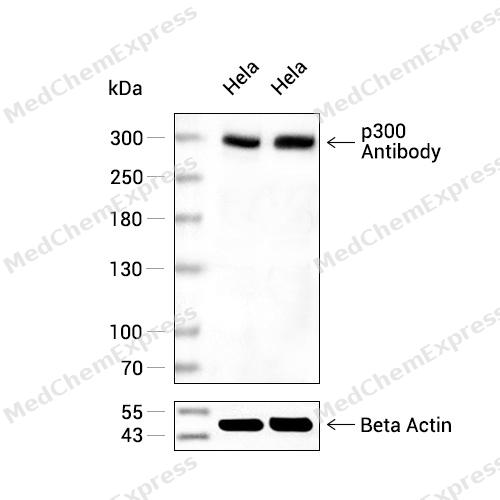 Western blot analysis of extracts from Hela(lane 2(20μg) and Hela(lane 3(40ug) using p300 Antibody (HY-P80775) Rabbit mAb. Proteins were transferred to a PVDF membrane and blocked with 5% non-fat milk in TBST for 2 hour at room temperature. The primary antibody (1/1000) and Loading control antibody (Beta Actin, HY-P80438, 1/10000) was used in 5% non-fat milk in TBST at 4°C overnight. Goat Anti-Mouse/Rabbit IgG-HRP Secondary Antibody (1/10000) was used for 1 hour at room temperature.
 -
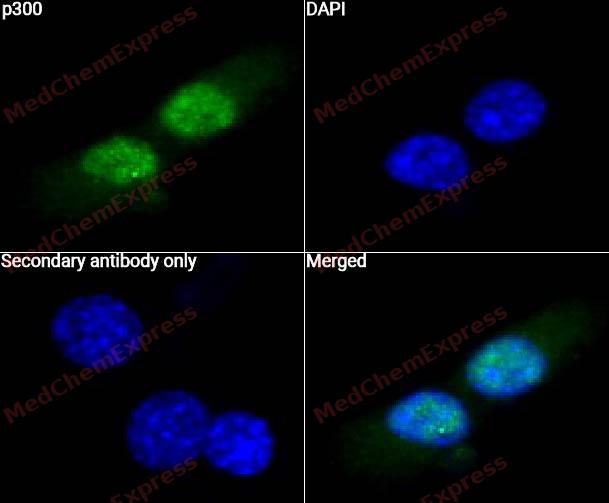 Immunocytochemistry analysis of NIH3T3 cells labeling p300 with p300 Antibody (HY-P80775)at 1/50 dilution. Cells were fixed in 4% paraformaldehyde for 15 minutes at room temperature, permeabilized with 0.1% Triton X-100 for 10 minutes at room temperature, then blocked with QuickBlock™ Blocking Buffer for Immunol Staining for 10 min at room temperature. Cells were then incubated with p300 Antibody (HY-P80775) at 1/50 dilution in QuickBlock™ Blocking Buffer for Immunol Staining at 4 ℃. Alexa Fluor® 488-conjugated AffiniPure Goat Anti-Rabbit IgG H&L(HY-P8002, Green) was used as the secondary antibody at 1/1,000 dilution. PBS instead of the primary antibody was used as the secondary antibody only control. The Nuclear counterstain was DAPI (Blue).
 -
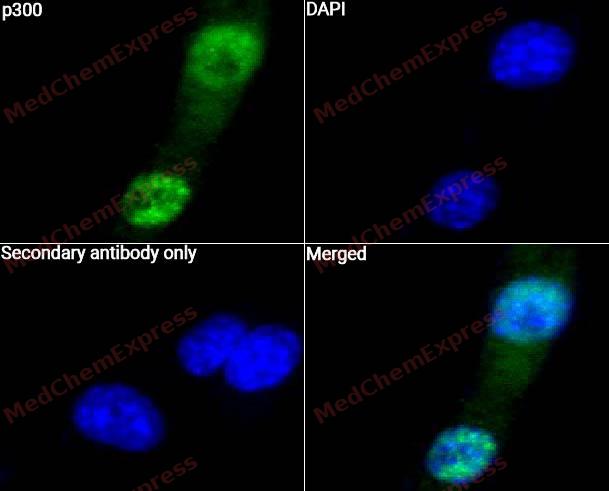 Immunocytochemistry analysis of NIH3T3 cells labeling p300 with p300 Antibody (HY-P80775) at 1/100 dilution. Cells were fixed in 4% paraformaldehyde for 15 minutes at room temperature, permeabilized with 0.1% Triton X-100 for 10 minutes at room temperature, then blocked with QuickBlock™ Blocking Buffer for Immunol Staining for 10 min at room temperature. Cells were then incubated with p300 Antibody (HY-P80775) at 1/100 dilution in QuickBlock™ Blocking Buffer for Immunol Staining at 4 ℃. Alexa Fluor® 488-conjugated AffiniPure Goat Anti-Rabbit IgG H&L(HY-P8002, Green) was used as the secondary antibody at 1/1,000 dilution. PBS instead of the primary antibody was used as the secondary antibody only control. The Nuclear counterstain was DAPI (Blue).


Background
-
Function
p300 functions as a histone acetyltransferase and regulates transcription via chromatin remodeling. Acetylates all four core histones in nucleosomes. Histone acetylation gives an epigenetic tag for transcriptional activation. Mediates acetylation of histone H3 at 'Lys-122' (H3K122ac), a modification that localizes at the surface of the histone octamer and stimulates transcription, possibly by promoting nucleosome instability. Mediates acetylation of histone H3 at 'Lys-18' and 'Lys-27' (H3K18ac and H3K27ac, respectively). Also able to acetylate histone lysine residues that are already monomethylated on the same side chain to form N6-acetyl-N6-methyllysine (Kacme), an epigenetic mark of active chromatin associated with increased transcriptional initiation. Catalyzes formation of histone H4 acetyl-methylated at 'Lys-5' and 'Lys-12' (H4K5acme and H4K12acme, respectively). Also functions as acetyltransferase for non-histone targets, such as ALX1, HDAC1, PRMT1, SIRT2, STAT3 or GLUL. Acetylates 'Lys-131' of ALX1 and acts as its coactivator. Acetylates SIRT2 and is proposed to indirectly increase the transcriptional activity of p53/TP53 through acetylation and subsequent attenuation of SIRT2 deacetylase function. Following DNA damage, forms a stress-responsive p53/TP53 coactivator complex with JMY which mediates p53/TP53 acetylation, thereby increasing p53/TP53-dependent transcription and apoptosis. Promotes chromatin acetylation in heat shock responsive HSP genes during the heat shock response (HSR), thereby stimulating HSR transcription. Acetylates HDAC1 leading to its inactivation and modulation of transcription. Acetylates 'Lys-247' of EGR2. Acts as a TFAP2A-mediated transcriptional coactivator in presence of CITED2. Plays a role as a coactivator of NEUROD1-dependent transcription of the secretin and p21 genes and controls terminal differentiation of cells in the intestinal epithelium. Promotes cardiac myocyte enlargement. Can also mediate transcriptional repression. Acetylates FOXO1 and enhances its transcriptional activity. Acetylates STAT3 at different sites, promoting both STAT3 dimerization and activation and recruitment to chromatin. Acetylates BCL6 which disrupts its ability to recruit histone deacetylases and hinders its transcriptional repressor activity. Participates in CLOCK or NPAS2-regulated rhythmic gene transcription; exhibits a circadian association with CLOCK or NPAS2, correlating with increase in PER1/2 mRNA and histone H3 acetylation on the PER1/2 promoter. Acetylates MTA1 at 'Lys-626' which is essential for its transcriptional coactivator activity. Acetylates XBP1 isoform 2; acetylation increases protein stability of XBP1 isoform 2 and enhances its transcriptional activity. Acetylates PCNA; acetylation promotes removal of chromatin-bound PCNA and its degradation during nucleotide excision repair (NER). Acetylates MEF2D. Acetylates and stabilizes ZBTB7B protein by antagonizing ubiquitin conjugation and degradation, this mechanism may be involved in CD4/CD8 lineage differentiation. Acetylates GABPB1, impairing GABPB1 heterotetramerization and activity. Acetylates PCK1 and promotes PCK1 anaplerotic activity. Acetylates RXRA and RXRG. Acetylates isoform M2 of PKM (PKM2), promoting its homodimerization and conversion into a protein kinase. Acetylates RPTOR in response to leucine, leading to activation of the mTORC1 complex. Acetylates RICTOR, leading to activation of the mTORC2 complex. Mediates cAMP-gene regulation by binding specifically to phosphorylated CREBBP. In addition to protein acetyltransferase, can use different acyl-CoA substrates, such as (2E)-butenoyl-CoA (crotonyl-CoA), butanoyl-CoA (butyryl-CoA), 2-hydroxyisobutanoyl-CoA (2-hydroxyisobutyryl-CoA), lactoyl-CoA or propanoyl-CoA (propionyl-CoA), and is able to mediate protein crotonylation, butyrylation, 2-hydroxyisobutyrylation, lactylation or propionylation, respectively. Acts as a histone crotonyltransferase; crotonylation marks active promoters and enhancers and confers resistance to transcriptional repressors. Histone crotonyltransferase activity is dependent on the concentration of (2E)-butenoyl-CoA (crotonyl-CoA) substrate and such activity is weak when (2E)-butenoyl-CoA (crotonyl-CoA) concentration is low. Also acts as a histone butyryltransferase; butyrylation marks active promoters. Catalyzes histone lactylation in macrophages by using lactoyl-CoA directly derived from endogenous or exogenous lactate, leading to stimulates gene transcription. Acts as a protein-lysine 2-hydroxyisobutyryltransferase; regulates glycolysis by mediating 2-hydroxyisobutyrylation of glycolytic enzymes. Functions as a transcriptional coactivator for SMAD4 in the TGF-beta signaling pathway; (Microbial infection) In case of HIV-1 infection, it is recruited by the viral protein Tat. Regulates Tat's transactivating activity and may help inducing chromatin remodeling of proviral genes. Binds to and may be involved in the transforming capacity of the adenovirus E1A protein[1][2][3][4][5][6][7][8][9][10][11][12][13][14][15][16][17][18][19][20][21][22][23][24][25][26][27][28][29][30][31][32][33][34][35][36][37][38].
-
Subcellular Localization
Cytoplasm; Nucleus; Chromosome
-
Subunit
Interacts with HIF1A; the interaction is stimulated in response to hypoxia and inhibited by CITED2 (PubMed:11959990, PubMed:9887100). Probably part of a complex with HIF1A and CREBBP (PubMed:8917528). Interacts (via N-terminus) with TFAP2A (via N-terminus); the interaction requires CITED2 (PubMed:12586840). Interacts (via CH1 domain) with CITED2 (via C-terminus) (PubMed:12586840, PubMed:12778114). Interacts with CITED1 (unphosphorylated form preferentially and via C-terminus) (PubMed:10722728, PubMed:16864582). Interacts with ESR1; the interaction is estrogen-dependent and enhanced by CITED1 (PubMed:11581164). Interacts with HIPK2 (By similarity). Interacts with DTX1, EID1, ELF3, FEN1, LEF1, NCOA1, NCOA6, NR3C1, PCAF, PELP1, PRDM6, SP1, SP3, SPIB, SRY, TCF7L2, DDX5, DDX17, SATB1, SRCAP and TRERF1 (PubMed:10823961, PubMed:11073989, PubMed:11073990, PubMed:11349124, PubMed:11430825, PubMed:11481323, PubMed:11564735, PubMed:11581372, PubMed:11864910, PubMed:12446687, PubMed:12527917, PubMed:12837748, PubMed:14605447, PubMed:15075319, PubMed:15297880, PubMed:16478997, PubMed:17226766, PubMed:8684459, PubMed:9590696). Interacts with JMY, the complex activates p53/TP53 transcriptional activity (PubMed:10518217, PubMed:11511361). Interacts with TTC5/STRAP; the interaction facilitates the association between JMY and p300/EP300 cofactors (PubMed:11511361). Interacts with p53/TP53; the interaction is facilitated by TTC5/STRAP (PubMed:15186775, PubMed:15448695, PubMed:19217391). Forms a complex with TTC5/STRAP and HSF1; these interactions augment chromatin-bound HSF1 and p300/EP300 histone acetyltransferase activity (PubMed:18451878). Part of a complex containing CARM1 and NCOA2/GRIP1 (PubMed:11701890, PubMed:11997499, PubMed:15731352). Interacts with ING4 and this interaction may be indirect (PubMed:12750254). Interacts with ING5 (PubMed:12750254). Interacts with the C-terminal region of CITED4 (PubMed:11744733). Non-sumoylated EP300 preferentially interacts with SENP3 (PubMed:19680224). Interacts with SS18L1/CREST (PubMed:14716005). Interacts with ALX1 (via homeobox domain) (PubMed:12929931). Interacts with NEUROD1; the interaction is inhibited by NR0B2 (PubMed:14752053). Interacts with TCF3 (PubMed:14752053). Interacts (via CREB-binding domain) with MYOCD (via C-terminus) (By similarity). Interacts with ROCK2 and PPARG (PubMed:11518699, PubMed:16574662). Forms a complex made of CDK9, CCNT1/cyclin-T1, EP300 and GATA4 that stimulates hypertrophy in cardiomyocytes (PubMed:20081228). Interacts with IRF1 and this interaction enhances acetylation of p53/TP53 and stimulation of its activity (PubMed:15509808). Interacts with ALKBH4 and DDIT3/CHOP (PubMed:17872950, PubMed:23145062). Interacts with KLF15 (PubMed:23999430). Interacts with CEBPB and RORA (PubMed:9862959). Interacts with NPAS2, BMAL1 and CLOCK (PubMed:14645221). Interacts with SIRT2 isoform 1, isoform 2 and isoform 5 (PubMed:24177535). Interacts with MTA1 (PubMed:16617102). Interacts with HDAC4 and HDAC5 in the presence of TFAP2C (PubMed:24413532). Interacts with TRIP4 (PubMed:25219498). Directly interacts with ZBTB49; this interaction leads to synergistic transactivation of CDKN1A (PubMed:25245946). Interacts with NR4A3 (By similarity). Interacts with ZNF451 (PubMed:24324267). Interacts with ATF5; EP300 is required for ATF5 and CEBPB interaction and DNA binding (By similarity). Interacts with HSF1 (PubMed:27189267). Interacts with ZBTB48/TZAP (PubMed:24382891). Interacts with STAT1; the interaction is enhanced upon IFN-gamma stimulation (PubMed:26479788). Interacts with HNRNPU (via C-terminus); this interaction enhances DNA-binding of HNRNPU to nuclear scaffold/matrix attachment region (S/MAR) elements (PubMed:11909954). Interacts with BCL11B (PubMed:16809611, PubMed:27959755). Interacts with SMAD4; negatively regulated by ZBTB7A (PubMed:25514493). Interacts with DUX4 (via C-terminus) (PubMed:26951377). Interacts with NUPR1; this interaction enhances the effect of EP300 on PAX2 transcription factor activity (PubMed:11940591). Interacts with RXRA; the interaction is decreased by 9-cis retinoic acid (PubMed:17761950). NR4A1 competes with EP300 for interaction with RXRA and thereby attenuates EP300 mediated acetylation of RXRA (PubMed:17761950). Interacts with RB1 (By similarity). Interacts with DDX3X; this interaction may facilitate HNF4A acetylation (PubMed:28128295). Interacts with SOX9 (PubMed:12732631). Interacts with ATF4; EP300/p300 stabilizes ATF4 and increases its transcriptional activity independently of its catalytic activity by preventing its ubiquitination (PubMed:16219772). Interacts with KAT5; promoting KAT5 autoacetylation (PubMed:24835996). Interacts (via bromo domain) with (acetylated) STAT3; interaction takes place following STAT3 acetylation by EP300 and promotes enhanceosome assembly (PubMed:18782771)
-
SwissProt ID
-
Synonyms
EP300; P300; Histone acetyltransferase p300; p300 HAT; E1A-associated protein p300
-
Research Field
Epigenetics and Nuclear Signaling


Documentation
-
Data Sheet (259 KB)
-
SDS (251 KB)
- English - EN (251 KB)
- Français - FR (251 KB)
- Deutsch - DE (251 KB)
- Norwegian - NO (251 KB)
- Español - ES (251 KB)
- Swedish - SV (251 KB)
- Italian - IT (251 KB)
- Korean - KR (251 KB)
- Portuguese - PT (251 KB)
-
User Guide for Antibodies (1077 KB)

 Powered by Bioz
