



PTEN Antibody (YA6253)
(Synonyms: MMAC1, TEP1, PTEN, Inositol polyphosphate 3-phosphatase, Mutated in multiple advanced cancers 1, Phosphatase and tensin homolog)
Based on 1 Customer Validation
PTEN Antibody (YA6253) is a Rabbit-derived and non-conjugated IgG monoclonal antibody, targeting to PTEN.
-
Host:
Rabbit
-
Isotype:
IgG
-
Application:
WB, ICC/IF, IP, ELISA
-
Reactivity :
Human, Mouse, Rat
-
Formulation:
Supplied in PBS, 50% glycerol, 0.05% Proclin 300, 0.05%BSA
-
Conjugation:
Non-conjugated


To place orders, for customer services and technical support, please contact: MedChemExpress USA
Tel: 609-228-6898 E-mail: [email protected] [email protected]





Applications
| Application |
WB

WB: Western Blot
|
ICC/IF
ICC/IF: Immunocytochemistry/
Immunofluorescence |
ELISA
ELISA: Enzyme Linked Immunosorbent Assay
|
IP
IP: Immunoprecipitation
|
|---|---|---|---|---|
| Dilution Ratio | 1:1000-1:5000 | 1:200-1:1000 | 1:5000-1:20000 | 1:50-1:200 |


Product Details
PTEN Antibody (YA6253) is a Rabbit-derived and non-conjugated IgG monoclonal antibody, targeting to PTEN.
-
Host Rabbit

-
Clonality Monoclonal

-
Species ReactivityHuman, Mouse, Rat
-
Observed Molecular WeightObserved band size: 56 kDa
Note: Due to possible protein modifications or aggregation, the molecular weight should be confirmed by actual measurement, and the predicted value is for reference only.

-
Calculated Molecular Weight Predicted band size: 47 kDa

Protein A
Non-conjugated
Unmodified
IgG


Product Properties
-
Appearance
Solution
-
Formulation
Supplied in PBS, 50% glycerol, 0.05% Proclin 300, 0.05%BSA
-
Concentration
Batch-dependent, Please check the COA for the concentration of each lot. Check Lot Concentration
-
Storage & Stability
Stored at -20°C for 1 year. Avoid repeated freeze / thaw cycles.
-
Shipping
Shipping with blue ice.


Verification Images
-
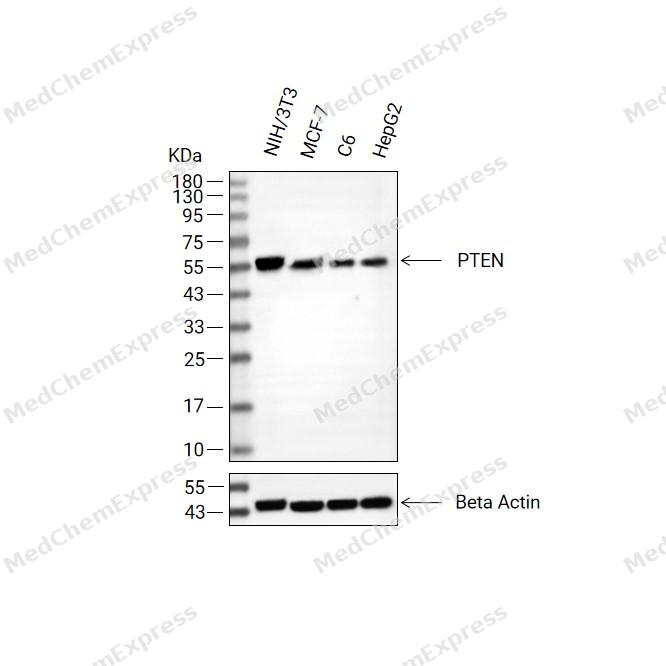 Western blot analysis of extracts from NIH/3T3 (lane 2(20μg)
 -
 Immunocytochemistry analysis of Hela cells labeling PTEN with PTEN Antibody (HY-P86561) at 1/200 dilution. Cells were fixed in 4% paraformaldehyde for 15 minutes at room temperature, permeabilized with 0.1% Triton X-100 in PBS for 15 minutes at room temperature, then blocked with quick block buffer for 10 minutes at room temperature. Cells were then incubated with PTEN Antibody (HY-P86561) at 1/200 dilution in quick block buffer overnight at 4 ℃.AF488-conjugated Goat Anti-Rabbit IgG H&L (HY-P8002, Green) was used as the secondary antibody at 1/1,000 dilution. PBS instead of the primary antibody was used as the secondary antibody only control. The Nuclear counterstain was DAPI (Blue).
 -
 Immunocytochemistry analysis of NIH-3T3 cells labeling PTEN with PTEN Antibody (HY-P86561) at 1/200 dilution. Cells were fixed in 4% paraformaldehyde for 15 minutes at room temperature, permeabilized with 0.1% Triton X-100 in PBS for 15 minutes at room temperature, then blocked with quick block buffer for 10 minutes at room temperature. Cells were then incubated with PTEN Antibody (HY-P86561) at 1/200 dilution in quick block buffer overnight at 4 ℃.AF488-conjugated Goat Anti-Rabbit IgG H&L (HY-P8002, Green) was used as the secondary antibody at 1/1,000 dilution. PBS instead of the primary antibody was used as the secondary antibody only control. The Nuclear counterstain was DAPI (Blue).


Background
-
Function
PTEN (Phosphatase and tensin homologue deleted on chromosome 10), a phosphoinositide 3-phosphatase, is an important regulator of insulin-dependent signaling. The loss or impairment of PTEN results in an antidiabetic impact, which led to the suggestion that PTEN could be an important target for drugs against type II diabetes. PTEN has a much wider active site cleft enabling it to bind the PtdIns (3, 4, 5) P3 substrate. a highly potent and specific inhibitor of PTEN that increases cellular PtdIns (3, 4, 5) P3 levels, phosphorylation of Akt, and glucose uptake in adipocytes at nanomolar concentrations.
-
Subcellular Localization
Cytoplasm; Nucleus; Nucleus, PML body; Cell projection, dendritic spine; Postsynaptic density; Secreted
-
Expression
Tissue_specificity:It is expressed at high levels in all adult tissues, including the heart, brain, placenta, lungs, liver, muscles, kidneys, and pancreas.
Induction:Down-regulated by TGFB1 -
Isoforms & Post-Translational Modification
P60484 has 3 isomers: P60484-1: 47166 Da (predicted); P60484-2: 64882 Da (predicted); P60484-3: 19796 Da (predicted).
Constitutively phosphorylated by CK2 under normal conditions. Phosphorylated in vitro by MAST1, MAST2, MAST3 and STK11. Phosphorylation results in an inhibited activity towards PIP3. Phosphorylation can both inhibit or promote PDZ-binding. Phosphorylation at Tyr-336 by FRK/PTK5 protects this protein from ubiquitin-mediated degradation probably by inhibiting its binding to NEDD4. Phosphorylation by ROCK1 is essential for its stability and activity. Phosphorylation by PLK3 promotes its stability and prevents its degradation by the proteasome. Phosphorylated on Thr-319 and Thr-321 in the C2-type tensin domain following EGF stimulation which changes its binding preference from the p85 regulatory subunit of the PI3K kinase complex to DLC1 (PubMed:26166433);Monoubiquitinated; monoubiquitination is increased in presence of retinoic acid. Deubiquitinated by USP7; leading to its nuclear exclusion. Monoubiquitination of one of either Lys-13 and Lys-289 amino acid is sufficient to modulate PTEN compartmentalization. Ubiquitinated by XIAP/BIRC4;Ubiquitinated by the DCX(DCAF13) E3 ubiquitin ligase complex, leading to its degradation;ISGylated. ISGylation promotes PTEN degradation -
Subunit
Monomer. The unphosphorylated form interacts with the second PDZ domain of MAGI2 and with DLG1 and MAST2 in vitro (PubMed:10646847, PubMed:10760291, PubMed:11707428). Interacts with MAGI2, MAGI3, MAST1 and MAST3, but neither with MAST4 nor with DLG5; interaction with MAGI2 increases protein stability (PubMed:10748157, PubMed:15951562). Interacts with NEDD4 (PubMed:17218260). Interacts with NDFIP1 and NDFIP2; in the presence of NEDD4 or ITCH, this interaction promotes PTEN ubiquitination (PubMed:20534535, PubMed:25801959). Interacts (via C2 domain) with FRK (PubMed:19345329). Interacts with USP7; the interaction is direct (PubMed:18716620). Interacts with ROCK1 (By similarity). Interacts with XIAP/BIRC4 (PubMed:19473982). Interacts with STK11; the interaction phosphorylates PTEN (PubMed:15987703). Interacts with PPP1R16B (PubMed:25007873). Interacts with NOP53; regulates PTEN phosphorylation and increases its stability (PubMed:15355975). Interacts (via PDZ domain-binding motif) with DLG4; the interaction is induced by NMDA and is required for PTEN location at postsynaptic density (By similarity). Interacts with the regulatory p85 subunit of the PI3K kinase complex and with Rho GTPase-activating protein DLC1; in resting cells, interacts (via C2 tensin-type domain) with p85 but, following growth factor stimulation, PTEN is phosphorylated which leads to weakened interaction with p85 and enhanced interaction (via C2 tensin-type domain) with DLC1 while p85 interaction with TNS3 increases (PubMed:26166433)
-
SwissProt ID
-
Synonyms
MMAC1, TEP1, PTEN, Inositol polyphosphate 3-phosphatase, Mutated in multiple advanced cancers 1, Phosphatase and tensin homolog


Documentation
-
Data Sheet (235 KB)
-
SDS (252 KB)
- English - EN (252 KB)
- Français - FR (252 KB)
- Deutsch - DE (252 KB)
- Norwegian - NO (252 KB)
- Español - ES (252 KB)
- Swedish - SV (252 KB)
- Italian - IT (252 KB)
- Korean - KR (252 KB)
- Portuguese - PT (252 KB)
-
User Guide for Antibodies (1077 KB)

 Powered by Bioz
