



RANKL Antibody
(Synonyms: OPGL; CD254; hRANKL2; ODF; OPGL; Osteoclast differentiation factor; Osteoprotegerin ligand; RANKL; Receptor activator of nuclear factor kappa B ligand; sOdf; SOFA; TNF related activation induced cytokine; TNFSF 11; TNFSF11; TRANCE; Tumor necrosis factor ligand superfamily member 11; Osteoprotegerin Ligand; TNF11_HUMAN.)Based on 1 publication(s) in Google Scholar
RANKL Antibody is a Rabbit-derived and non-conjugated IgG polyclonal antibody, targeting to RANKL.
-
Host:
Rabbit
-
Isotype:
IgG
-
Application:
WB, IHC-P, ELISA
-
Reactivity :
Human, Mouse, Rat
-
Formulation:
Supplied in PBS containing 50% glycerol, 0.5% BSA and 0.02% sodium azide, pH 7.3.
-
Conjugation:
Non-conjugated


To place orders, for customer services and technical support, please contact: MedChemExpress USA
Tel: 609-228-6898 E-mail: [email protected] [email protected]



Publications Citing Use of MedChemExpress (MCE) RANKL Antibody
More

Applications
| Application |
WB

WB: Western Blot
|
IHC-P
IHC-P: Immunohistochemistry-Paraffin
|
ELISA
ELISA: Enzyme Linked Immunosorbent Assay
|
|---|---|---|---|
| Dilution Ratio | 1:500-1:1000 | 1:50-1:100 | 1:10000 |


Product Details
RANKL Antibody is a Rabbit-derived and non-conjugated IgG polyclonal antibody, targeting to RANKL.
-
Host Rabbit

-
Clonality Polyclonal

-
Species ReactivityHuman, Mouse, Rat
-
Observed Molecular WeightObserved band size: 35 kDa
Note: Due to possible protein modifications or aggregation, the molecular weight should be confirmed by actual measurement, and the predicted value is for reference only.

-
Calculated Molecular Weight Predicted band size: 35 kDa

Entrez Gene: 8600 Human ; 21943 Mouse ; 117516 Rat
SwissProt: O14788 Human ; O35235 Mouse ; Q9ESE2 Rat
OMIM: 259710 Human
The antiserum was produced against synthesized peptide derived from the C-terminal region of human TNFSF11.
Endogenous
affinity purified
Non-conjugated
Unmodified
IgG


Product Properties
-
Appearance
Liquid
-
Formulation
Supplied in PBS containing 50% glycerol, 0.5% BSA and 0.02% sodium azide, pH 7.3.
-
Concentration
Batch-dependent, Please check the COA for the concentration of each lot. Check Lot Concentration
-
Storage & Stability
Stored at -20°C for 1 year. Avoid repeated freeze / thaw cycles.
-
Shipping
Shipping with blue ice.


Publications (1)
-
Journal Impact Factor
-
Most Recent


Verification Images
-
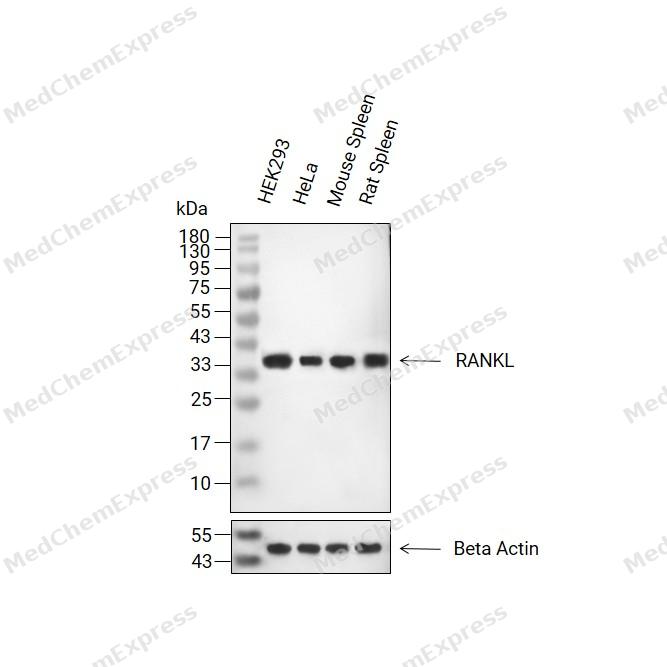 Western blot analysis of extracts from 293(lane 2, 20μg), HeLa(lane 3, 20μg), Mouse Spleen(lane 4, 20μg) and Rat Spleen(lane 5, 20μg) using RANKL Antibody (HY-P81124). Proteins were transferred to a PVDF membrane and blocked with 5% non-fat milk in TBST for 2 hours at room temperature. The primary antibody (1/1000) and Loading control antibody (Beta Actin, HY-P80993, 1/10000) was used in 5% non-fat milk in TBST at 4°C overnight. Goat Anti-Rabbit IgG-HRP Secondary Antibody (HY-P8001, 1/10000) was used for 1 hour at room temperature.


Background
-
Function
RANKL is a Cytokine that binds to TNFRSF11B/OPG and to TNFRSF11A/RANK. Osteoclast differentiation and activation factor. Augments the ability of dendritic cells to stimulate naive T-cell proliferation. May be an important regulator of interactions between T-cells and dendritic cells and may play a role in the regulation of the T-cell-dependent immune response. May also play an important role in enhanced bone-resorption in humoral hypercalcemia of malignancy. Induces osteoclastogenesis by activating multiple signaling pathways in osteoclast precursor cells, chief among which is induction of long lasting oscillations in the intracellular concentration of Ca (2+) resulting in the activation of NFATC1, which translocates to the nucleus and induces osteoclast-specific gene transcription to allow differentiation of osteoclasts. During osteoclast differentiation, in a TMEM64 and ATP2A2-dependent manner induces activation of CREB1 and mitochondrial ROS generation necessary for proper osteoclast generation[1].
-
Subcellular Localization
Cell membrane; Single-pass type II membrane protein; Cell membrane; Single-pass type II membrane protein; Cytoplasm; Secreted
-
Expression
Tissue_specificity:It has the highest content in peripheral lymph nodes, and lower content in spleen, peripheral blood leukocytes, bone marrow, heart, placenta, skeletal muscle, stomach and thyroid gland.
Induction:Up-regulated by T-cell receptor stimulation -
Isoforms & Post-Translational Modification
O14788 has 3 isomers: O14788-1: 35478 Da (predicted); O14788-2: 27690 Da (predicted); O14788-3: 30523 Da (predicted).
The soluble form of isoform 1 derives from the membrane form by proteolytic processing (By similarity). The cleavage may be catalyzed by ADAM17 -
Subunit
Homotrimer (By similarity). Interacts with TNFRSF11B (PubMed:22664871). Interacts with TNFRSF11A. Interacts with FBN1 (via N-terminal domain) in a Ca(+2)-dependent manner (By similarity). Interacts with TNFAIP6 (via both Link and CUB domains)
-
SwissProt ID
-
Synonyms
OPGL; CD254; hRANKL2; ODF; OPGL; Osteoclast differentiation factor; Osteoprotegerin ligand; RANKL; Receptor activator of nuclear factor kappa B ligand; sOdf; SOFA; TNF related activation induced cytokine; TNFSF 11; TNFSF11; TRANCE; Tumor necrosis factor ligand superfamily member 11; Osteoprotegerin Ligand; TNF11_HUMAN.
Documentation
-
Data Sheet (258 KB)
-
SDS (252 KB)
- English - EN (252 KB)
- Français - FR (252 KB)
- Deutsch - DE (252 KB)
- Norwegian - NO (252 KB)
- Español - ES (252 KB)
- Swedish - SV (252 KB)
- Italian - IT (252 KB)
- Korean - KR (252 KB)
- Portuguese - PT (252 KB)
-
User Guide for Antibodies (1077 KB)

 Powered by Bioz
