



Ret Antibody (YA097)
(Synonyms: CDHF12, CDHR16, PTC, RET, RET51, Proto-oncogene tyrosine-protein kinase receptor Ret, Cadherin family member 12, Proto-oncogene c-Ret)
Based on 1 Customer Validation
Ret Antibody (YA097) is a Rabbit-derived and non-conjugated IgG monoclonal antibody, targeting to Ret.
-
Host:
Rabbit
-
Isotype:
IgG
-
Application:
WB, ICC/IF, IHC-P, IP, FC
-
Reactivity :
Human, Mouse
-
Formulation:
Supplied in 1*TBS (pH7.4), 0.05% BSA and 40% Glycerol. Preservative: 0.05% Sodium Azide.
-
Conjugation:
Non-conjugated


To place orders, for customer services and technical support, please contact: MedChemExpress USA
Tel: 609-228-6898 E-mail: [email protected] [email protected]





Applications
| Application |
WB

WB: Western Blot
|
ICC/IF
ICC/IF: Immunocytochemistry/
Immunofluorescence |
IHC-P
IHC-P: Immunohistochemistry-Paraffin
|
FC
FC: Flow Cytometry
|
IP
IP: Immunoprecipitation
|
|---|---|---|---|---|---|
| Dilution Ratio | 1:500-1:2000 | 1:100-1:500 | 1:500 | 1:50-1:100 | Use at an assay dependent concentration. |


Product Details
Ret Antibody (YA097) is a Rabbit-derived and non-conjugated IgG monoclonal antibody, targeting to Ret.
-
Host Rabbit

-
Clonality Recombinant,Monoclonal

-
Species ReactivityHuman, Mouse
-
Observed Molecular WeightObserved band size: 155,185 kDa
Note: Due to possible protein modifications or aggregation, the molecular weight should be confirmed by actual measurement, and the predicted value is for reference only.

-
Calculated Molecular Weight Predicted band size: 124 kDa

Synthetic peptide corresponding to Human Ret.AA range:1065-1114.
Endogenous
Protein A affinity purified.
Non-conjugated
Unmodified
IgG


Product Properties
-
Appearance
Solution
-
Formulation
Supplied in 1*TBS (pH7.4), 0.05% BSA and 40% Glycerol. Preservative: 0.05% Sodium Azide.
-
Concentration
Batch-dependent, Please check the COA for the concentration of each lot. Check Lot Concentration
-
Storage & Stability
Stored at -20°C for 1 year. Avoid repeated freeze / thaw cycles.
-
Shipping
Shipping with blue ice.


Verification Images
-
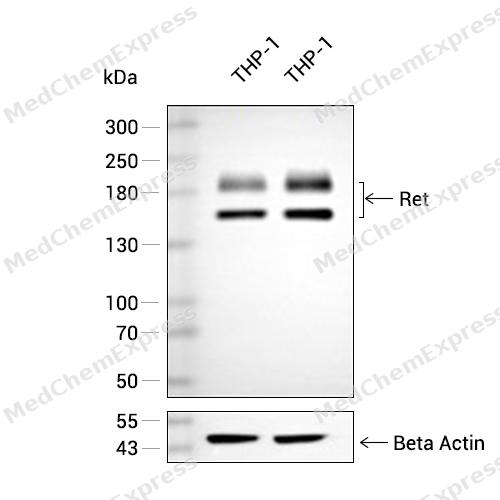 Western blot analysis of extracts from THP-1(lane 2(20μg) ) and THP-1 (lane 3(20μg) using Ret (HY-P80307) Rabbit mAb. Proteins were transferred to a PVDF membrane and blocked with 5% non-fat milk in TBST for 2 hour at room temperature. The primary antibody (1/1000) and Loading control antibody (Beta Actin, HY-P80307, 1/10, 000) was used in 5% non-fat milk in TBST at 4°C overnight. Goat Anti-Mouse/Rabbit IgG-HRP Secondary Antibody (1/10,000) was used for 1 hour at room temperature.
 -
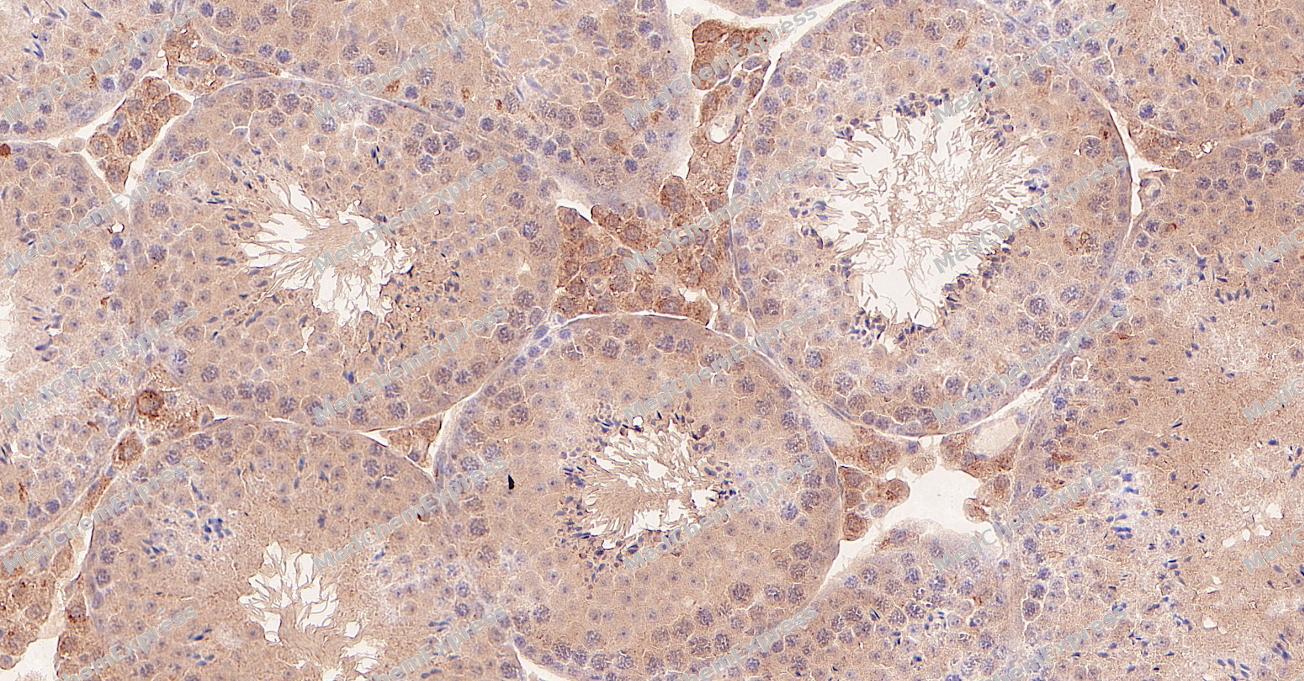 Immunohistochemical analysis of paraffin-embedded Mouse testis tissue using Ret Antibody. The section was pre-treated using heat mediated antigen retrieval with Tris-EDTA buffer (pH 9.0) for 8 minutes. The tissues were blocked in QuickBlock for 20 minutes at room temperature, washed with ddH2O and PBS, and then probed with the primary antibody (HY-P80307, 1/500) in 4℃ overnight. The detection was performed using an HRP conjugated compact polymer system. DAB was used as the chromogen. Tissues were counterstained with hematoxylin and mounted with DPX.
 -
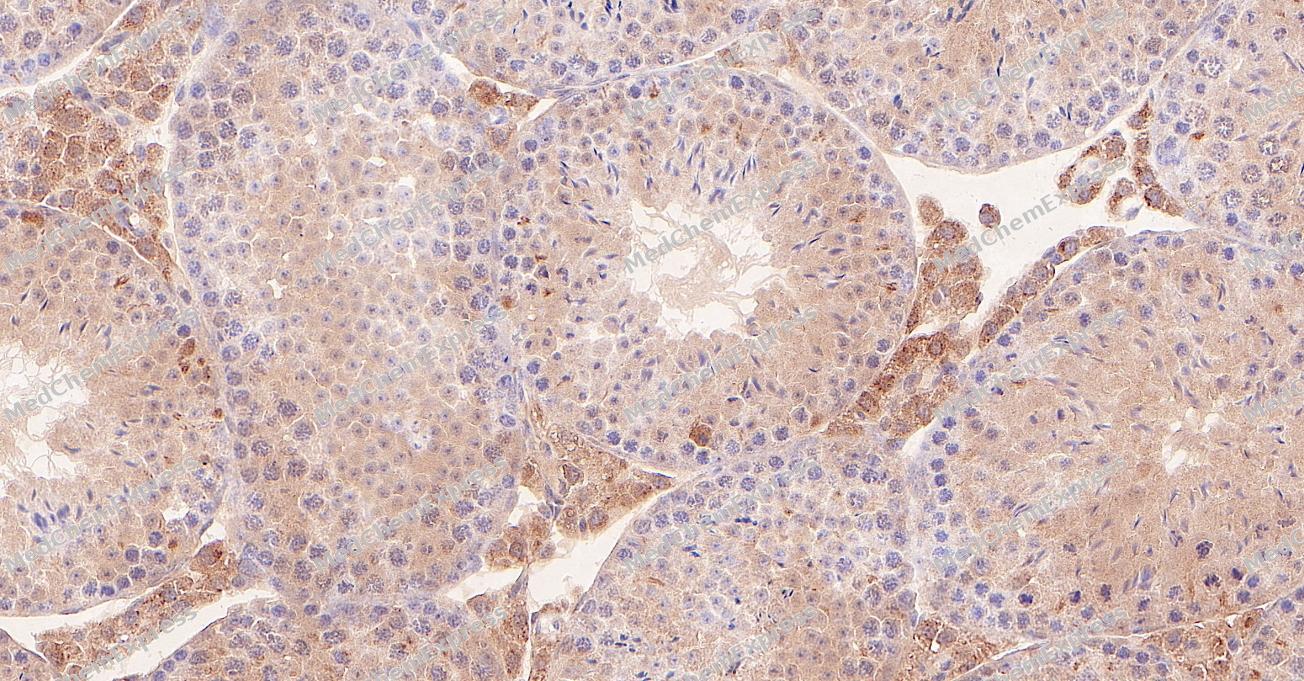 Immunohistochemical analysis of paraffin-embedded Mouse testis tissue using Ret Antibody. The section was pre-treated using heat mediated antigen retrieval with Tris-EDTA buffer (pH 9.0) for 8 minutes. The tissues were blocked in QuickBlock for 20 minutes at room temperature, washed with ddH2O and PBS, and then probed with the primary antibody (HY-P80307, 1/500) in 4℃ overnight. The detection was performed using an HRP conjugated compact polymer system. DAB was used as the chromogen. Tissues were counterstained with hematoxylin and mounted with DPX.
 -
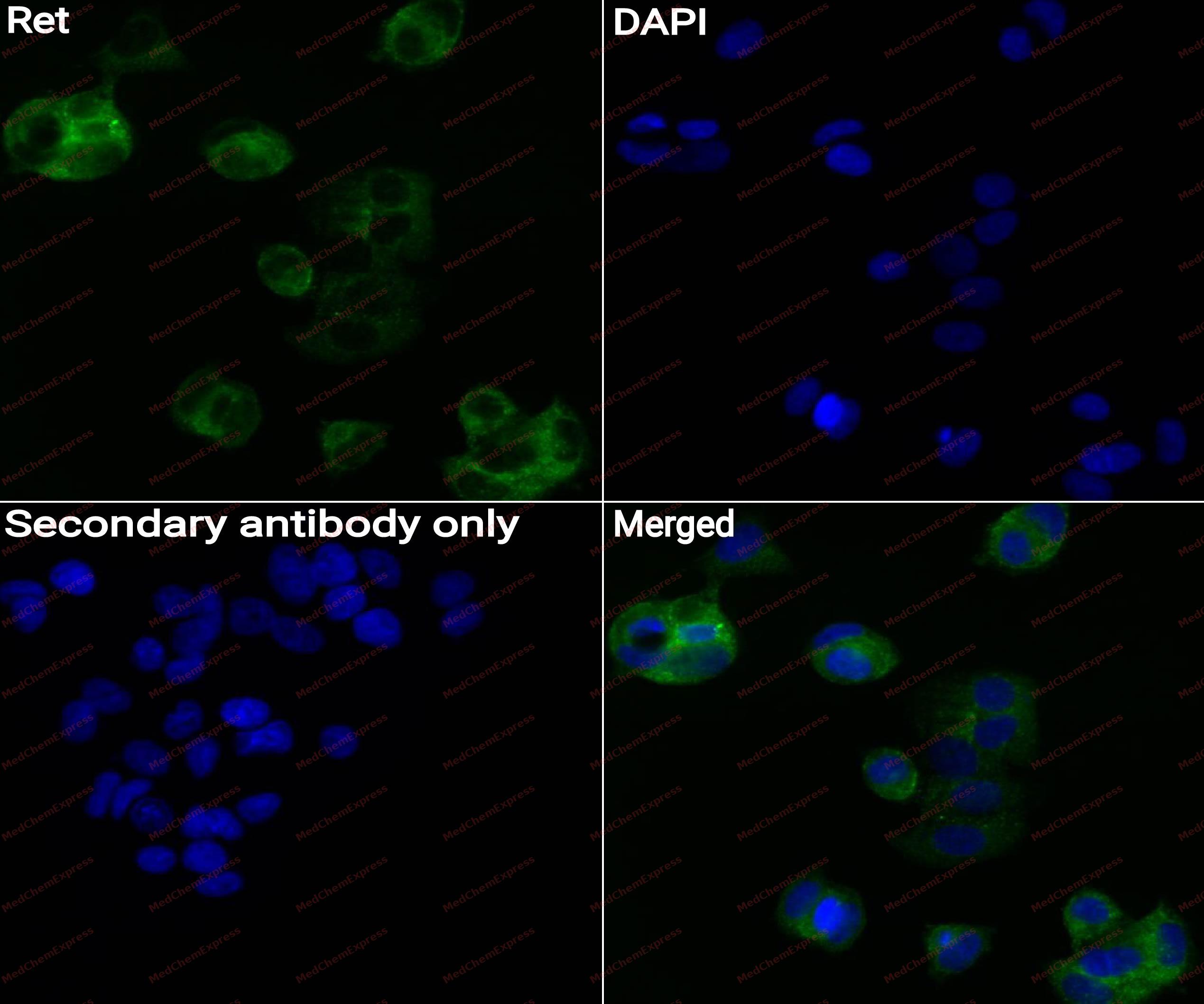 Immunocytochemistry analysis of NIH3T3 cells labeling Ret with Ret antibody (HY-P80307) at 1/100 dilution. Cells were fixed in 4% paraformaldehyde for 15 minutes at room temperature, permeabilized with 0.1% Triton X-100 for 10 minutes at room temperature, then blocked with QuickBlock™ Blocking Buffer for Immunol Staining for 10 min at room temperature. Cells were then incubated with Ret antibody (HY-P80307) at 1/100 dilution in QuickBlock™ Blocking Buffer for Immunol Staining at 4 ℃. Alexa Fluor® 488-conjugated AffiniPure Goat Anti-Rabbit IgG H&L(HY-P8002, Green) was used as the secondary antibody at 1/1,000 dilution. PBS instead of the primary antibody was used as the secondary antibody only control. The Nuclear counterstain was DAPI (Blue).
 -
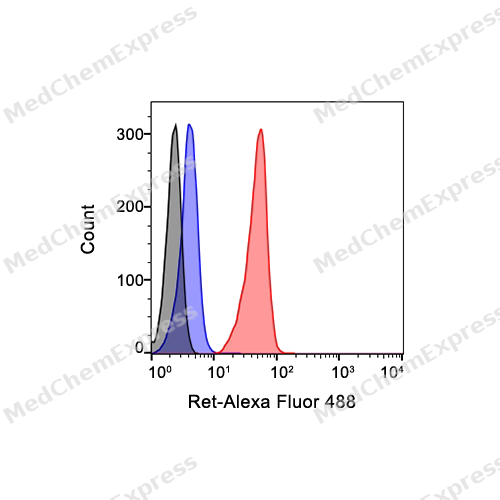 Flow cytometric analysis of 1X10^6 Hela cells labeling Ret Antibody (HY-P80307, red). Cells were fixed with 4% paraformaldehyde and permeabilised with 90% methanol. Then stained with the primary antibody at 1/50 dilution for an hour at 4℃. Alexa Fluor® 488-conjugated AffiniPure Goat Anti-Rabbit IgG H&L (HY-P8002) was used as the secondary antibody at 1/1,000 dilution for 30 minutes at 4℃. Rabbit IgG Isotype Control (HY-P80879, blue) was used as the isotype control, cells without incubation with primary antibody were used as the unlabeled control (black).


Background
-
Function
RET (REarranged during Transfection) is a transmembrane receptor tyrosine kinase that is activated by a complex consisting of a soluble glial cell line-derived neurotrophic factor (GDNF) family ligand (GFL) and a glycosyl phosphatidylinositol-anchored co-receptor, GDNF family receptors alpha (GFRalpha) .
RET signalling is crucial for the development of the enteric nervous system. RET regulates the development of sympathetic, parasympathetic, motor, and sensory neurons, and is necessary for the postnatal maintenance of dopaminergic neurons. RET also plays a role as a driver oncogene in a variety of human cancers. Fusion of RET with several partner genes has been detected in papillary thyroid, lung, colorectal, pancreatic, and breast cancers, and tyrosine kinase inhibitors (TKIs) for RET (particularly RET-specific inhibitors) show promising effects against such cancers.
-
Subcellular Localization
Cell membrane; Single-pass type I membrane protein; Endosome membrane; Single-pass type I membrane protein
-
Expression
Induction:Positively regulated by NKX2-1, PHOX2B, SOX10 and PAX3 -
Subunit
Phosphorylated form interacts with the PBT domain of DOK2, DOK4 and DOK5 (By similarity). The phosphorylated form interacts with PLCG1 and GRB7 (By similarity). Interacts (not phosphorylated) with PTK2/FAK1 (via FERM domain) (PubMed:21454698). Extracellular cell-membrane anchored RET cadherin fragments form complex in neurons with reduced trophic status, preferentially at the contact sites between somas (PubMed:21357690). Interacts with AIP in the pituitary gland; this interaction prevents the formation of the AIP-survivin complex (PubMed:19366855). Interacts (inactive) with CBLC and CD2AP; dissociates upon activation by GDNF which increases CBLC:CD2AP interaction (PubMed:18753381)
-
SwissProt ID
-
Synonyms
CDHF12, CDHR16, PTC, RET, RET51, Proto-oncogene tyrosine-protein kinase receptor Ret, Cadherin family member 12, Proto-oncogene c-Ret
-
Research Field
Signal Transduction


Documentation
-
Data Sheet (235 KB)
-
SDS (252 KB)
- English - EN (252 KB)
- Français - FR (252 KB)
- Deutsch - DE (252 KB)
- Norwegian - NO (252 KB)
- Español - ES (252 KB)
- Swedish - SV (252 KB)
- Italian - IT (252 KB)
- Korean - KR (252 KB)
- Portuguese - PT (252 KB)
-
User Guide for Antibodies (1077 KB)

 Powered by Bioz
