



RF1 Antibody (YA4125)
(Synonyms: ERF; ETF1; ERF1; TB3-1; D5S1995; SUP45L1)
Based on 1 Customer Validation
RF1 Antibody (YA4125) is a Mouse-derived and non-conjugated IgG1 monoclonal antibody, targeting to RF1.
-
Host:
Mouse
-
Isotype:
IgG1
-
Application:
WB, FC, ELISA
-
Reactivity :
Human
-
Formulation:
Supplied in PBS with 0.05% sodium azide
-
Conjugation:
Non-conjugated


To place orders, for customer services and technical support, please contact: MedChemExpress USA
Tel: 609-228-6898 E-mail: [email protected] [email protected]





Applications
| Application |
WB

WB: Western Blot
|
FC
FC: Flow Cytometry
|
ELISA
ELISA: Enzyme Linked Immunosorbent Assay
|
|---|---|---|---|
| Dilution Ratio | 1:500-1:2000 | 1:200-1:400 | 1:10000 |


Product Details
RF1 Antibody (YA4125) is a Mouse-derived and non-conjugated IgG1 monoclonal antibody, targeting to RF1.
-
Host Mouse

-
Clonality Monoclonal

-
Species ReactivityHuman
-
Observed Molecular WeightObserved band size: 49 kDa
Note: Due to possible protein modifications or aggregation, the molecular weight should be confirmed by actual measurement, and the predicted value is for reference only.

-
Calculated Molecular Weight Predicted band size: 49 kDa

Purified recombinant fragment of human RF1 (AA: 288-437) expressed in E. Coli.
affinity purified.
Non-conjugated
Unmodified
IgG1


Product Properties
-
Appearance
Solution
-
Formulation
Supplied in PBS with 0.05% sodium azide
-
Concentration
Batch-dependent, Please check the COA for the concentration of each lot. Check Lot Concentration
-
Storage & Stability
Stored at -20°C for 1 year. Avoid repeated freeze / thaw cycles.
-
Shipping
Shipping with blue ice.


Verification Images
-
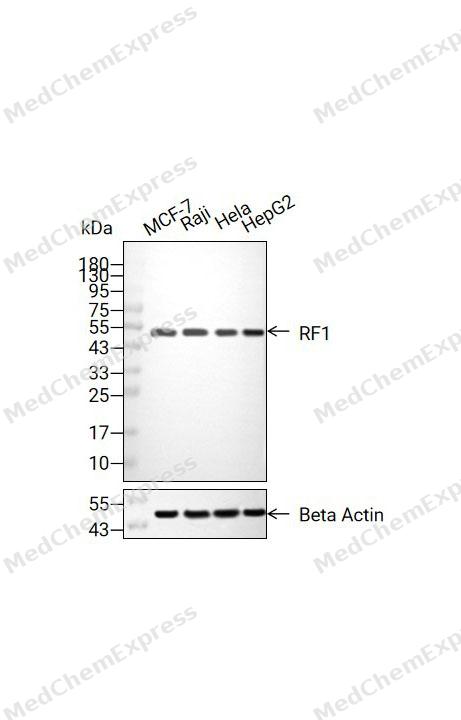 Western blot analysis of extracts from MCF-7 (lane 2(20μg), Raji (lane 3(20μg), Hela (lane 4(20μg), HepG2 (lane 5(20μg) using RF1 Antibody(HY-P84428). Proteins were transferred to a PVDF membrane and blocked with 5% non-fat milk in TBST for 2 hour at room temperature. The primary antibody (1/1000) and Loading control antibody (Beta Actin, HY-P80993, 1/10,000) was used in 5% non-fat milk in TBST at 4°C overnight. Goat Anti-Mouse IgG-HRP Secondary Antibody (HY-P8004 ,1/10,000) was used for 1 hour at room temperature.
 -
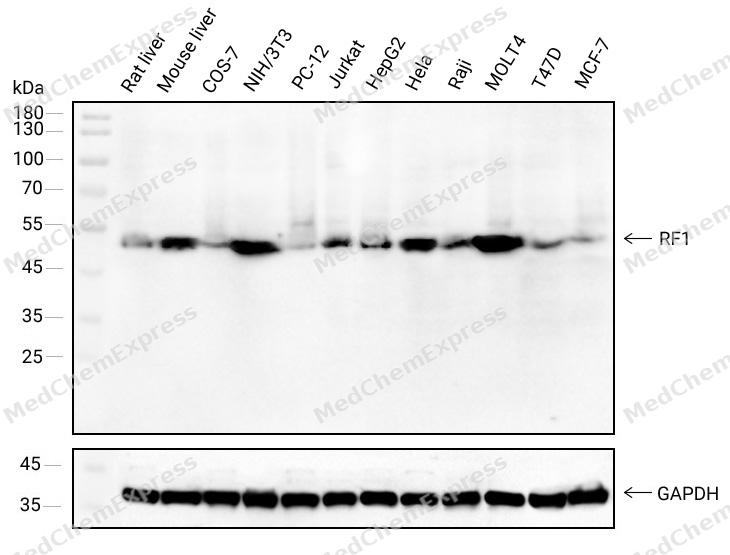 Western blot analysis of extracts from Rat liver(lane 1(40μg) )
 -
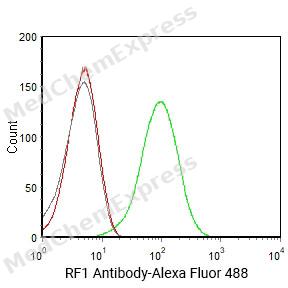 Flow cytometric analysis of 1X10^6 Hela cells labeling RF1 Antibody(HY-P84428
 -
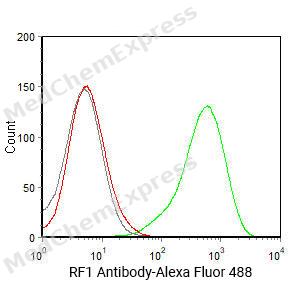 Flow cytometric analysis of 1X10^6 HepG2 cells labeling RF1 Antibody(HY-P84428


Background
-
Function
RF1 component of the eRF1-eRF3-GTP ternary complex, a ternary complex that mediates translation termination in response to the termination codons. The eRF1-eRF3-GTP complex binds to a stop codon in the ribosomal A-site. ETF1/ERF1 is responsible for stop codon recognition and inducing hydrolysis of peptidyl-tRNA. Following GTP hydrolysis, eRF3 (GSPT1/ERF3A or GSPT2/ERF3B) dissociates, permitting ETF1/eRF1 to accommodate fully in the A-site and mediate hydrolysis of peptidyl-tRNA. Component of the transient SURF complex which recruits UPF1 to stalled ribosomes in the context of nonsense-mediated decay (NMD) of mRNAs containing premature stop codons. Required for SHFL-mediated translation termination which inhibits programmed ribosomal frameshifting (-1PRF) of mRNA from viruses and cellular genes[1][2][3][4][5][6][7][8][9].
-
Subcellular Localization
Cytoplasm
-
Isoforms & Post-Translational Modification
P62495 has 2 isomers: P62495-1: 49031 Da (predicted); P62495-2: 45463 Da (predicted).
Methylated at Gln-185 by N6AMT1;Hydroxylation at Lys-63 by JMJD4 promotes its translational termination efficiency;Ubiquitinated at Lys-279 via 'Lys-6'-linked polyubiquitin chains by RNF14 and RNF25 in response to ribosome collisions (ribosome stalling), leading to its degradation by the proteasome and rescue of stalled ribosomes -
Subunit
Component of the eRF1-eRF3-GTP ternary complex, composed of ETF1/ERF1 and eRF3 (GSPT1/ERF3A or GSPT2/ERF3B) and GTP (PubMed:19417105, PubMed:27863242). Component of the transient SURF (SMG1-UPF1-eRF1-eRF3) complex (PubMed:19417104). Interacts with JMJD4 (PubMed:24486019). The ETF1-GSPT1 complex interacts with JMJD4 (PubMed:24486019)
-
SwissProt ID
-
Synonyms
ERF; ETF1; ERF1; TB3-1; D5S1995; SUP45L1


Documentation
-
Data Sheet (234 KB)
-
SDS (251 KB)
- English - EN (251 KB)
- Français - FR (251 KB)
- Deutsch - DE (251 KB)
- Norwegian - NO (251 KB)
- Español - ES (251 KB)
- Swedish - SV (251 KB)
- Italian - IT (251 KB)
- Korean - KR (251 KB)
- Portuguese - PT (251 KB)
-
User Guide for Antibodies (1077 KB)

 Powered by Bioz
