



SH2D1A Antibody (YA1950)
(Synonyms: LYP; SAP; XLP; DSHP; EBVS; IMD5; XLPD; MTCP1; XLPD1; SAP/SH2D1A)
Based on 1 Customer Validation
SH2D1A Antibody (YA1950) is a Rabbit-derived and non-conjugated IgG monoclonal antibody, targeting to SH2D1A.
-
Host:
Rabbit
-
Isotype:
IgG
-
Application:
WB
-
Reactivity :
Human, Mouse, Rat
-
Formulation:
Supplied in 50mM Tris-Glycine(pH 7.4), 0.15M NaCl, 40% Glycerol, 0.01% Sodium azide and 0.05% BSA
-
Conjugation:
Non-conjugated


To place orders, for customer services and technical support, please contact: MedChemExpress USA
Tel: 609-228-6898 E-mail: [email protected] [email protected]





Applications
| Application |
WB

WB: Western Blot
|
|---|---|
| Dilution Ratio | 1:500-1:1000 |


Product Details
SH2D1A Antibody (YA1950) is a Rabbit-derived and non-conjugated IgG monoclonal antibody, targeting to SH2D1A.
-
Host Rabbit

-
Clonality Recombinant, Monoclonal

-
Species ReactivityHuman, Mouse, Rat
-
Observed Molecular WeightObserved band size: 14 kDa
Note: Due to possible protein modifications or aggregation, the molecular weight should be confirmed by actual measurement, and the predicted value is for reference only.

-
Calculated Molecular Weight Predicted band size: 14 kDa

Entrez Gene: 4068 Human ; 20400 Mouse ; 501502 Rat
SwissProt: O60880 Human ; O88890 Mouse ; B2RZ59 Rat
OMIM: 308240 Human
A synthetic peptide of human SH2D1A/SAP
Endogenous
Affinity Purified
Non-conjugated
Unmodified
IgG


Product Properties
-
Appearance
Liquid
-
Formulation
Supplied in 50mM Tris-Glycine(pH 7.4), 0.15M NaCl, 40% Glycerol, 0.01% Sodium azide and 0.05% BSA
-
Concentration
Batch-dependent, Please check the COA for the concentration of each lot. Check Lot Concentration
-
Storage & Stability
Stored at -20°C for 1 year. Avoid repeated freeze / thaw cycles.
-
Shipping
Shipping with blue ice.


Verification Images
-
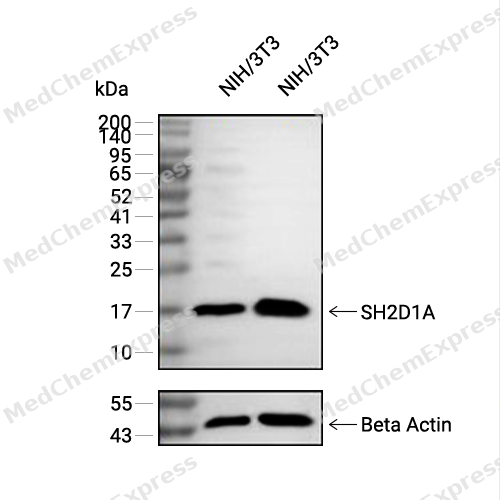 Western blot analysis of extracts from NIH3T3 (lane 2(20μg) and NIH3T3 (lane 3(40μg) using SH2D1A (HY-P82205) Rabbit mAb. Proteins were transferred to a PVDF membrane and blocked with 5% non-fat milk in TBST for 2 hour at room temperature. The primary antibody (1/1000) and Loading control antibody (Beta Actin, HY-P80438, 1/10000) was used in 5% non-fat milk in TBST at 4°C overnight. Goat Anti-Mouse/Rabbit IgG-HRP Secondary Antibody (1/10000) was used for 1 hour at room temperature.


Background
-
Function
SH2D1A is a Cytoplasmic adapter regulating receptors of the signaling lymphocytic activation molecule (SLAM) family such as SLAMF1, CD244, LY9, CD84, SLAMF6 and SLAMF7. In SLAM signaling seems to cooperate with SH2D1B/EAT-2. Initially it has been proposed that association with SLAMF1 prevents SLAMF1 binding to inhibitory effectors including INPP5D/SHIP1 and PTPN11/SHP-2. However, by simultaneous interactions, recruits FYN which subsequently phosphorylates and activates SLAMF1. Positively regulates CD244/2B4- and CD84-mediated natural killer (NK) cell functions. Can also promote CD48-, SLAMF6 -, LY9-, and SLAMF7-mediated NK cell activation. In the context of NK cell-mediated cytotoxicity enhances conjugate formation with target cells. May also regulate the activity of the neurotrophin receptors NTRK1, NTRK2 and NTRK3[1][2].
-
Subcellular Localization
Cytoplasm
-
Expression
Tissue_specificity:Expressed at a high level in thymus and lung, with a lower level of expression in spleen and liver. Expressed in peripheral blood leukocytes, including T-lymphocytes. Tends to be expressed at lower levels in peripheral blood leukocytes with rheumatoid arthritis -
Isoforms & Post-Translational Modification
O60880 has 6 isomers: O60880-1: 14187 Da (predicted); O60880-2: 8392 Da (predicted); O60880-3: 6284 Da (predicted); O60880-4: 13928 Da (predicted); O60880-5: 8188 Da (predicted); O60880-6: 6631 Da (predicted).
-
Subunit
Interacts with NTRK1, NTRK2 and NTRK3 (By similarity). Interacts with CD84, CD244, LY9, SLAMF1 and FYN
-
SwissProt ID
-
Synonyms
LYP; SAP; XLP; DSHP; EBVS; IMD5; XLPD; MTCP1; XLPD1; SAP/SH2D1A
-
Research Field
Cardiovascular


Documentation
-
Data Sheet (258 KB)
-
SDS (251 KB)
- English - EN (251 KB)
- Français - FR (251 KB)
- Deutsch - DE (251 KB)
- Norwegian - NO (251 KB)
- Español - ES (251 KB)
- Swedish - SV (251 KB)
- Italian - IT (251 KB)
- Korean - KR (251 KB)
- Portuguese - PT (251 KB)
-
User Guide for Antibodies (1077 KB)

 Powered by Bioz
