



SIRT4 Antibody (YA6962)
(Synonyms: MGC130046 antibody; MGC130047 antibody; MGC57437 antibody; NAD dependent deacetylase sirtuin 4 antibody; NAD dependent protein deacetylase sirtuin 4 antibody; NAD-dependent ADP-ribosyltransferase sirtuin-4 antibody; NAD-dependent protein deacetylase sirtuin-4 antibody; NAD-dependent protein lipoamidase sirtuin-4, mitochondrial antibody; Regulatory protein SIR2 homolog 4 antibody; Silent mating type information regulation 2 homolog antibody)
Based on 1 Customer Validation
SIRT4 Antibody (YA6962) is a Rabbit-derived and non-conjugated IgG monoclonal antibody, targeting to SIRT4.
-
Host:
Rabbit
-
Isotype:
IgG
-
Application:
WB, IHC-P, IP
-
Reactivity :
Human, Mouse, Rat, Monkey
-
Formulation:
Supplied in PBS (pH7.4), 0.1% BSA, 40% Glycerol. Preservative: 0.05% Sodium Azide.
-
Conjugation:
Non-conjugated


To place orders, for customer services and technical support, please contact: MedChemExpress USA
Tel: 609-228-6898 E-mail: [email protected] [email protected]





Applications
| Application |
WB

WB: Western Blot
|
IHC-P
IHC-P: Immunohistochemistry-Paraffin
|
IP
IP: Immunoprecipitation
|
|---|---|---|---|
| Dilution Ratio | 1:5000 | 1:200 | 1-2μg/sample |


Product Details
SIRT4 Antibody (YA6962) is a Rabbit-derived and non-conjugated IgG monoclonal antibody, targeting to SIRT4.
-
Host Rabbit

-
Clonality Recombinant,Monoclonal

-
Species ReactivityHuman, Mouse, Rat, Monkey
-
Observed Molecular WeightObserved band size: 32 kDa
Note: Due to possible protein modifications or aggregation, the molecular weight should be confirmed by actual measurement, and the predicted value is for reference only.

-
Calculated Molecular Weight Predicted band size: 35 kDa

Recombinant protein within human SIRT4 aa 1-314.
Endogenous
Protein A affinity purified.
Non-conjugated
Unmodified
IgG


Product Properties
-
Appearance
Solution
-
Formulation
Supplied in PBS (pH7.4), 0.1% BSA, 40% Glycerol. Preservative: 0.05% Sodium Azide.
-
Concentration
Batch-dependent, Please check the COA for the concentration of each lot. Check Lot Concentration
-
Storage & Stability
Stored at -20°C for 1 year. Avoid repeated freeze / thaw cycles.
-
Shipping
Shipping with blue ice.


Verification Images
-
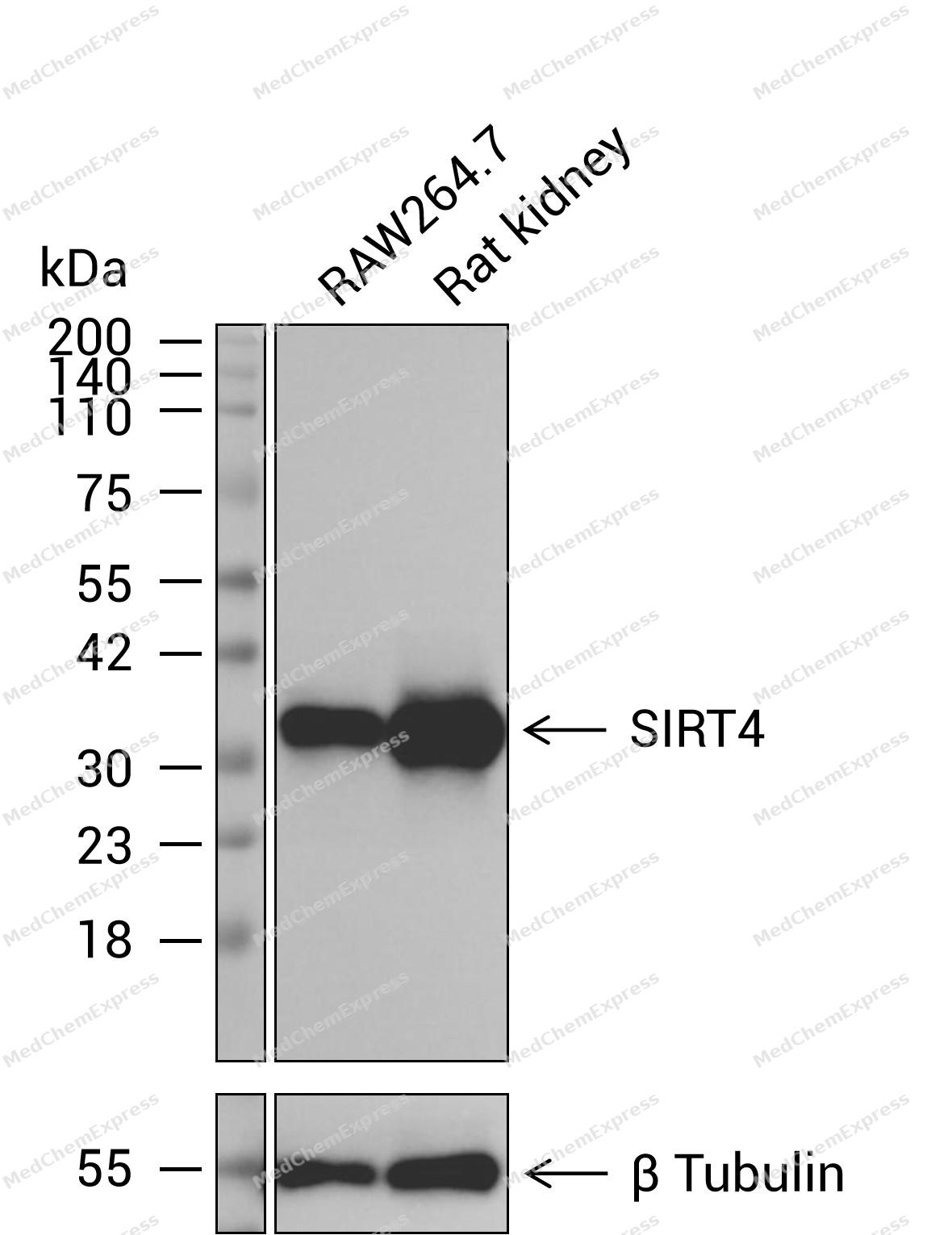 Western blot analysis of extracts from RAW264.7 (lane 1(20μg)) and Rat kidney (lane 2(20μg)) using SIRT4 Antibody (HY-P87279) . Proteins were transferred to a PVDF membrane and blocked with 5% nonfat dry milk in TBST for 1.5 hour at room temperature. The primary antibody (1/5000) and Loading control antibody (β Tubulin, 1/10000) was used in 5% nonfat dry milk in TBST at 4℃ overnight. Goat Anti-Rabbit IgG-HRP Secondary Antibody (1/10,000) was used for 1 hour at room temperature.
 -
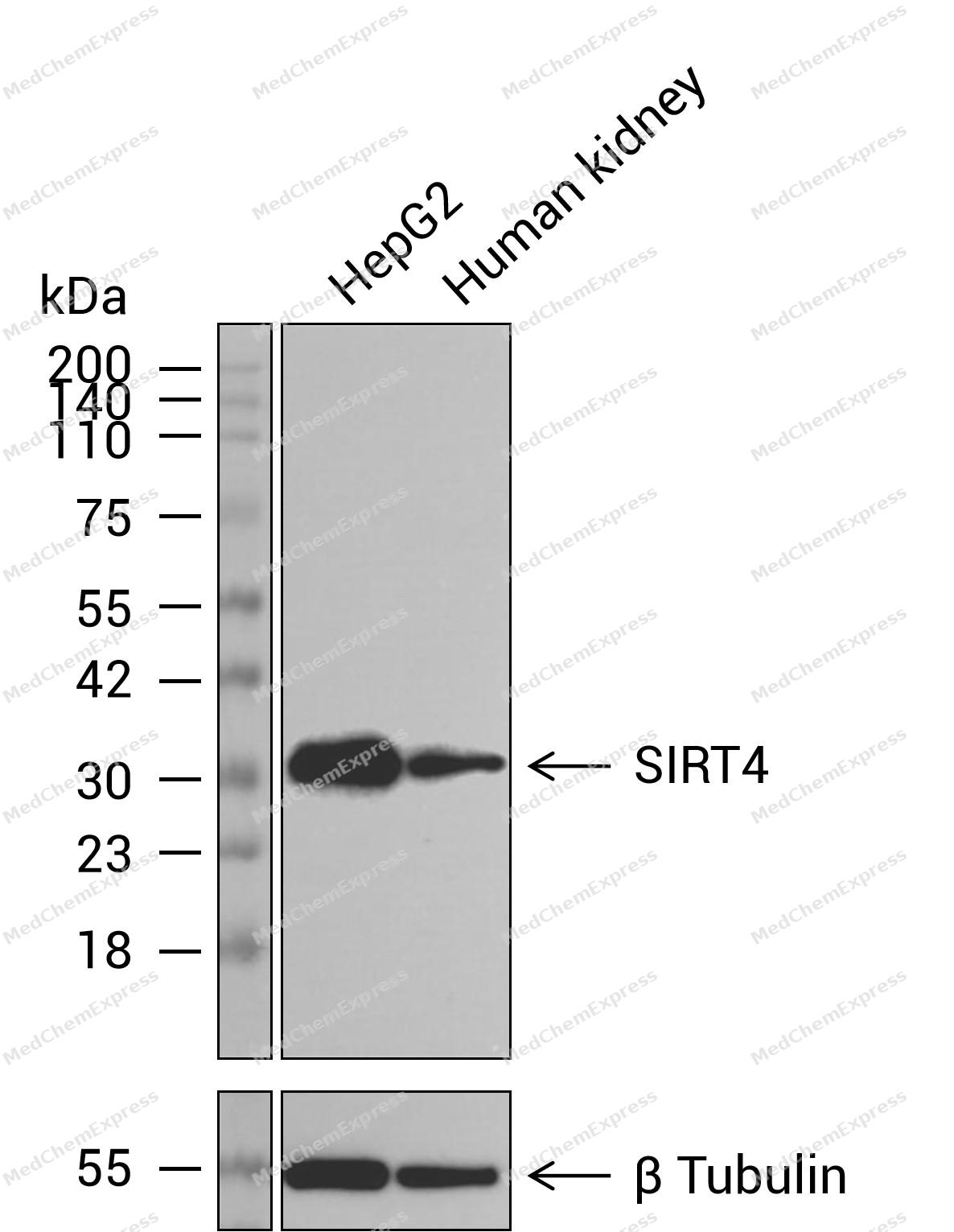 Western blot analysis of extracts from HepG2 (lane 1(20μg)) and Human kidney (lane 2(40μg)) using SIRT4 Antibody (HY-P87279) . Proteins were transferred to a PVDF membrane and blocked with 5% nonfat dry milk in TBST for 1.5 hour at room temperature. The primary antibody (1/1000) and Loading control antibody (β Tubulin, 1/10000) was used in 5% nonfat dry milk in TBST at 4℃ overnight. Goat Anti-Rabbit IgG-HRP Secondary Antibody (1/10,000) was used for 1 hour at room temperature.


Background
-
Function
SIRT4 is a mitochondrial member of the sirtuin family that functions as an NAD+-dependent metabolic regulator and is distinguished by its prominent ADP-ribosyltransferase activity toward glutamate dehydrogenase (GDH) [1][2]. Mechanistically, SIRT4 represses mitochondrial glutamine and glutamate metabolism through ADP-ribosylation-mediated inhibition of GDH, thereby reducing amino acid-stimulated insulin secretion and modulating cellular energy homeostasis[1][2][3]. Beyond GDH regulation, SIRT4 participates in broader metabolic control, including the regulation of fatty acid oxidation, branched-chain amino acid catabolism, and mitochondrial metabolic adaptation during nutrient stress[4][5][6]. These functions position SIRT4 as an important regulator of mitochondrial metabolism and endocrine signaling in pancreatic β cells and other metabolically active tissues[1][4]. In disease contexts, reduced SIRT4 activity or expression has been associated with enhanced glutamine utilization and tumor progression, whereas restoration of SIRT4 suppresses proliferation and promotes tumor-suppressive metabolic programs in multiple experimental cancer models[7][8][9]. Compared with related mitochondrial isoforms such as SIRT3 and SIRT5, which primarily function through deacylation-dependent activation or remodeling of metabolic enzymes, SIRT4 is notable for suppressing metabolic flux through ADP-ribosylation-mediated inhibition of key mitochondrial targets[1][10]. For experimental applications, selective SIRT4 inhibitors have recently been reported, providing emerging tools for mechanistic studies of mitochondrial metabolism, insulin secretion, and cancer-associated metabolic reprogramming[11].
-
Subcellular Localization
Mitochondrion matrix
-
Expression
Tissue_Specificity: Detected in vascular smooth muscle and striated muscle. Detected in insulin-producing beta-cells in pancreas islets of Langerhans (at protein level). Widely expressed. Weakly expressed in leukocytes and fetal thymus
Induction: Induced by glutamine (at protein level) -
Isoforms & Post-Translational Modification
Q9Y6E7: 314 amino acids, molecular weight 35188 Da.
-
Subunit
Interacts with GLUD1, IDE and SLC25A5 (PubMed:16959573, PubMed:17715127)
-
SwissProt ID
-
Synonyms
MGC130046 antibody; MGC130047 antibody; MGC57437 antibody; NAD dependent deacetylase sirtuin 4 antibody; NAD dependent protein deacetylase sirtuin 4 antibody; NAD-dependent ADP-ribosyltransferase sirtuin-4 antibody; NAD-dependent protein deacetylase sirtuin-4 antibody; NAD-dependent protein lipoamidase sirtuin-4, mitochondrial antibody; Regulatory protein SIR2 homolog 4 antibody; Silent mating type information regulation 2 homolog antibody


Documentation
-
Data Sheet (261 KB)
-
SDS (254 KB)
- English - EN (254 KB)
- Français - FR (254 KB)
- Deutsch - DE (254 KB)
- Norwegian - NO (254 KB)
- Español - ES (254 KB)
- Swedish - SV (254 KB)
- Italian - IT (254 KB)
- Korean - KR (254 KB)
- Portuguese - PT (254 KB)
-
User Guide for Antibodies (1077 KB)
References
[1]. Haigis MC, et al. SIRT4 inhibits glutamate dehydrogenase and opposes the effects of calorie restriction in pancreatic beta cells. Cell. 2006 Sep 8;126(5):941-54. [Content Brief]
[2]. Caride AJ, et al. The plasma membrane Ca2+ pump isoform 4a differs from isoform 4b in the mechanism of calmodulin binding and activation kinetics: implications for Ca2+ signaling. J Biol Chem. 2007 Aug 31;282(35):25640-8. [Content Brief]
[3]. Zaganjor E, et al. SIRT4 Is a Regulator of Insulin Secretion. Cell Chem Biol. 2017;24(6):656-658.
[5]. Zaganjor E, et al. SIRT4 is an early regulator of branched-chain amino acid catabolism that promotes adipogenesis. Cell Rep. 2021 Jul 13;36(2):109345. [Content Brief]
[6]. Wood JG, et al. Sirt4 is a mitochondrial regulator of metabolism and lifespan in Drosophila melanogaster. Proc Natl Acad Sci U S A. 2018 Feb 13;115(7):1564-1569. [Content Brief]
[8]. Cai G, et al. SIRT4 functions as a tumor suppressor during prostate cancer by inducing apoptosis and inhibiting glutamine metabolism. Sci Rep. 2022 Jul 16;12(1):12208. [Content Brief]
[9]. Wang C, et al. Mammalian SIRT4 is a tumor suppressor of clear cell renal cell carcinoma by inhibiting cancer proliferation, migration and invasion. Cancer Biomark. 2020;29(4):453-462. [Content Brief]
[11]. Pannek M, et al. Specific Inhibitors of Mitochondrial Deacylase Sirtuin 4 Endowed with Cellular Activity. J Med Chem. 2024 Feb 8;67(3):1843-1860. [Content Brief]

 Powered by Bioz
