



SMARCA1 Antibody (YA3932)
(Synonyms: SWI; ISWI; SWI2; SNF2L; SNF2L1; SNF2LB; SNF2LT; hSNF2L; NURF140)
Based on 1 Customer Validation
SMARCA1 Antibody (YA3932) is a Mouse-derived and non-conjugated IgG1 monoclonal antibody, targeting to SMARCA1.
-
Host:
Mouse
-
Isotype:
IgG1
-
Application:
WB, IHC-P, FC, ELISA
-
Reactivity :
Human, Mouse
-
Formulation:
Supplied in PBS with 0.05% sodium azide
-
Conjugation:
Non-conjugated


To place orders, for customer services and technical support, please contact: MedChemExpress USA
Tel: 609-228-6898 E-mail: [email protected] [email protected]





Applications
| Application |
WB

WB: Western Blot
|
IHC-P
IHC-P: Immunohistochemistry-Paraffin
|
FC
FC: Flow Cytometry
|
ELISA
ELISA: Enzyme Linked Immunosorbent Assay
|
|---|---|---|---|---|
| Dilution Ratio | 1:500-1:2000 | 1:200-1:1000 | 1:200-1:400 | 1:10000 |


Product Details
SMARCA1 Antibody (YA3932) is a Mouse-derived and non-conjugated IgG1 monoclonal antibody, targeting to SMARCA1.
-
Host Mouse

-
Clonality Monoclonal

-
Species ReactivityHuman, Mouse
-
Observed Molecular WeightObserved band size: 123 kDa
Note: Due to possible protein modifications or aggregation, the molecular weight should be confirmed by actual measurement, and the predicted value is for reference only.

-
Calculated Molecular Weight Predicted band size: 123 kDa

Purified recombinant fragment of human SMARCA1 (AA: 933-1070) expressed in E. Coli.
affinity purified.
Non-conjugated
Unmodified
IgG1


Product Properties
-
Appearance
Solution
-
Formulation
Supplied in PBS with 0.05% sodium azide
-
Concentration
Batch-dependent, Please check the COA for the concentration of each lot. Check Lot Concentration
-
Storage & Stability
Stored at -20°C for 1 year. Avoid repeated freeze / thaw cycles.
-
Shipping
Shipping with blue ice.


Verification Images
-
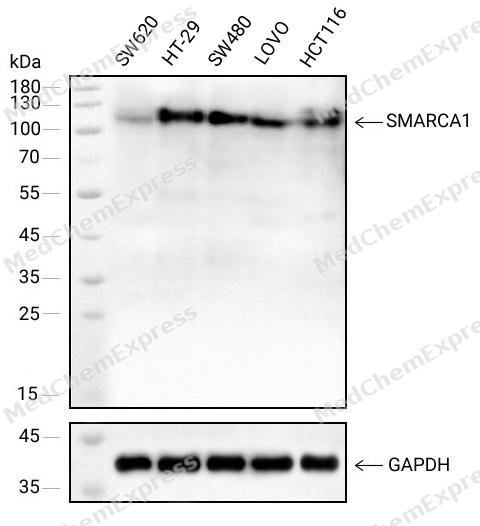 Western blot analysis of extracts from SW620(lane 1(40μg) )
 -
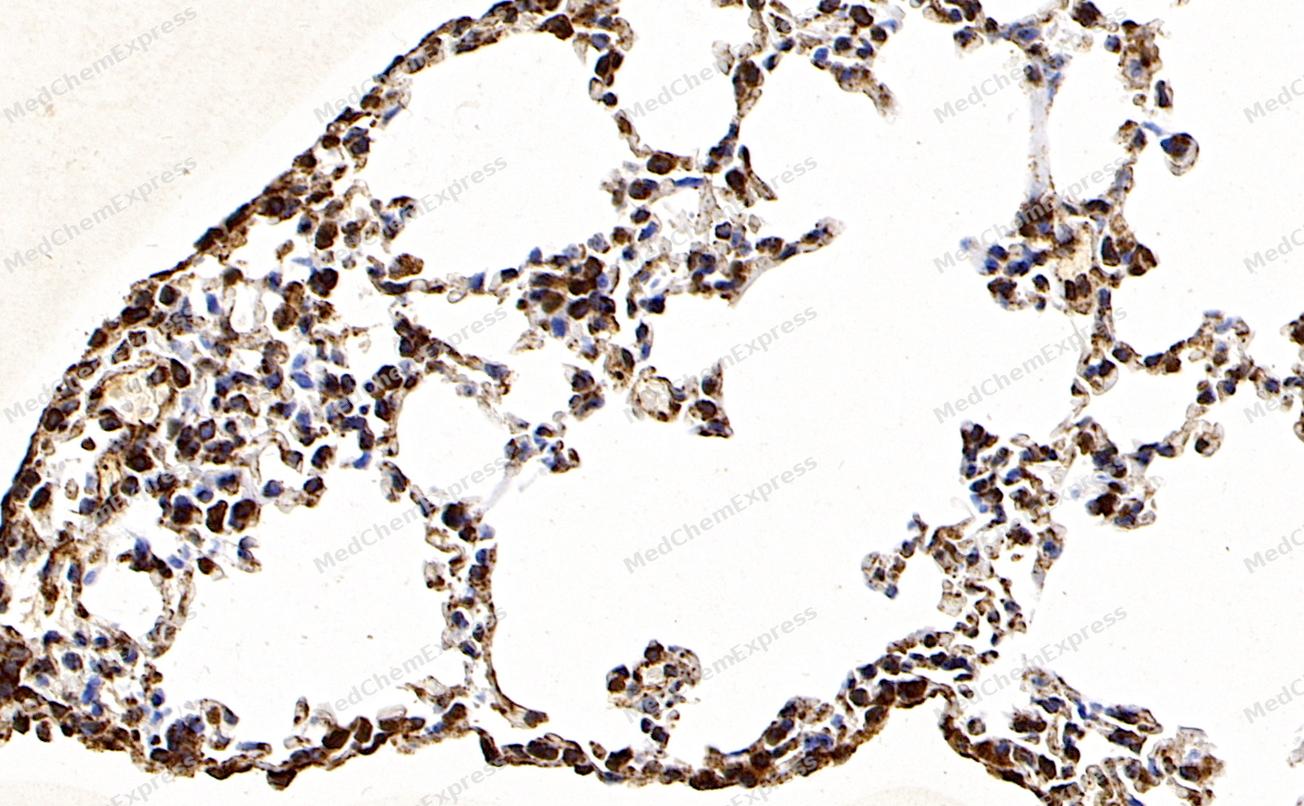 Immunohistochemical analysis of paraffin-embedded Mouse lung tissue using SMARCA1 Antibody. The section was pre-treated using heat mediated antigen retrieval with sodium citrate buffer (pH 6.0) for 8 minutes. The tissues were blocked in QuickBlock for 20 minutes at room temperature, washed with ddH2O and PBS, and then probed with the primary antibody (HY-P84235, 1/500) in 4℃ overnight. The detection was performed using an HRP conjugated compact polymer system. DAB was used as the chromogen. Tissues were counterstained with hematoxylin and mounted with DPX.
 -
Immunohistochemical analysis of paraffin-embedded Mouse lung tissue using SMARCA1 Antibody. The section was pre-treated using heat mediated antigen retrieval with sodium citrate buffer (pH 6.0) for 8 minutes. The tissues were blocked in QuickBlock for 20 minutes at room temperature, washed with ddH2O and PBS, and then probed with the primary antibody (HY-P84235, 1/500) in 4℃ overnight. The detection was performed using an HRP conjugated compact polymer system. DAB was used as the chromogen. Tissues were counterstained with hematoxylin and mounted with DPX.


Background
-
Function
SMARCA1 is an ATPase that possesses intrinsic ATP-dependent chromatin-remodeling activity. ATPase activity is substrate-dependent, and is increased when nucleosomes are the substrate, but is also catalytically active when DNA alone is the substrate. Catalytic subunit of ISWI chromatin-remodeling complexes, which form ordered nucleosome arrays on chromatin and facilitate access to DNA during DNA-templated processes such as DNA replication, transcription, and repair. Within the ISWI chromatin-remodeling complexes, slides edge- and center-positioned histone octamers away from their original location on the DNA template. Catalytic activity and histone octamer sliding propensity is regulated and determined by components of the ISWI chromatin-remodeling complexes. The BAZ1A-, BAZ1B-, BAZ2A- and BAZ2B-containing ISWI chromatin-remodeling complexes regulate the spacing of nucleosomes along the chromatin and have the ability to slide mononucleosomes to the center of a DNA template. The CECR2- and RSF1-containing ISWI chromatin-remodeling complexes do not have the ability to slide mononucleosomes to the center of a DNA template. Within the NURF-1 and CERF-1 ISWI chromatin remodeling complexes, nucleosomes are the preferred substrate for its ATPase activity. Within the NURF-1 ISWI chromatin-remodeling complex, binds to the promoters of En1 and En2 to positively regulate their expression and promote brain development. May promote neurite outgrowth. May be involved in the development of luteal cells. Facilitates nucleosome assembly during DNA replication, ensuring replication fork progression and genomic stability by preventing replication stress and nascent DNA gaps; Catalytically inactive when either DNA or nucleosomes are the substrate and does not possess chromatin-remodeling activity. Acts as a negative regulator of chromatin remodelers by generating inactive complexes[1][2][3][4][5][6].
-
Subcellular Localization
Nucleus; Chromosome
-
Expression
Tissue_specificity:Expressed in lung, breast, kidney, ovary, skeletal muscle and brain; Mainly expressed in non-neuronal tissues such as lung, breast, kidney, and ovary -
Isoforms & Post-Translational Modification
P28370 has 2 isomers: P28370-2: 121142 Da (predicted); P28370-1: 122605 Da (predicted).
-
Subunit
May form homodimers (PubMed:15310751). Component of the ACF-1 ISWI chromatin remodeling complex at least composed of SMARCA1 and BAZ1A, which regulates the spacing of histone octamers on the DNA template to facilitate access to DNA (PubMed:28801535). Within the complex interacts with BAZ1A; the interaction is direct (PubMed:28801535). Component of the WICH-1 ISWI chromatin remodeling complex at least composed of SMARCA1 and BAZ1B/WSTF (PubMed:28801535). Within the complex interacts with BAZ1B/WSTF (PubMed:28801535). Component of the NoRC-1 ISWI chromatin remodeling complex at least composed of SMARCA1 and BAZ2A/TIP5 (PubMed:28801535). Within the complex interacts with BAZ2A/TIP5 (PubMed:28801535). Component of the BRF-1 ISWI chromatin remodeling complex at least composed of SMARCA1 and BAZ2B (PubMed:28801535). Within the complex interacts with BAZ2B (PubMed:28801535). Component of the NURF-1 ISWI chromatin remodeling complex (also called the nucleosome-remodeling factor (NURF) complex) at least composed of SMARCA1, BPTF, RBBP4 and RBBP7 (PubMed:14609955, PubMed:15640247, PubMed:28801535). Within the complex interacts with BPTF (PubMed:14609955, PubMed:15310751, PubMed:28801535). Within the complex interacts with RBBP4 and RBBP7 (PubMed:14609955, PubMed:15310751). Component of the CERF-1 ISWI chromatin remodeling complex (also called the CECR2-containing-remodeling factor (CERF) complex) at least composed of CECR2 and SMARCA1 (PubMed:15640247, PubMed:28801535). LUZP1 is detected as part of the CERF-1 complex in embryonic stem cells where it is involved in complex stabilization but is not detected in the complex in the testis (By similarity). Component of the RSF-1 ISWI chromatin remodeling complex at least composed of SMARCA1 and RSF1 (PubMed:15640247, PubMed:28801535). Within the complex interacts with RSF1 (PubMed:28801535). Interacts with PRLR (PubMed:16740656). Interacts with ERCC6 (PubMed:26030138)
-
SwissProt ID
-
Synonyms
SWI; ISWI; SWI2; SNF2L; SNF2L1; SNF2LB; SNF2LT; hSNF2L; NURF140


Documentation
-
Data Sheet (260 KB)
-
SDS (251 KB)
- English - EN (251 KB)
- Français - FR (251 KB)
- Deutsch - DE (251 KB)
- Norwegian - NO (251 KB)
- Español - ES (251 KB)
- Swedish - SV (251 KB)
- Italian - IT (251 KB)
- Korean - KR (251 KB)
- Portuguese - PT (251 KB)
-
User Guide for Antibodies (1077 KB)

 Powered by Bioz
