



SMARCA5 Antibody (YA2013)
(Synonyms: ISWI; SNF2H; hISWI; hSNF2H; WCRF135)
Based on 1 Customer Validation
SMARCA5 Antibody (YA2013) is a Rabbit-derived and non-conjugated IgG monoclonal antibody, targeting to SMARCA5.
-
Host:
Rabbit
-
Isotype:
IgG
-
Application:
WB, ICC/IF
-
Reactivity :
Human, Mouse, Rat
-
Formulation:
Supplied in 50mM Tris-Glycine(pH 7.4), 0.15M NaCl, 40% Glycerol, 0.01% Sodium azide and 0.05% BSA
-
Conjugation:
Non-conjugated


To place orders, for customer services and technical support, please contact: MedChemExpress USA
Tel: 609-228-6898 E-mail: [email protected] [email protected]





Applications
| Application |
WB

WB: Western Blot
|
ICC/IF
ICC/IF: Immunocytochemistry/
Immunofluorescence |
|---|---|---|
| Dilution Ratio | 1:500-1:1000 | 1:50-1:200 |


Product Details
SMARCA5 Antibody (YA2013) is a Rabbit-derived and non-conjugated IgG monoclonal antibody, targeting to SMARCA5.
-
Host Rabbit

-
Clonality Recombinant, Monoclonal

-
Species ReactivityHuman, Mouse, Rat
-
Observed Molecular WeightObserved band size: 122 kDa
Note: Due to possible protein modifications or aggregation, the molecular weight should be confirmed by actual measurement, and the predicted value is for reference only.

-
Calculated Molecular Weight Predicted band size: 122 kDa

Entrez Gene: 8467 Human ; 93762 Mouse ; 307766 Rat
SwissProt: O60264 Human ; Q91ZW3 Mouse ;
OMIM: 603375 Human
A synthetic peptide of human SNF2H
Endogenous
Affinity Purified
Non-conjugated
Unmodified
IgG


Product Properties
-
Appearance
Liquid
-
Formulation
Supplied in 50mM Tris-Glycine(pH 7.4), 0.15M NaCl, 40% Glycerol, 0.01% Sodium azide and 0.05% BSA
-
Concentration
Batch-dependent, Please check the COA for the concentration of each lot. Check Lot Concentration
-
Storage & Stability
Stored at -20°C for 1 year. Avoid repeated freeze / thaw cycles.
-
Shipping
Shipping with blue ice.


Verification Images
-
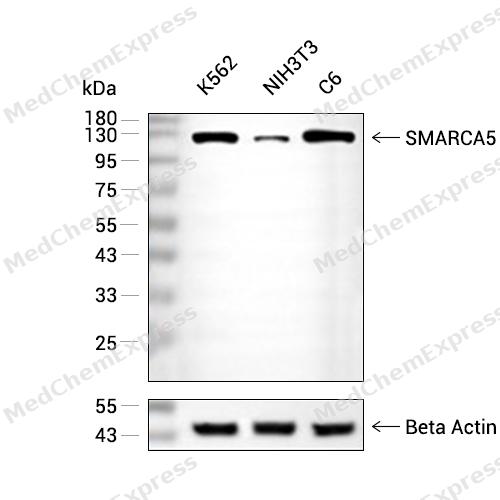 Western blot analysis of extracts from K562 (lane 2(20μg), NIH3T3 (lane 3(20μg) and C6 (lane 4(20μg) using SMARCA5 (HY-P82268) Rabbit mAb. Proteins were transferred to a PVDF membrane and blocked with 5% non-fat milk in TBST for 2 hour at room temperature. The primary antibody (1/1000) and Loading control antibody (Beta Actin, HY-P80438, 1/10000) was used in 5% non-fat milk in TBST at 4°C overnight. Goat Anti-Mouse IgG-HRP Secondary Antibody (1/10000) was used for 1 hour at room temperature.
 -
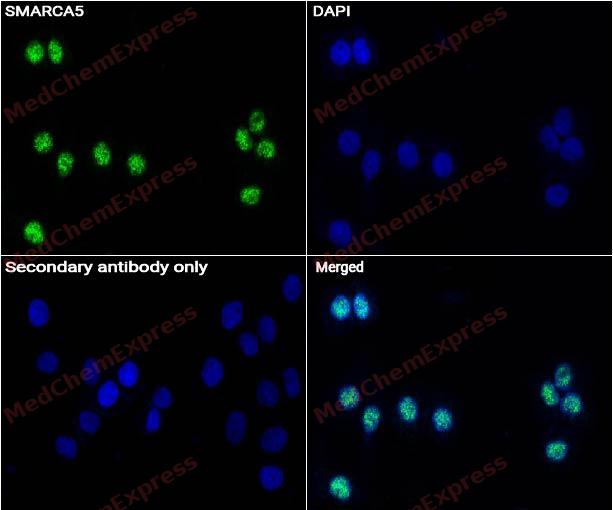 Immunocytochemistry analysis of Hela cells labeling SMARCA5 Antibody (HY-P82268) at 1/50 dilution. Cells were fixed in 4% paraformaldehyde for 15 minutes at room temperature, permeabilized with 0.1% Triton X-100 for 10 minutes at room temperature, then blocked with QuickBlock™ Blocking Buffer for Immunol Staining for 10 min at room temperature. Cells were then incubated with SMARCA5 Antibody (HY-P82268) at 1/50 dilution in QuickBlock™ Blocking Buffer for Immunol Staining at 4 ℃. Alexa Fluor® 488-conjugated AffiniPure Goat Anti-Rabbit IgG H&L(HY-P8002, Green) was used as the secondary antibody at 1/1,000 dilution. PBS instead of the primary antibody was used as the secondary antibody only control. The Nuclear counterstain was DAPI (Blue).
 -
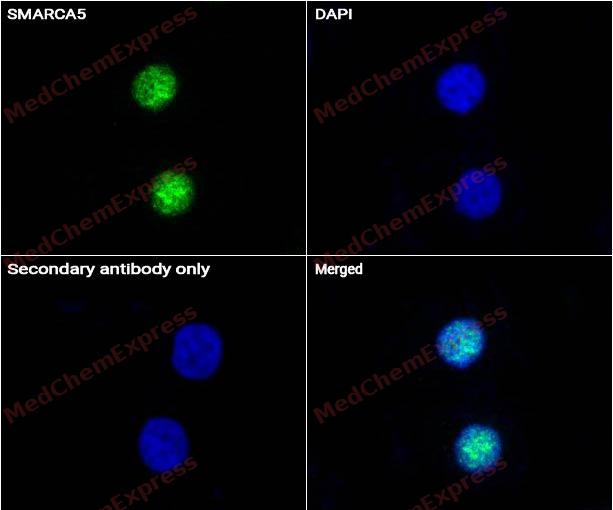 Immunocytochemistry analysis of Hela cells labeling SMARCA5 Antibody (HY-P82268) at 1/200 dilution. Cells were fixed in 4% paraformaldehyde for 15 minutes at room temperature, permeabilized with 0.1% Triton X-100 for 10 minutes at room temperature, then blocked with QuickBlock™ Blocking Buffer for Immunol Staining for 10 min at room temperature. Cells were then incubated with SMARCA5 Antibody (HY-P82268) at 1/200 dilution in QuickBlock™ Blocking Buffer for Immunol Staining at 4 ℃. Alexa Fluor® 488-conjugated AffiniPure Goat Anti-Rabbit IgG H&L(HY-P8002, Green) was used as the secondary antibody at 1/1,000 dilution. PBS instead of the primary antibody was used as the secondary antibody only control. The Nuclear counterstain was DAPI (Blue).


Background
-
Function
SMARCA5 is an ATPase that possesses intrinsic ATP-dependent nucleosome-remodeling activity. Catalytic subunit of ISWI chromatin-remodeling complexes, which form ordered nucleosome arrays on chromatin and facilitate access to DNA during DNA-templated processes such as DNA replication, transcription, and repair; this may require intact histone H4 tails. Within the ISWI chromatin-remodeling complexes, slides edge- and center-positioned histone octamers away from their original location on the DNA template. Catalytic activity and histone octamer sliding propensity is regulated and determined by components of the ISWI chromatin-remodeling complexes. The BAZ1A/ACF1-, BAZ1B/WSTF-, BAZ2A/TIP5- and BAZ2B-containing ISWI chromatin-remodeling complexes regulate the spacing of nucleosomes along the chromatin and have the ability to slide mononucleosomes to the center of a DNA template in an ATP-dependent manner. The CECR2- and RSF1-containing ISWI chromatin-remodeling complexes do not have the ability to slide mononucleosomes to the center of a DNA template. Binds to core histones together with RSF1, and is required for the assembly of regular nucleosome arrays by the RSF-5 ISWI chromatin-remodeling complex. Involved in DNA replication and together with BAZ1A/ACF1 is required for replication of pericentric heterochromatin in S-phase. Probably plays a role in repression of RNA polymerase I dependent transcription of the rDNA locus, through the recruitment of the SIN3/HDAC1 corepressor complex to the rDNA promoter. Essential component of the WICH-5 ISWI chromatin-remodeling complex (also called the WICH complex), a chromatin-remodeling complex that mobilizes nucleosomes and reconfigures irregular chromatin to a regular nucleosomal array structure. The WICH-5 ISWI chromatin-remodeling complex regulates the transcription of various genes, has a role in RNA polymerase I transcription. Within the B-WICH complex has a role in RNA polymerase III transcription. Mediates the histone H2AX phosphorylation at 'Tyr-142', and is involved in the maintenance of chromatin structures during DNA replication processes. Essential component of NoRC-5 ISWI chromatin-remodeling complex, a complex that mediates silencing of a fraction of rDNA by recruiting histone-modifying enzymes and DNA methyltransferases, leading to heterochromatin formation and transcriptional silencing[1][2][3][4][5][6][7][8][9][10].
-
Subcellular Localization
Nucleus; Chromosome
-
Expression
Tissue_specificity:Ubiquitously expressed -
Subunit
Component of the ACF-5 ISWI chromatin-remodeling complex (also called the ACF/WCRF complex) at least composed of SMARCA5/SNF2H and BAZ1A/ACF1, which regulates the spacing of histone octamers on the DNA template to facilitate access to DNA (PubMed:10880450, PubMed:12198550, PubMed:12434153, PubMed:28801535). Within the complex interacts with BAZ1A/ACF1; the interaction is direct and is required to slide nucleosomes from end to center positions on a DNA template in an ATP-dependent manner (PubMed:10880450, PubMed:12198550, PubMed:12434153, PubMed:28801535). Component of the CHRAC ISWI chromatin-remodeling complex at least composed of SMARCA5/SNF2H, BAZ1A/ACF1, CHRAC1 and POLE3; the complex preferentially binds DNA through the CHRAC1-POLE3 heterodimer and possesses ATP-dependent nucleosome-remodeling activity (PubMed:10880450, PubMed:12434153). Within the complex interacts with BAZ1A/ACF1; the interaction is direct and promotes the interaction with the POLE3-CHRAC1 heterodimer (PubMed:10880450, PubMed:12434153, PubMed:14759371). Within the complex interacts with the POLE3-CHRAC1 heterodimer; the interaction is direct and enhances nucleosome sliding activity by the SMARCA5/SNF2H and BAZ1A/ACF1 interaction (PubMed:10880450, PubMed:14759371). Neither POLE3 nor CHRAC1 enhances nucleosome sliding activity of the ACF-5 ISWI chromatin remodeling complex (PubMed:14759371). Component of the WICH-5 ISWI chromatin-remodeling complex (also called the WICH complex) at least composed of SMARCA5/SNF2H and BAZ1B/WSTF, which regulates the spacing of histone octamers on the DNA template to facilitate access to DNA (PubMed:11980720, PubMed:28801535). Within the complex interacts with BAZ1B/WSTF (PubMed:11980720, PubMed:15543136, PubMed:28801535). Component of the NoRC-5 ISWI chromatin-remodeling complex (also called the NoRC chromatin-remodeling complex) at least composed of SMARCA5/SNF2H and BAZ2A/TIP5; the complex suppresses rDNA transcription by a combination of nucleosome remodeling, histone deacetylation, and DNA methylation (PubMed:28801535). Within the complex interacts with BAZ2A/TIP5 (PubMed:28801535). Within the complex interacts with HDAC1 (By similarity). Component of the BRF-5 ISWI chromatin-remodeling complex at least composed of SMARCA5/SNF2H and BAZ2B (PubMed:28801535). Within the complex interacts with BAZ2B (PubMed:28801535). Component of the NURF-5 ISWI chromatin-remodeling complex at least composed of SMARCA5/SNF2H and BPTF (PubMed:28801535). Within the complex interacts with BPFT (PubMed:28801535). Component of the CERF-5 ISWI chromatin-remodeling complex at least composed of SMARCA5/SNF2H and CECR2 (PubMed:28801535). LUZP1 is detected as part of the CERF-5 complex in embryonic stem cells where it is involved in complex stabilization but is not detected in the complex in the testis (By similarity). Within the complex interacts with CECR2 (PubMed:28801535). Component of the RSF-5 ISWI chromatin-remodeling complex (also called the RSF complex) at least composed of SMARCA5/SNF2H and RSF1 (PubMed:12972596, PubMed:28801535). Within the complex interacts with RSF1 (PubMed:12972596, PubMed:28801535). Interacts with the cohesin complex component RAD21; the interaction is direct (PubMed:12198550). Interacts with the NuRD complex components HDAC2, RBBP4 and CHD4; the interactions are direct (PubMed:12198550). Interacts with PCNA (PubMed:15543136). Component of the B-WICH complex, at least composed of SMARCA5/SNF2H, BAZ1B/WSTF, SF3B1, DEK, MYO1C, ERCC6, MYBBP1A and DDX21 which positively regulates RNA polymerase III transcription (PubMed:16603771). Interacts with MYO1C (By similarity). Interacts with BEND3 (PubMed:26100909). Interacts with SIRT6; promoting recruitment to DNA damage sites (PubMed:23911928)
-
SwissProt ID
-
Synonyms
ISWI; SNF2H; hISWI; hSNF2H; WCRF135
-
Research Field
Epigenetics and Nuclear Signaling


Documentation
-
Data Sheet (258 KB)
-
SDS (251 KB)
- English - EN (251 KB)
- Français - FR (251 KB)
- Deutsch - DE (251 KB)
- Norwegian - NO (251 KB)
- Español - ES (251 KB)
- Swedish - SV (251 KB)
- Italian - IT (251 KB)
- Korean - KR (251 KB)
- Portuguese - PT (251 KB)
-
User Guide for Antibodies (1077 KB)

 Powered by Bioz
