



STUB1 Antibody (YA2096)
(Synonyms: STUB1; CHIP; HSPABP2; NY-CO-7; SDCCAG7; UBOX1)
Based on 1 Customer Validation
STUB1 Antibody (YA2096) is a Rabbit-derived and non-conjugated IgG monoclonal antibody, targeting to STUB1.
-
Host:
Rabbit
-
Isotype:
IgG
-
Application:
WB, ICC/IF, IP
-
Reactivity :
Human, Mouse, Rat
-
Formulation:
Supplied in 50mM Tris-Glycine(pH 7.4), 0.15M NaCl, 40% Glycerol, 0.01% Sodium azide and 0.05% BSA
-
Conjugation:
Non-conjugated


To place orders, for customer services and technical support, please contact: MedChemExpress USA
Tel: 609-228-6898 E-mail: [email protected] [email protected]





Applications
| Application |
WB

WB: Western Blot
|
ICC/IF
ICC/IF: Immunocytochemistry/
Immunofluorescence |
IP
IP: Immunoprecipitation
|
|---|---|---|---|
| Dilution Ratio | 1:500-1:1000 | 1:50-1:200 | 1:20 |


Product Details
STUB1 Antibody (YA2096) is a Rabbit-derived and non-conjugated IgG monoclonal antibody, targeting to STUB1.
-
Host Rabbit

-
Clonality Recombinant,Monoclonal

-
Species ReactivityHuman, Mouse, Rat
-
Observed Molecular WeightObserved band size: 35 kDa
Note: Due to possible protein modifications or aggregation, the molecular weight should be confirmed by actual measurement, and the predicted value is for reference only.

-
Calculated Molecular Weight Predicted band size: 35 kDa

Entrez Gene: 10273 Human ; 56424 Mouse ; 287155 Rat
SwissProt: Q9UNE7 Human ; Q9WUD1 Mouse ;
OMIM: 615768 Human
A synthetic peptide of human STUB1
Endogenous
Affinity Purified
Non-conjugated
Unmodified
IgG


Product Properties
-
Appearance
Liquid
-
Formulation
Supplied in 50mM Tris-Glycine(pH 7.4), 0.15M NaCl, 40% Glycerol, 0.01% Sodium azide and 0.05% BSA
-
Concentration
Batch-dependent, Please check the COA for the concentration of each lot. Check Lot Concentration
-
Storage & Stability
Stored at -20°C for 1 year. Avoid repeated freeze / thaw cycles.
-
Shipping
Shipping with blue ice.


Verification Images
-
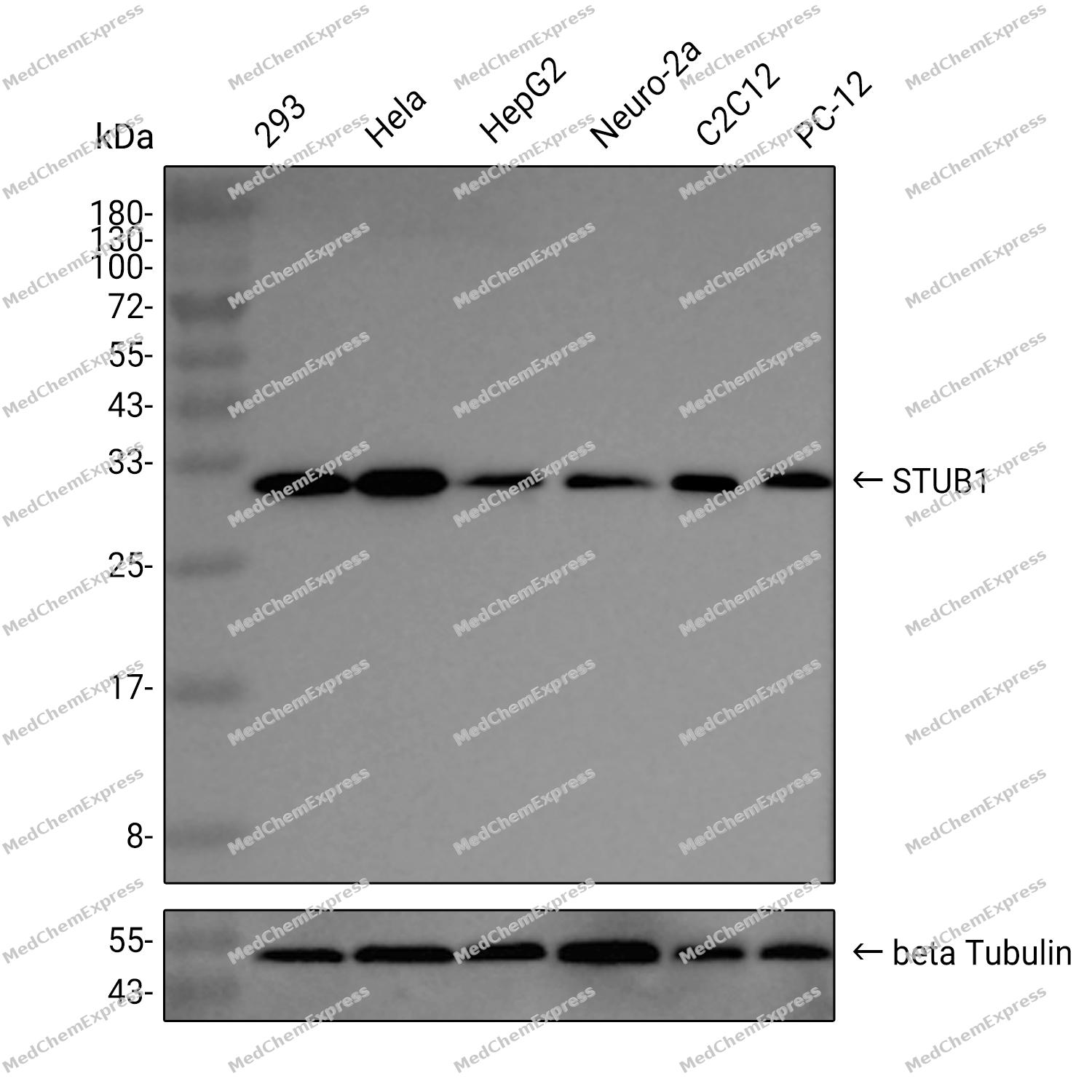
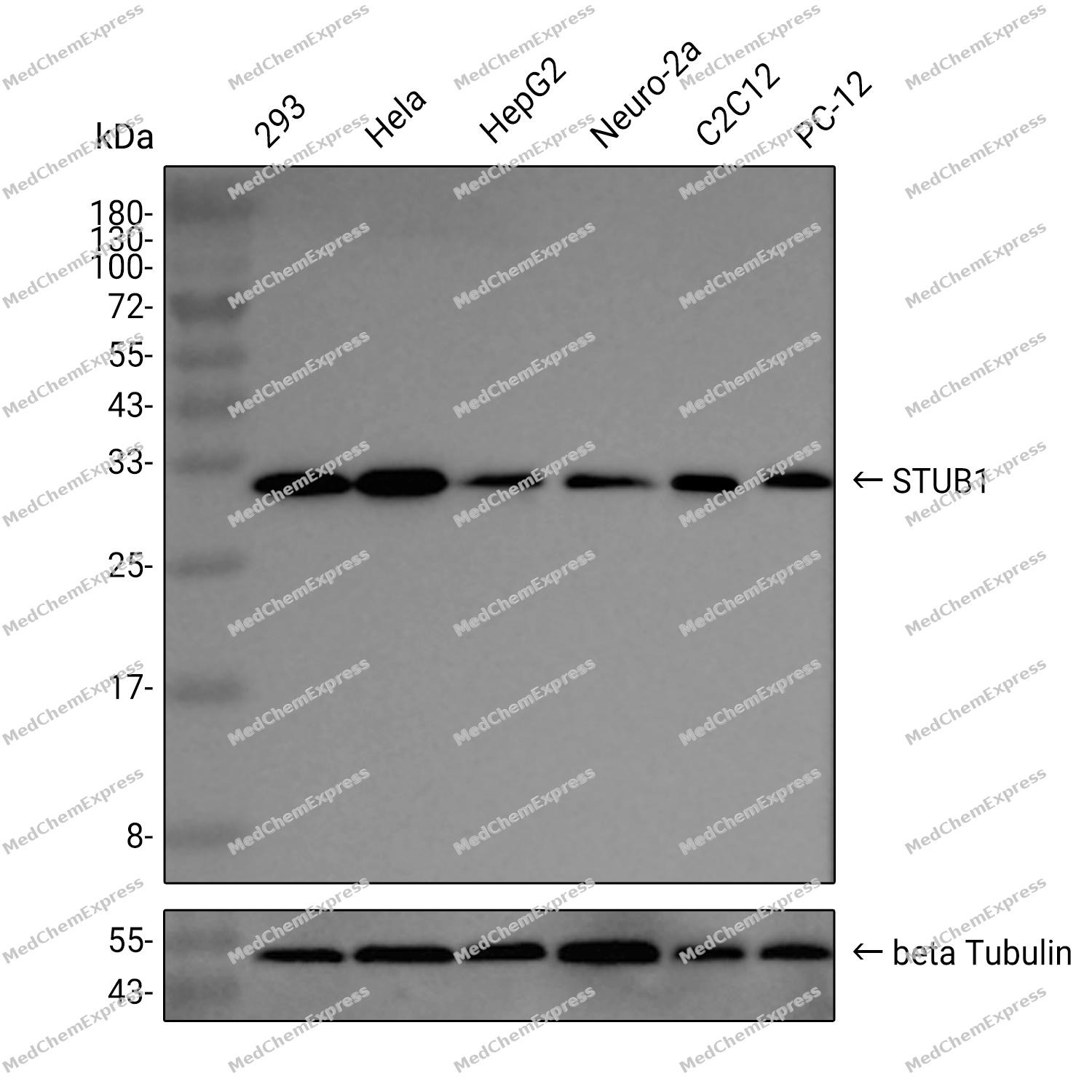 Western blot analysis was performed on extracts from 293 (lane 1, 15 μg), Hela (lane 2, 15 μg), HepG2 (lane 3, 15 μg), Neuro-2a (lane 4, 15 μg), C2C12 (lane 5, 15 μg), and PC-12 (lane 6, 15 μg) using STUB1 Rabbit mAb. Proteins were transferred to a PVDF membrane and blocked with 5% non - fat milk in TBST at 4°C overnight. The primary antibody (1:1000 dilution) and the loading control antibody (beta-Tubulin(HRP), HY-P80955A, 1:5000 dilution) was incubated in 5% non-fat milk in TBST for 1 hour at 37°C. Goat Anti - Rabbit IgG - HRP Secondary Antibody (1:20000 dilution) was then applied for 40 minutes at 37°C.
 -
 Immunocytochemistry analysis of MCF-7 cells labeling STUB1 with STUB1 Antibody (HY-P82351) at 1/100 dilution. Cells were fixed in 4% paraformaldehyde for 15 minutes at room temperature, permeabilized with 0.1% Triton X-100 in PBS for 15 minutes at room temperature, then blocked with quick block buffer for 10 minutes at room temperature. Cells were then incubated with STUB1 Antibody (HY-P82351) at 1/100 dilution in quick block buffer overnight at 4 ℃. AF488-conjugated Goat Anti-Rabbit IgG H&L (HY-P8002, Green) was used as the secondary antibody at 1/1,000 dilution. PBS instead of the primary antibody was used as the secondary antibody only control. The Nuclear counterstain was DAPI (Blue).
 -
 Immunocytochemistry analysis of MCF-7 cells labeling STUB1 with STUB1 Antibody (HY-P82351) at 1/200 dilution. Cells were fixed in 4% paraformaldehyde for 15 minutes at room temperature, permeabilized with 0.1% Triton X-100 in PBS for 15 minutes at room temperature, then blocked with quick block buffer for 10 minutes at room temperature. Cells were then incubated with STUB1 Antibody (HY-P82351) at 1/200 dilution in quick block buffer overnight at 4 ℃. AF488-conjugated Goat Anti-Rabbit IgG H&L (HY-P8002, Green) was used as the secondary antibody at 1/1,000 dilution. PBS instead of the primary antibody was used as the secondary antibody only control. The Nuclear counterstain was DAPI (Blue).


Background
-
Function
STUB1 is an E3 ubiquitin-protein ligase which targets misfolded chaperone substrates towards proteasomal degradation. Plays a role in the maintenance of mitochondrial morphology and promotes mitophagic removal of dysfunctional mitochondria; thereby acts as a protector against apoptosis in response to cellular stress. Negatively regulates vascular smooth muscle contraction, via degradation of the transcriptional activator MYOCD and subsequent loss of transcription of genes involved in vascular smooth muscle contraction. Promotes survival and proliferation of cardiac smooth muscle cells via ubiquitination and degradation of FOXO1, resulting in subsequent repression of FOXO1-mediated transcription of pro-apoptotic genes. Ubiquitinates ICER-type isoforms of CREM and targets them for proteasomal degradation, thereby acts as a positive effector of MAPK/ERK-mediated inhibition of apoptosis in cardiomyocytes. Inhibits lipopolysaccharide-induced apoptosis and hypertrophy in cardiomyocytes, via ubiquitination and subsequent proteasomal degradation of NFATC3. Collaborates with ATXN3 in the degradation of misfolded chaperone substrates: ATXN3 restricting the length of ubiquitin chain attached to STUB1/CHIP substrates and preventing further chain extension. Ubiquitinates NOS1 in concert with Hsp70 and Hsp40. Modulates the activity of several chaperone complexes, including Hsp70, Hsc70 and Hsp90. Ubiquitinates CHRNA3 targeting it for endoplasmic reticulum-associated degradation in cortical neurons, as part of the STUB1-VCP-UBXN2A complex. Ubiquitinates and promotes ESR1 proteasomal degradation in response to age-related circulating estradiol (17-beta-estradiol/E2) decline, thereby promotes neuronal apoptosis in response to ischemic reperfusion injury. Mediates transfer of non-canonical short ubiquitin chains to HSPA8 that have no effect on HSPA8 degradation. Mediates polyubiquitination of DNA polymerase beta (POLB) at 'Lys-41', 'Lys-61' and 'Lys-81', thereby playing a role in base-excision repair: catalyzes polyubiquitination by amplifying the HUWE1/ARF-BP1-dependent monoubiquitination and leading to POLB-degradation by the proteasome. Mediates polyubiquitination of CYP3A4. Ubiquitinates EPHA2 and may regulate the receptor stability and activity through proteasomal degradation. Acts as a co-chaperone for HSPA1A and HSPA1B chaperone proteins and promotes ubiquitin-mediated protein degradation. Negatively regulates the suppressive function of regulatory T-cells (Treg) during inflammation by mediating the ubiquitination and degradation of FOXP3 in a HSPA1A/B-dependent manner. Catalyzes monoubiquitination of SIRT6, preventing its degradation by the proteasome. Likely mediates polyubiquitination and down-regulates plasma membrane expression of PD-L1/CD274, an immune inhibitory ligand critical for immune tolerance to self and antitumor immunity. Negatively regulates TGF-beta signaling by modulating the basal level of SMAD3 via ubiquitin-mediated degradation. Plays a role in the degradation of TP53. Mediates ubiquitination of RIPK3 leading to its subsequent proteasome-dependent degradation. May regulate myosin assembly in striated muscles together with UBE4B and VCP/p97 by targeting myosin chaperone UNC45B for proteasomal degradation. Ubiquitinates PPARG in macrophages playing a role in M2 macrophages polarization and angiogenesis[1][2][3][4][5][6][7][8][9][10][11][12][13][14][15][16][17][18][19][20].
-
Subcellular Localization
Cytoplasm; Nucleus; Mitochondrion
-
Expression
Tissue_specificity:Expressed in differentiated myotubes (at protein level) (PubMed:17369820) . Highly expressed in skeletal muscle, heart, pancreas, brain and placenta (PubMed:10330192, PubMed:11435423) . Detected in kidney, liver and lung (PubMed:10330192, PubMed:11435423)
Induction:Up-regulated by inflammatory signals in regulatory T-cells (Treg) -
Isoforms & Post-Translational Modification
Q9UNE7 has 2 isomers: Q9UNE7-1: 34856 Da (predicted); Q9UNE7-2: 27067 Da (predicted).
Monoubiquitinated at Lys-2 following cell stress by UBE2W, promoting the interaction with ATXN3 (By similarity). Auto-ubiquitinated; mediated by UBE2D1 and UBE2D2 and enhanced in the presence of MAP2K5 (PubMed:20724525) -
Subunit
Homodimer (By similarity). Interacts with BAG2 (PubMed:16169850). Interacts with E2 ubiquitin conjugating enzymes UBE2D1, UBE2D2 and UBE2D3 (PubMed:11557750). Detected in a ternary complex containing STUB1, HSPA1A and HSPBP1 (PubMed:15215316). Part of a complex composed of STUB1/CHIP, VCP/p97, CHRNA3, and UBXN2A that modulates the ubiquitination and endoplasmic reticulum-associated degradation (ERAD) of CHRNA3 (PubMed:26265139). Within the complex UBXN2A acts as a scaffold protein required for the interaction of CHRNA3 with VCP/p97, this interaction also inhibits CHRNA3 ubiquitination by STUB1/CHIP and subsequently ERAD (PubMed:26265139). Interacts with MKKS (PubMed:18094050). Interacts with DNAAF4 (PubMed:19423554). Interacts (when monoubiquitinated) with ATXN3. Interacts with UBE2W. Interacts (via the U-box domain) with the UBE2V2-UBE2N heterodimer; the complex has a specific 'Lys-63'-linked polyubiquitination activity (By similarity). Interacts with DNAJB6 (PubMed:22366786). Interacts with FLCN (PubMed:27353360). Interacts with HSP90AA1 (PubMed:24613385, PubMed:27353360). Interacts with HSP90 (PubMed:11146632). Interacts with UBE2N and UBE2V1 (PubMed:16307917). Interacts (via TPR repeats) with HSPA8 (via C-terminus) (PubMed:10330192, PubMed:11557750, PubMed:23990462, PubMed:27708256). Interacts (via TPR repeats) with HSPA1A (via C-terminus) (PubMed:10330192). Interacts with the non-acetylated form of HSPA1A and HSPA1B (PubMed:27708256). Interacts with SMAD3 and HSP90AB1 (PubMed:24613385). Interacts with UBE4B (PubMed:17369820). Interacts with PRMT5 (PubMed:33376131). Interacts with MYOCD (via C-terminus) (By similarity). Interacts with FOXO1 (when phosphorylated on 'Ser-256') (PubMed:19483080). Interacts with MAPK7/ERK5; the interaction is enhanced in the presence of IGF1 or MAP2K5 and promotes STUB1/CHIP E3 ligase activity (PubMed:20724525). Interacts with and ubiquitinates ESR1; the interaction is promoted in the absence of estradiol (17-beta-estradiol/E2) (By similarity). Interacts with ESR2 (By similarity). Interacts with and ubiquitinates NFATC3; HSPA1A/HSP70 is required as a co-chaperone (PubMed:30980393). In macrophages, interacts with PAQR3; the interaction promotes PPARG poylubiquitination and STUB1-mediated degradation (By similarity). Component of the chaperone-assisted selective autophagy (CASA) complex consisting of BAG3, HSPA8/HSC70, HSPB8 and STUB1/CHIP (PubMed:20060297)
-
SwissProt ID
-
Synonyms
STUB1; CHIP; HSPABP2; NY-CO-7; SDCCAG7; UBOX1
-
Research Field
Signal Transduction


Documentation
-
Data Sheet (258 KB)
-
SDS (251 KB)
- English - EN (251 KB)
- Français - FR (251 KB)
- Deutsch - DE (251 KB)
- Norwegian - NO (251 KB)
- Español - ES (251 KB)
- Swedish - SV (251 KB)
- Italian - IT (251 KB)
- Korean - KR (251 KB)
- Portuguese - PT (251 KB)
-
User Guide for Antibodies (1077 KB)

 Powered by Bioz
