



TAB3 Antibody (YA2401)
(Synonyms: MAP3K7IP 3; NAP1; NFkB activating protein 1; Tab3; TAK1 binding protein 3)
Based on 1 Customer Validation
TAB3 Antibody (YA2401) is a Rabbit-derived and non-conjugated IgG monoclonal antibody, targeting to TAB3.
-
Host:
Rabbit
-
Isotype:
IgG
-
Application:
WB, ICC/IF
-
Reactivity :
Human, Mouse
-
Formulation:
Supplied in 50mM Tris-Glycine(pH 7.4), 0.15M NaCl, 40%Glycerol, 0.01% sodium azide and 0.05% BSA.
-
Conjugation:
Non-conjugated


To place orders, for customer services and technical support, please contact: MedChemExpress USA
Tel: 609-228-6898 E-mail: [email protected] [email protected]





Applications
| Application |
WB

WB: Western Blot
|
ICC/IF
ICC/IF: Immunocytochemistry/
Immunofluorescence |
|---|---|---|
| Dilution Ratio | 1:500-1:1000 | 1:50-1:200 |


Product Details
TAB3 Antibody (YA2401) is a Rabbit-derived and non-conjugated IgG monoclonal antibody, targeting to TAB3.
-
Host Rabbit

-
Clonality Recombinant,Monoclonal

-
Species ReactivityHuman, Mouse
-
Observed Molecular WeightObserved band size: 90 kDa
Note: Due to possible protein modifications or aggregation, the molecular weight should be confirmed by actual measurement, and the predicted value is for reference only.

-
Calculated Molecular Weight Predicted band size: 79 kDa

Entrez Gene: 257397 Human ; 66724 Mouse ;
SwissProt: Q8N5C8 Human ; Q571K4 Mouse ;
OMIM: 300480 Human
A synthesized peptide derived from human TAB3 aa50-94.
Endogenous
Affinity Purified
Non-conjugated
Unmodified
IgG


Product Properties
-
Appearance
Liquid
-
Formulation
Supplied in 50mM Tris-Glycine(pH 7.4), 0.15M NaCl, 40%Glycerol, 0.01% sodium azide and 0.05% BSA.
-
Concentration
Batch-dependent, Please check the COA for the concentration of each lot. Check Lot Concentration
-
Storage & Stability
Stored at -20°C for 1 year. Avoid repeated freeze / thaw cycles.
-
Shipping
Shipping with blue ice.


Verification Images
-
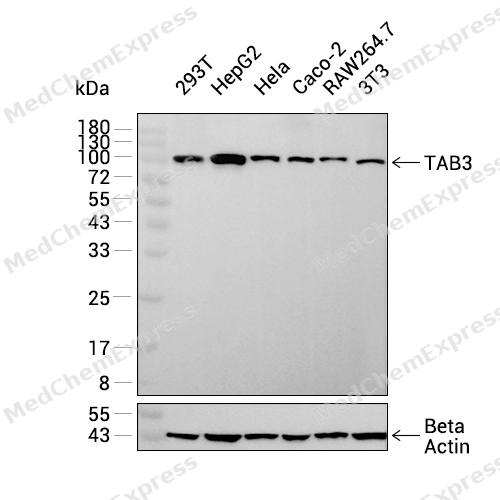
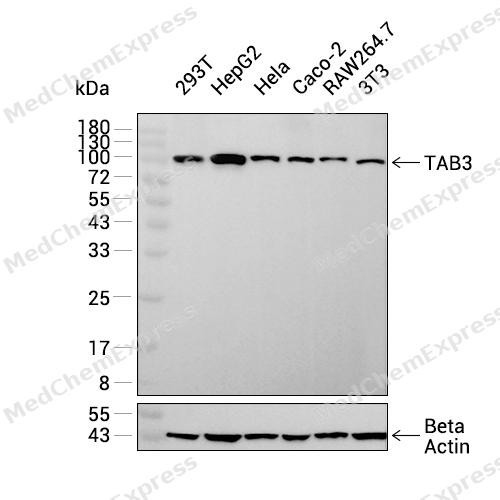 Western blot analysis was performed on extracts from 293T (lane 1, 15 μg), HepG2 (lane 2, 15 μg), Hela (lane 3, 15 μg), Caco-2 (lane 4, 15 μg), RAW264.7 (lane 5, 15 μg) , and 3T3 (lane 6, 15 μg) using TAB3 Rabbit mAb.Proteins were transferred to a PVDF membrane and blocked with 5% non-fat milk in TBST at 4°C overnight.The primary antibody (1:1000 dilution) and the loading control antibody (beta-Actin, HY-P83730, 1:20000 dilution) were incubated in 5% non-fat milk in TBST for 1 hour at 37°C.Goat Anti-Rabbit IgG-HRP Secondary Antibody (1:20000 dilution) was then applied for 40 minutes at 37°C.
 -
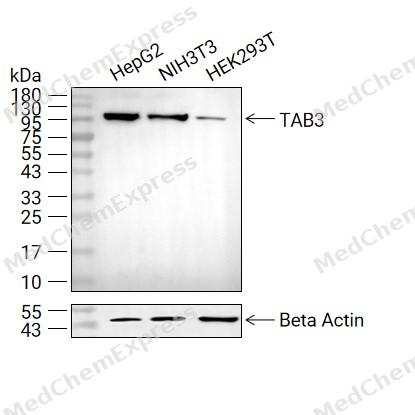 Western blot analysis of extracts from HepG2 (lane 2(20μg), NIH3T3 (lane 3(20μg), HEK293T (lane 4(20μg) using TAB3 (HY-P82656) Rabbit mAb. Proteins were transferred to a PVDF membrane and blocked with 5% non-fat milk in TBST for 2 hour at room temperature. The primary antibody (1/1000) and Loading control antibody (Beta Actin, HY-P80438, 1/10000) was used in 5% non-fat milk in TBST at 4°C overnight. Goat Anti-Rabbit IgG-HRP Secondary Antibody (1/10000) was used for 1 hour at room temperature.
 -
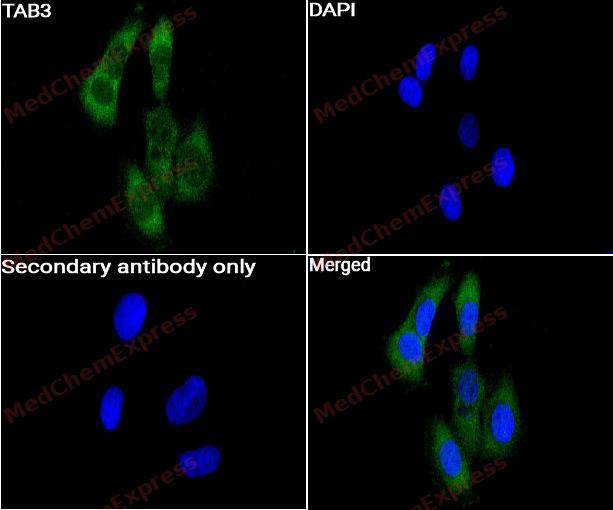 Immunocytochemistry analysis of HepG2 cells labeling TAB3 with TAB3 antibody (HY-P82656) at 1/50 dilution. Cells were fixed in 4% paraformaldehyde for 15 minutes at room temperature, permeabilized with 0.1% Triton X-100 for 10 minutes at room temperature, then blocked with BSA for Immunol Staining for 10 min at room temperature. Cells were then incubated with TAB3 antibody (HY-P82656) at 1/50 dilution in BSA for Immunol Staining at 4 ℃, Stay overnight. AF488-conjugated AffiniPure Goat Anti-Rabbit IgG H&L(HY-P8002, Green) was used as the secondary antibody at 1/1,000 dilution. PBS instead of the primary antibody was used as the secondary antibody only control. The Nuclear counterstain was DAPI (Blue).
 -
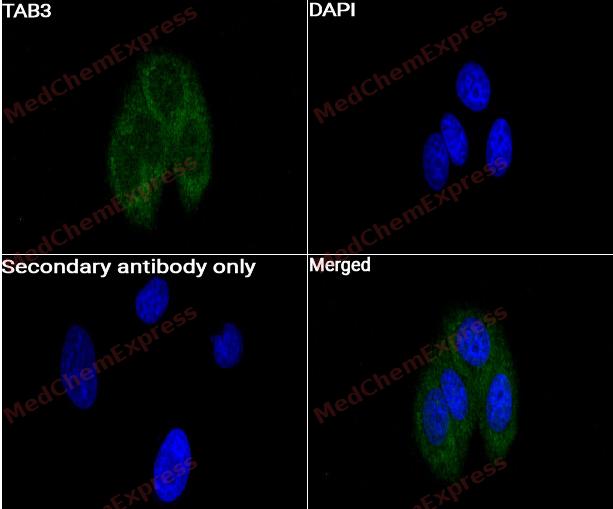 Immunocytochemistry analysis of HepG2 cells labeling TAB3 with TAB3 antibody (HY-P82656) at 1/100 dilution. Cells were fixed in 4% paraformaldehyde for 15 minutes at room temperature, permeabilized with 0.1% Triton X-100 for 10 minutes at room temperature, then blocked with BSA for Immunol Staining for 10 min at room temperature. Cells were then incubated with TAB3 antibody (HY-P82656) at 1/100 dilution in BSA for Immunol Staining at 4℃, Stay overnight. AF488-conjugated AffiniPure Goat Anti-Rabbit IgG H&L(HY-P8002, Green) was used as the secondary antibody at 1/1,000 dilution. PBS instead of the primary antibody was used as the secondary antibody only control. The Nuclear counterstain was DAPI (Blue).


Background
-
Function
TAB3 is an Adapter required to activate the JNK and NF-kappa-B signaling pathways through the specific recognition of 'Lys-63'-linked polyubiquitin chains by its RanBP2-type zinc finger (NZF). Acts as an adapter linking MAP3K7/TAK1 and TRAF6 to 'Lys-63'-linked polyubiquitin chains. The RanBP2-type zinc finger (NZF) specifically recognizes Lys-63'-linked polyubiquitin chains unanchored or anchored to the substrate proteins such as RIPK1/RIP1 and RIPK2: this acts as a scaffold to organize a large signaling complex to promote autophosphorylation of MAP3K7/TAK1, and subsequent activation of I-kappa-B-kinase (IKK) core complex by MAP3K7/TAK1; May be an oncogenic factor[1][2][3][4][5][6].
-
Expression
Tissue_specificity:Widely expressed. Constitutively overexpressed in certain tumor tissues; Major transcript; Minor transcript -
Isoforms & Post-Translational Modification
Q8N5C8 has 2 isomers: Q8N5C8-1: 78653 Da (predicted); Q8N5C8-2: 75569 Da (predicted).
Ubiquitinated; following IL1 stimulation or TRAF6 overexpression (PubMed:14633987). Ubiquitinated by AMFR via 'Lys-27'-linked polyubiquitination; leading to TAK1/MAP3K7 activation (PubMed:36593296);Degraded in a lysosome-dependent manner following interaction with TRIM38;Phosphorylated at Ser-506 by MAPKAPK2 and MAPKAPK3 following IL1 treatment;(Microbial infection) Methylated at Cys-692 by enteropathogenic E.coli protein NleE or S.flexneri protein OspZ: methylation disrupts zinc-binding and ability to bind 'Lys-63'-linked ubiquitin, leading to NF-kappa-B inactivation -
Subunit
Interacts with TAB1, TAB2, MAP3K7, TRAF2 and TRAF6 (PubMed:14633987, PubMed:14670075, PubMed:14766965). The minimal TAB3-containing complex (TAB1-MAP3K7-TAB3) appears not to contain TAB2 (PubMed:14670075). However, it seems sensible to consider that TAB2 may also join this complex and may act in a cooperative manner with TAB3 (PubMed:14670075). Interacts with DYNC2I2 (via the WD domains) (PubMed:19521662). Interacts with RBCK1 (PubMed:17449468). Binds 'Lys-63'-linked polyubiquitin chains (PubMed:22158122). Interacts with TRIM5 (PubMed:21512573). Interacts with TRIM38 (via B30.2/SPRY domain), leading to its translocation to lysosomes and degradation (PubMed:24434549). Interacts with ASB1 (PubMed:33431678)
-
SwissProt ID
-
Synonyms
MAP3K7IP 3; NAP1; NFkB activating protein 1; Tab3; TAK1 binding protein 3
-
Research Field
-


Documentation
-
Data Sheet (258 KB)
-
SDS (251 KB)
- English - EN (251 KB)
- Français - FR (251 KB)
- Deutsch - DE (251 KB)
- Norwegian - NO (251 KB)
- Español - ES (251 KB)
- Swedish - SV (251 KB)
- Italian - IT (251 KB)
- Korean - KR (251 KB)
- Portuguese - PT (251 KB)
-
User Guide for Antibodies (1077 KB)

 Powered by Bioz
