



USP22 Antibody (YA1334)
(Synonyms: Ubiquitin carboxyl terminal hydrolase 22; Usp22; USP3L)
Based on 1 Customer Validation
USP22 Antibody (YA1334) is a Rabbit-derived and non-conjugated IgG monoclonal antibody, targeting to USP22.
-
Host:
Rabbit
-
Isotype:
IgG
-
Application:
WB, ICC/IF, IP, FC
-
Reactivity :
Human
-
Formulation:
Supplied in rabbit IgG in phosphate buffered saline , pH 7.4, 150mM NaCl, 0.02% sodium azide and 50% glycerol.
-
Conjugation:
Non-conjugated


To place orders, for customer services and technical support, please contact: MedChemExpress USA
Tel: 609-228-6898 E-mail: [email protected] [email protected]





Applications
| Application |
WB

WB: Western Blot
|
ICC/IF
ICC/IF: Immunocytochemistry/
Immunofluorescence |
IP
IP: Immunoprecipitation
|
FC
FC: Flow Cytometry
|
|---|---|---|---|---|
| Dilution Ratio | 1:500-1:1000 | 1:50-1:200 | 1:50 | 1:50-1:100 |


Product Details
USP22 Antibody (YA1334) is a Rabbit-derived and non-conjugated IgG monoclonal antibody, targeting to USP22.
-
Host Rabbit

-
Clonality Recombinant,Monoclonal

-
Species ReactivityHuman
-
Observed Molecular WeightObserved band size: 60 kDa
Note: Due to possible protein modifications or aggregation, the molecular weight should be confirmed by actual measurement, and the predicted value is for reference only.

-
Calculated Molecular Weight Predicted band size: 60 kDa

A synthesized peptide derived from human USP22 aa310-374.
Endogenous
Affinity Chromatography
Non-conjugated
Unmodified
IgG


Product Properties
-
Appearance
Liquid
-
Formulation
Supplied in rabbit IgG in phosphate buffered saline , pH 7.4, 150mM NaCl, 0.02% sodium azide and 50% glycerol.
-
Concentration
Batch-dependent, Please check the COA for the concentration of each lot. Check Lot Concentration
-
Storage & Stability
Stored at -20°C for 1 year. Avoid repeated freeze / thaw cycles.
-
Shipping
Shipping with blue ice.


Verification Images
-
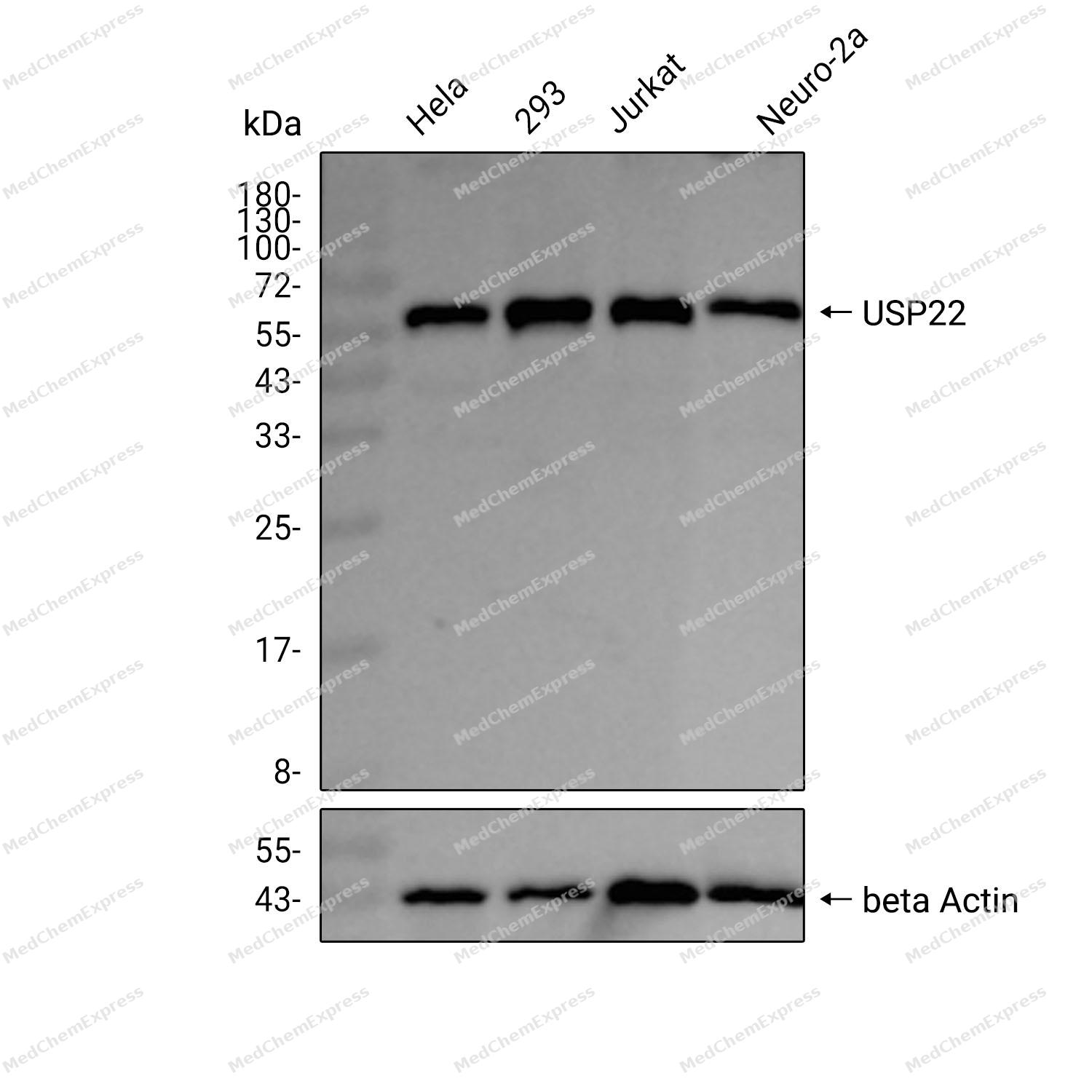 Western blot analysis was performed on extracts from Hela (lane 1, 15 μg), 293 (lane 2, 15 μg), Jurkat (lane 3, 15 μg), and Neuro-2a (lane 4, 15 μg) using USP22 Rabbit mAb.Proteins were transferred to a PVDF membrane and blocked with 5% non-fat milk in TBST at 4°C overnight.The primary antibody (1:1000 dilution) and the loading control antibody (beta-Actin, HY-P80438, 1:20000 dilution) were incubated in 5% non-fat milk in TBST for 1 hour at 37°C.Goat Anti-Rabbit IgG-HRP Secondary Antibody (1:20000 dilution) was then applied for 40 minutes at 37°C.


Background
-
Function
USP22 is a Deubiquitinase that plays a role in several cellular processes including transcriptional regulation, cell cycle progression or innate immunity. As part of the transcription regulatory histone acetylation (HAT) complex SAGA, catalyzes the deubiquitination of both histones H2A and H2B, thereby acting as a transcriptional coactivator. Recruited to specific gene promoters by activators such as MYC, where it is required for transcription. Facilitates cell-cycle progression by stabilizing CCNB1 and antagonizing its proteasome-mediated degradation in a cell cycle-specific manner. Modulates cell cycle progression and apoptosis also by antagonizing TP53 transcriptional activation through deacetylase SIRT1 stabilization. Plays multiple roles in immunity and inflammation. Participates in antiviral response by deubiquitinating the importin KPNA2, leading to IRF3 nuclear translocation and subsequent type I interferon production. Acts as a central regulator of type III IFN signaling by negatively regulating STING1 activation and ubiquitination. Inhibits NLRP3 inflammasome activation by promoting NLRP3 degradation through ATG5-dependent autophagy. Deubiquitinates CD274 to induce its stabilization and thereby participates in maintenance of immune tolerance to self. Controls necroptotic cell death by regulating RIPK3 phosphorylation and ubiquitination. During bacterial infection, promotes pro-inflammatory response by targeting TRAF6 and removing its 'Lys-48'-linked polyubiquitination[1][2][3][4][5][6][7][8][9].
-
Subcellular Localization
Nucleus; Cytoplasm
-
Expression
Tissue_specificity:Moderately expressed in various tissues including heart and skeletal muscle, and weakly expressed in lung and liver -
Isoforms & Post-Translational Modification
Q9UPT9 has 2 isomers: Q9UPT9-1: 59961 Da (predicted); Q9UPT9-2: 58179 Da (predicted).
Phosphorylated in G2/M phase, but not in G1 phase by CDK1;Ubiquitinated and subsequently degraded in a CDC20-dependent manner -
Subunit
Component of some SAGA transcription coactivator-HAT complexes, at least composed of ATXN7, ATXN7L3, ENY2, GCN5L2, SUPT3H, TAF10, TRRAP and USP22.
-
SwissProt ID
-
Synonyms
Ubiquitin carboxyl terminal hydrolase 22; Usp22; USP3L
-
Research Field
Epigenetics and Nuclear Signaling


Documentation
-
Data Sheet (234 KB)
-
SDS (251 KB)
- English - EN (251 KB)
- Français - FR (251 KB)
- Deutsch - DE (251 KB)
- Norwegian - NO (251 KB)
- Español - ES (251 KB)
- Swedish - SV (251 KB)
- Italian - IT (251 KB)
- Korean - KR (251 KB)
- Portuguese - PT (251 KB)
-
User Guide for Antibodies (1077 KB)

 Powered by Bioz
