



Wnt16 Antibody (YA2421)
(Synonyms: WNT16; Protein Wnt-16)
Based on 1 Customer Validation
Wnt16 Antibody (YA2421) is a Rabbit-derived and non-conjugated IgG monoclonal antibody, targeting to Wnt16.
-
Host:
Rabbit
-
Isotype:
IgG
-
Application:
WB, IP
-
Reactivity :
Human, Mouse, Rat
-
Formulation:
Supplied in 50mM Tris-Glycine(pH 7.4), 0.15M NaCl, 40% Glycerol, 0.01% Sodium azide and 0.05% BSA
-
Conjugation:
Non-conjugated


To place orders, for customer services and technical support, please contact: MedChemExpress USA
Tel: 609-228-6898 E-mail: [email protected] [email protected]





Applications
| Application |
WB

WB: Western Blot
|
IP
IP: Immunoprecipitation
|
|---|---|---|
| Dilution Ratio | 1:500-1:1000 | 1:20 |


Product Details
Wnt16 Antibody (YA2421) is a Rabbit-derived and non-conjugated IgG monoclonal antibody, targeting to Wnt16.
-
Host Rabbit

-
Clonality Recombinant,Monoclonal

-
Species ReactivityHuman, Mouse, Rat
-
Observed Molecular WeightObserved band size: 41 kDa
Note: Due to possible protein modifications or aggregation, the molecular weight should be confirmed by actual measurement, and the predicted value is for reference only.

-
Calculated Molecular Weight Predicted band size: 41 kDa

Entrez Gene: 51384 Human ; 93735 Mouse ; 500047 Rat
SwissProt: Q9UBV4 Human ; Q9QYS1 Mouse ;
OMIM: 606267 Human
A synthetic peptide of human Wnt16 aa60-74.
Endogenous
Affinity Purified
Non-conjugated
Unmodified
IgG


Product Properties
-
Appearance
Solution
-
Formulation
Supplied in 50mM Tris-Glycine(pH 7.4), 0.15M NaCl, 40% Glycerol, 0.01% Sodium azide and 0.05% BSA
-
Concentration
Batch-dependent, Please check the COA for the concentration of each lot. Check Lot Concentration
-
Storage & Stability
Stored at -20°C for 1 year. Avoid repeated freeze / thaw cycles.
-
Shipping
Shipping with blue ice.


Verification Images
-
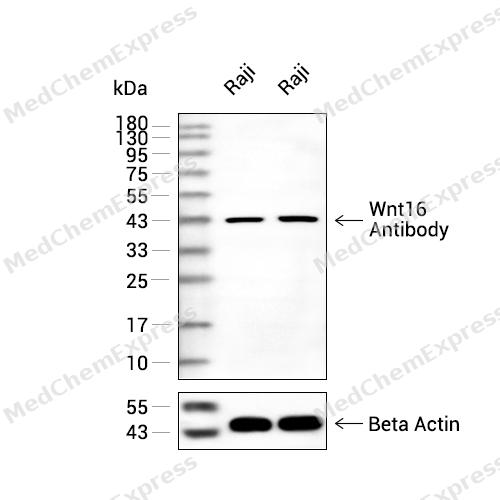 Western blot analysis of extracts from Raji(lane 2(20ug) and Raji(lane 3(40ug) using Wnt16 Antibody (HY-P82676) Rabbit mAb. Proteins were transferred to a PVDF membrane and blocked with 5% non-fat milk in TBST for 2 hour at room temperature. The primary antibody (1/1000) and Loading control antibody (Beta Actin, HY-P80438, 1/10000) was used in 5% non-fat milk in TBST at 4°C overnight. Goat Anti-Mouse/Rabbit IgG-HRP Secondary Antibody (1/10000) was used for 1 hour at room temperature.


Background
-
Function
Wnt16 encodes a secreted Wnt ligand, and Wnt ligands bind cell-surface receptors to activate canonical or non-canonical Wnt signaling pathways that regulate development, adult tissue homeostasis, and disease mechanisms[1]. In bone research, WNT16 is a physiological regulator of bone mass and fracture susceptibility, and glucocorticoid treatment decreases Wnt16 mRNA in bone while osteoblast-lineage WNT16 overexpression partly protects mice from glucocorticoid-induced bone loss[2]. Mechanistically, inflammatory oncostatin M robustly increases Wnt16 mRNA in mouse calvarial osteoblasts through gp130, OSMR, and SHC1/STAT3 signaling, and WNT16 limits oncostatin M-induced osteoclast formation as a negative feedback regulator[3]. Compared with related Wnt isoforms, WNT16A and WNT16B arise from alternative 5′ regions and first exons, with WNT16A expressed mainly in adult pancreas and WNT16B showing broader adult tissue expression[4]. In disease models, WNT16B marks cellular senescence, supports p53-dependent p21 activation, and regulates PI3K/AKT signaling[5]. For experimental applications, WNT16B promotes human limbal epithelial stem/progenitor cell proliferation and self-renewal through a non-canonical calcium/calcineurin A/NFATC2 pathway, supporting corneal epithelial repair models[6].
-
Subcellular Localization
Secreted, extracellular space, extracellular matrix
-
Expression
Tissue_specificity:Isoform Wnt-16b is expressed in peripheral lymphoid organs such as spleen, appendix, and lymph nodes, in kidney but not in bone marrow. Isoform Wnt-16a is expressed at significant levels only in the pancreas -
Isoforms & Post-Translational Modification
Q9UBV4 has 2 isomers: Q9UBV4-1: 40690 Da (predicted); Q9UBV4-2: 40447 Da (predicted).
Palmitoleoylation is required for efficient binding to frizzled receptors. Depalmitoleoylation leads to Wnt signaling pathway inhibition -
SwissProt ID
-
Synonyms
WNT16; Protein Wnt-16
-
Research Field
Stem Cells


Documentation
-
Data Sheet (262 KB)
-
SDS (251 KB)
- English - EN (251 KB)
- Français - FR (251 KB)
- Deutsch - DE (251 KB)
- Norwegian - NO (251 KB)
- Español - ES (251 KB)
- Swedish - SV (251 KB)
- Italian - IT (251 KB)
- Korean - KR (251 KB)
- Portuguese - PT (251 KB)
-
User Guide for Antibodies (1077 KB)
References
[1]. Hu L, et al. Wnt/β-catenin signaling components and mechanisms in bone formation, homeostasis, and disease. Bone Res. 2024 Jul 10;12(1):39. [Content Brief]
[2]. Ohlsson C, et al. WNT16 overexpression partly protects against glucocorticoid-induced bone loss. Am J Physiol Endocrinol Metab. 2018 Jun 1;314(6):E597-E604. [Content Brief]
[3]. Henning P, et al. WNT16 is Robustly Increased by Oncostatin M in Mouse Calvarial Osteoblasts and Acts as a Negative Feedback Regulator of Osteoclast Formation Induced by Oncostatin M. J Inflamm Res. 2021 Sep 18;14:4723-4741. [Content Brief]
[4]. Fear MW, et al. Wnt-16a, a novel Wnt-16 isoform, which shows differential expression in adult human tissues. Biochem Biophys Res Commun. 2000 Nov 30;278(3):814-20. [Content Brief]
[5]. Binet R, et al. WNT16B is a new marker of cellular senescence that regulates p53 activity and the phosphoinositide 3-kinase/AKT pathway. Cancer Res. 2009 Dec 15;69(24):9183-91. [Content Brief]
[6]. Wan X, et al. WNT16b promotes the proliferation and self-renewal of human limbal epithelial stem/progenitor cells via activating the calcium/calcineurin A/NFATC2 pathway. Cell Prolif. 2023 Oct;56(10):e13460. [Content Brief]

 Powered by Bioz
