



XIAP Antibody (YA2429)
(Synonyms: API3; ILP1; MIHA; XLP2; BIRC4; IAP-3; hIAP3; hIAP-3)
Based on 1 Customer Validation
XIAP Antibody (YA2429) is a Rabbit-derived and non-conjugated IgG monoclonal antibody, targeting to XIAP.
-
Host:
Rabbit
-
Isotype:
IgG
-
Application:
WB
-
Reactivity :
Human, Mouse, Rat
-
Formulation:
Supplied in 50mM Tris-Glycine(pH 7.4), 0.15M NaCl, 40% Glycerol, 0.01% Sodium azide and 0.05% BSA
-
Conjugation:
Non-conjugated


To place orders, for customer services and technical support, please contact: MedChemExpress USA
Tel: 609-228-6898 E-mail: [email protected] [email protected]





Applications
| Application |
WB

WB: Western Blot
|
|---|---|
| Dilution Ratio | 1:500-1:1000 |


Product Details
XIAP Antibody (YA2429) is a Rabbit-derived and non-conjugated IgG monoclonal antibody, targeting to XIAP.
-
Host Rabbit

-
Clonality Recombinant,Monoclonal

-
Species ReactivityHuman, Mouse, Rat
-
Observed Molecular WeightObserved band size: 53 kDa
Note: Due to possible protein modifications or aggregation, the molecular weight should be confirmed by actual measurement, and the predicted value is for reference only.

-
Calculated Molecular Weight Predicted band size: 56 kDa

Entrez Gene: 331 Human ; 11798 Mouse ; 63879 Rat
SwissProt: P98170 Human ; Q60989 Mouse ; Q9R0I6 Rat
OMIM: 300635 Human
Recombinant protein of mouse XIAP
Endogenous
Affinity Purified
Non-conjugated
Unmodified
IgG


Product Properties
-
Appearance
Solution
-
Formulation
Supplied in 50mM Tris-Glycine(pH 7.4), 0.15M NaCl, 40% Glycerol, 0.01% Sodium azide and 0.05% BSA
-
Concentration
Batch-dependent, Please check the COA for the concentration of each lot. Check Lot Concentration
-
Storage & Stability
Stored at -20°C for 1 year. Avoid repeated freeze / thaw cycles.
-
Shipping
Shipping with blue ice.


Verification Images
-
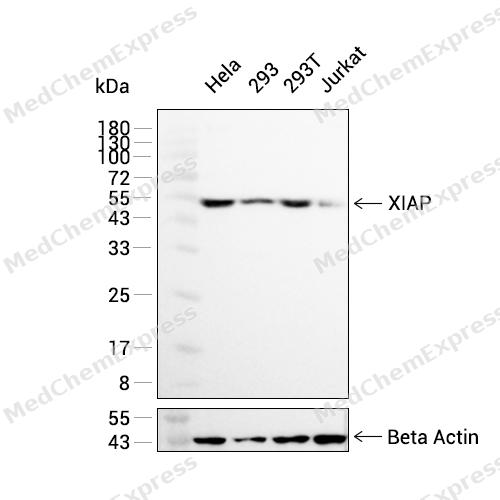 Western blot analysis of extracts from HeLa (lane 2(20μg)) , 293 (lane 3(20μg)), 293T (lane 4(20μg)) and Jurkat(lane 4(20μg)) using XIAP Rabbit mAb. Proteins were transferred to a PVDF membrane and blocked with 5% non-fat milk in TBST for 2 hour at room temperature. The primary antibody (1/1000) and Loading control antibody (beta Actin, HY-P83730, 1/5000) was used in 5% non-fat milk in TBST at 4°C overnight. Goat Anti-Rabbit/Mouse IgG-HRP Secondary Antibody (1/10000) was used for 1 hour at room temperature.


Background
-
Function
XIAP is a core inhibitor of apoptosis protein that directly restrains executioner caspase-3 and caspase-7 through BIR2-region mechanisms and inhibits initiator caspase-9 through BIR3 binding[1][2][3]. Mechanistically, its RING domain also supports E3 ubiquitin-ligase activity, linking XIAP biology to protein stability, apoptosis regulation, and non-apoptotic signaling contexts[4]. In innate immune signaling, XIAP ubiquitylates RIPK2 and recruits LUBAC after NOD2 stimulation, thereby enabling NF-κB activation and proinflammatory cytokine secretion[5]. In disease models and patient studies, XIAP deficiency associates with Crohn disease-like inflammatory bowel disease and defective NOD2 function in monocytes[6]. Compared with related cIAP1 and cIAP2 isoforms, XIAP has the clearest biochemical role as a direct caspase inhibitor, whereas cIAP1 and cIAP2 bind but do not efficiently inhibit caspases[7]. For experimental applications, selective XIAP antagonism can block NOD2-mediated inflammatory signaling by disrupting the XIAP-RIPK2 interaction, while broader IAP antagonists are used to test apoptosis sensitization mechanisms involving XIAP and cIAP proteins[8][9].- XIAP directly controls caspase-dependent apoptosis and connects apoptosis biology with inflammatory NOD2 signaling[1][5].- XIAP differs from cIAP1/cIAP2 because it directly inhibits caspase activity[7].- XIAP-RIPK2 antagonism provides a practical model for studying NOD2-driven inflammation[8].
-
Subcellular Localization
Cytoplasm; Nucleus
-
Expression
Tissue_specificity:Expressed in small intestine crypts (at protein level) (PubMed:30389919) . Expressed in bulge hair follicle stem cells, sebaceous glands and dermal papillae (at protein level) (PubMed:23788729) -
Subunit
Monomer, and homodimer. Interacts (via BIR3 domain) with DIABLO/SMAC; the interaction inhibits apoptotic suppressor activity (By similarity). Interacts with HTRA2/PRSS25; the interaction inhibits apoptotic suppressor activity. Interacts with TAB1/MAP3K7IP1 and AIFM1. Interaction with DIABLO/SMAC hinders binding of TAB1/MAP3K7IP1 and AIFM1. Interacts with TCF25 and COMMD1. Interacts (via BIR3 domain) with SEPTIN4 (PubMed:30389919). Interacts with RIP1, RIP2, RIP3, RIP4, CCS and USP19. Interacts (via BIR 2 domain and BIR 3 domain) with HAX1 (via C-terminus) and this interaction blocks ubiquitination of XIAP/BIRC4. Interacts with the monomeric form of BIRC5/survivin (By similarity). Interacts with TLE3 and TCF7L2/TCF4 (By similarity). Interacts (via BIR 3 and RING domains) with PDCL3 (By similarity)
-
SwissProt ID
-
Synonyms
API3; ILP1; MIHA; XLP2; BIRC4; IAP-3; hIAP3; hIAP-3
-
Research Field
Cell Biology


Documentation
-
Data Sheet (262 KB)
-
SDS (251 KB)
- English - EN (251 KB)
- Français - FR (251 KB)
- Deutsch - DE (251 KB)
- Norwegian - NO (251 KB)
- Español - ES (251 KB)
- Swedish - SV (251 KB)
- Italian - IT (251 KB)
- Korean - KR (251 KB)
- Portuguese - PT (251 KB)
-
User Guide for Antibodies (1077 KB)
References
[1]. Riedl SJ, et al. Structural basis for the inhibition of caspase-3 by XIAP. Cell. 2001 Mar 9;104(5):791-800. [Content Brief]
[2]. Chai J, et al. Structural basis of caspase-7 inhibition by XIAP. Cell. 2001 Mar 9;104(5):769-80. [Content Brief]
[3]. Shiozaki EN, et al. Mechanism of XIAP-mediated inhibition of caspase-9. Mol Cell. 2003 Feb;11(2):519-27. [Content Brief]
[4]. Galbán S, et al. XIAP as a ubiquitin ligase in cellular signaling. Cell Death Differ. 2010 Jan;17(1):54-60. [Content Brief]
[5]. Damgaard RB, et al. The ubiquitin ligase XIAP recruits LUBAC for NOD2 signaling in inflammation and innate immunity. Mol Cell. 2012 Jun 29;46(6):746-58. [Content Brief]
[6]. Aguilar C, et al. Characterization of Crohn disease in X-linked inhibitor of apoptosis-deficient male patients and female symptomatic carriers. J Allergy Clin Immunol. 2014 Nov;134(5):1131-41.e9. [Content Brief]
[7]. Eckelman BP, et al. The human anti-apoptotic proteins cIAP1 and cIAP2 bind but do not inhibit caspases. J Biol Chem. 2006 Feb 10;281(6):3254-60. [Content Brief]
[8]. Goncharov T, et al. Disruption of XIAP-RIP2 Association Blocks NOD2-Mediated Inflammatory Signaling. Mol Cell. 2018 Feb 15;69(4):551-565.e7. [Content Brief]
[9]. Ndubaku C, et al. Antagonism of c-IAP and XIAP proteins is required for efficient induction of cell death by small-molecule IAP antagonists. ACS Chem Biol. 2009 Jul 17;4(7):557-66. [Content Brief]

 Powered by Bioz
