



YB1 Antibody
(Synonyms: YBX1; NSEP1; YB1; Nuclease-sensitive element-binding protein 1; CCAAT-binding transcription factor I subunit A; CBF-A; DNA-binding protein B; DBPB; Enhancer factor I subunit A; EFI-A; Y-box transcription factor; Y-box-binding protein 1; YB-)Based on 1 publication(s) in Google Scholar
YB1 Antibody is a Rabbit-derived and non-conjugated IgG polyclonal antibody, targeting to YB1.
-
Host:
Rabbit
-
Isotype:
IgG
-
Application:
WB, IHC-P, ICC/IF, IP
-
Reactivity :
Human, Mouse, Rat
-
Formulation:
Supplied in 50mM Tris-Glycine(pH 7.4), 0.15M NaCl, 40%Glycerol, 0.01% sodium azide and 0.05% BSA or 10mM PBS, pH 7.4, 150mM sodium chloride, 0.05% BSA, 0.02% sodium azide and 50% glycerol.
-
Conjugation:
Non-conjugated


To place orders, for customer services and technical support, please contact: MedChemExpress USA
Tel: 609-228-6898 E-mail: [email protected] [email protected]



Publications Citing Use of MedChemExpress (MCE) YB1 Antibody
More

Applications
| Application |
WB

WB: Western Blot
|
IHC-P
IHC-P: Immunohistochemistry-Paraffin
|
ICC/IF
ICC/IF: Immunocytochemistry/
Immunofluorescence |
IP
IP: Immunoprecipitation
|
|---|---|---|---|---|
| Dilution Ratio | 1:500-1:1000 | 1:50-1:100 | 1:50-1:200 | 1:20 |


Product Details
YB1 Antibody is a Rabbit-derived and non-conjugated IgG polyclonal antibody, targeting to YB1.
-
Host Rabbit

-
Clonality Polyclonal

-
Species ReactivityHuman, Mouse, Rat
-
Observed Molecular WeightObserved band size: 50 kDa
Note: Due to possible protein modifications or aggregation, the molecular weight should be confirmed by actual measurement, and the predicted value is for reference only.

-
Calculated Molecular Weight Predicted band size: 36 kDa

Entrez Gene: 4904 Human ; 22608 Mouse ; 500538 Rat
SwissProt: P67809 Human ; P62960 Mouse ; P62961 Rat
OMIM: 154030 Human
Synthetic peptide corresponding to Human YB1 aa288-301.
Endogenous
affinity purified
Non-conjugated
Unmodified
IgG


Product Properties
-
Appearance
Solution
-
Formulation
Supplied in 50mM Tris-Glycine(pH 7.4), 0.15M NaCl, 40%Glycerol, 0.01% sodium azide and 0.05% BSA or 10mM PBS, pH 7.4, 150mM sodium chloride, 0.05% BSA, 0.02% sodium azide and 50% glycerol.
-
Concentration
Batch-dependent, Please check the COA for the concentration of each lot. Check Lot Concentration
-
Storage & Stability
Stored at -20°C for 1 year. Avoid repeated freeze / thaw cycles.
-
Shipping
Shipping with blue ice.


Publications (1)
-
Journal Impact Factor
-
Most Recent
-
Free Radic Biol Med
LINC01116 promotes glycolysis by up-regulating HIF-1α via YBX1-mediated dual mechanism in lung cancer. [Abstract]2026 May:248:320-332. PMID: 41740687


Verification Images
-
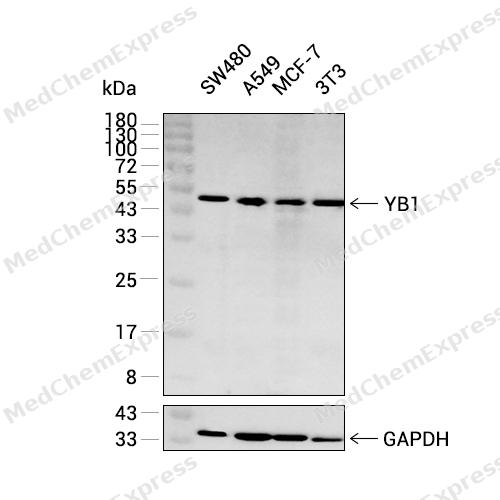 Western blot analysis was performed on extracts from SW480 (lane 1, 15 μg), A549 (lane 2, 15 μg), MCF-7 (lane 3, 15 μg), and 3T3 (lane 4, 15 μg) using YB1 Rabbit pAb.Proteins were transferred to a PVDF membrane and blocked with 5% non-fat milk in TBST at 4°C overnight.The primary antibody (1:1000 dilution) and the loading control antibody (GAPDH, HY-P80137, 1:80000 dilution) were incubated in 5% non-fat milk in TBST for 1 hour at 37°C.Goat Anti-Rabbit IgG-HRP Secondary Antibody (1:20000 dilution) was then applied for 40 minutes at 37°C.
 -
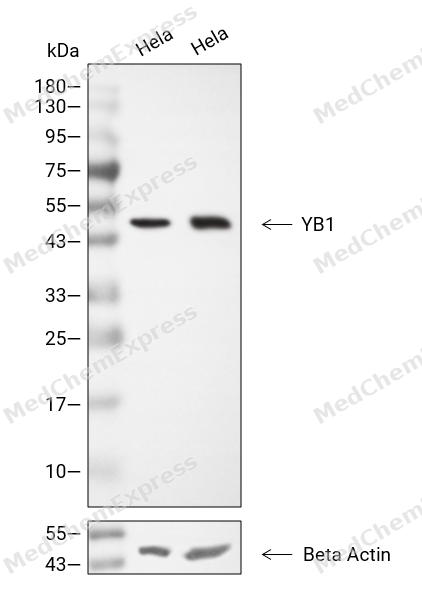 Western blot analysis of extracts from Hela (lane 2(20μg), Hela (lane 3(40μg), using YB1 Antibody. Proteins were transferred to a PVDF membrane and blocked with 5% BSA in TBST for 2 hour at room temperature. The primary antibody and Loading control antibody (Beta Actin, HY-P80438, 1/3000) was used in 5% BSA in TBST at 4°C overnight. Goat Anti-Mouse/Rabbit IgG-HRP Secondary Antibody (HY-P8004/HY-P8001, 1/10,000) was used for 1 hour at room temperature.
 -
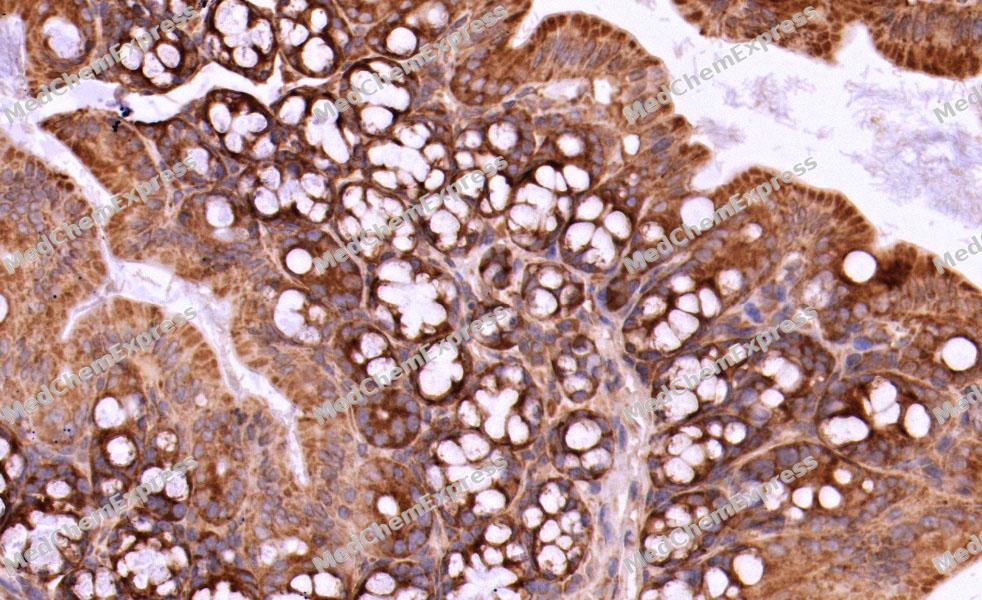 Immunohistochemical analysis of paraffin-embedded mouse colon tissue using YB1 Antibody. The section was pre-treated using heat mediated antigen retrieval with sodium citrate buffer (pH 6.0) for 8 minutes. The tissues were blocked in QuickBlock for 20 minutes at room temperature, washed with ddH2O and PBS, and then probed with the primary antibody at 1/100 dilution in 4℃ overnight. The detection was performed using an HRP conjugated compact polymer system. DAB was used as the chromogen. Tissues were counterstained with hematoxylin and mounted with DPX.
 -
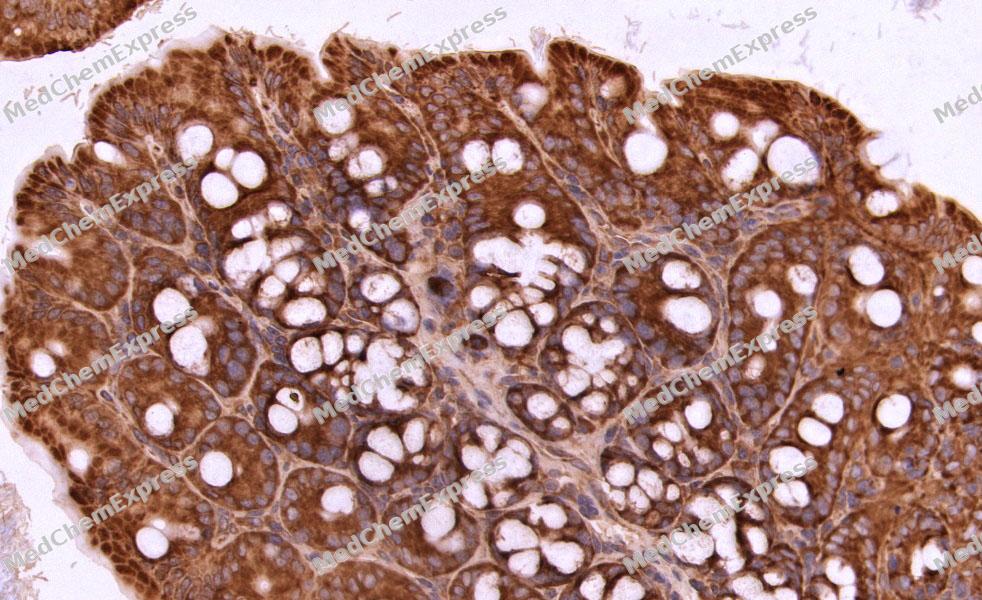 Immunohistochemical analysis of paraffin-embedded mouse colon tissue using YB1 Antibody. The section was pre-treated using heat mediated antigen retrieval with sodium citrate buffer (pH 6.0) for 8 minutes. The tissues were blocked in QuickBlock for 20 minutes at room temperature, washed with ddH2O and PBS, and then probed with the primary antibody at 1/100 dilution in 4℃ overnight. The detection was performed using an HRP conjugated compact polymer system. DAB was used as the chromogen. Tissues were counterstained with hematoxylin and mounted with DPX.
 -
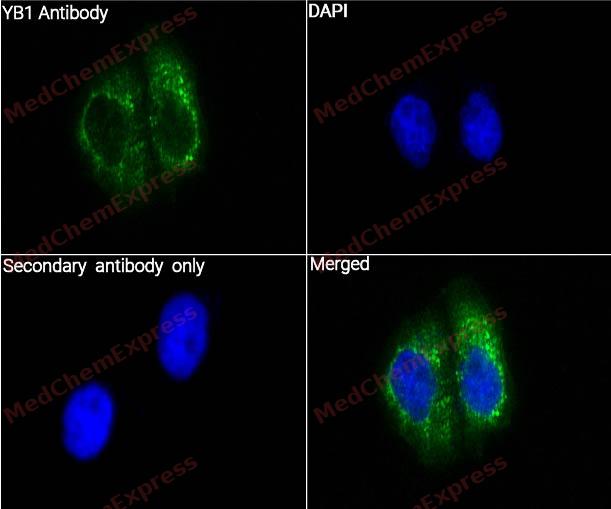 Immunocytochemistry analysis of HeLa cells labeling YB1 with YB1 Antibody (HY-P80936) at 1/50 dilution. Cells were fixed in 4% paraformaldehyde for 15 minutes at room temperature, permeabilized with 0.1% Triton X-100 for 10 minutes at room temperature, then blocked with BSA for Immunol Staining for 10 min at room temperature. Cells were then incubated with YB1 Antibody (HY-P80936) at 1/50 dilution in BSA for Immunol Staining at 4 ℃, Stay overnight. AF488-conjugated AffiniPure Goat Anti-Rabbit IgG H&L(HY-P8002, Green) was used as the secondary antibody at 1/1,000 dilution. PBS instead of the primary antibody was used as the secondary antibody only control. The Nuclear counterstain was DAPI (Blue).
 -
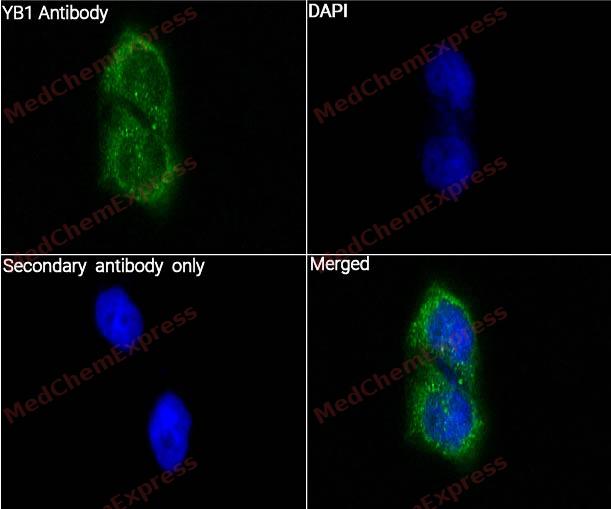 Immunocytochemistry analysis of HeLa cells labeling YB1 with YB1 Antibody (HY-P80936) at 1/100 dilution. Cells were fixed in 4% paraformaldehyde for 15 minutes at room temperature, permeabilized with 0.1% Triton X-100 for 10 minutes at room temperature, then blocked with BSA for Immunol Staining for 10 min at room temperature. Cells were then incubated with YB1 Antibody (HY-P80936) at 1/100 dilution in BSA for Immunol Staining at 4℃, Stay overnight. AF488-conjugated AffiniPure Goat Anti-Rabbit IgG H&L(HY-P8002, Green) was used as the secondary antibody at 1/1,000 dilution. PBS instead of the primary antibody was used as the secondary antibody only control. The Nuclear counterstain was DAPI (Blue).


Background
-
Function
YB-1 (Y box binding protein 1) is a multifunctional transcription and translation factor, and is over-expressed in various human cancers. YB-1 is a 36 kDa protein, and consists of three domains: the alanine/proline-rich N-terminal domain (A/P domain), the cold shock domain (CSD), and the large C terminal domain (CTD) with alternating clusters of positively and negatively charged amino acid residues. YB-1 regulates cancer cell proliferation and progression, cell survival, cell proliferation and differentiation, stress response, and malignant cell transformation. YB-1 also participates in a wide variety of DNA/RNA-dependent events, including DNA reparation, pre-mRNA transcription and splicing, mRNA packaging, and regulation of mRNA stability and translation[1][2].
-
Subcellular Localization
Cytoplasm; Nucleus; Cytoplasmic granule; Secreted; Secreted, extracellular exosome; Cytoplasm, P-body
-
Subunit
Homodimer in the presence of ATP (PubMed:10817758, PubMed:11851341). Component of the coding region determinant (CRD)-mediated complex, composed of DHX9, HNRNPU, IGF2BP1, SYNCRIP and YBX1 (PubMed:19029303).
-
SwissProt ID
-
Synonyms
YBX1; NSEP1; YB1; Nuclease-sensitive element-binding protein 1; CCAAT-binding transcription factor I subunit A; CBF-A; DNA-binding protein B; DBPB; Enhancer factor I subunit A; EFI-A; Y-box transcription factor; Y-box-binding protein 1; YB-
-
Research Field
Tags & Cell Markers
Documentation
-
Data Sheet (260 KB)
-
SDS (252 KB)
- English - EN (252 KB)
- Français - FR (252 KB)
- Deutsch - DE (252 KB)
- Norwegian - NO (252 KB)
- Español - ES (252 KB)
- Swedish - SV (252 KB)
- Italian - IT (252 KB)
- Korean - KR (252 KB)
- Portuguese - PT (252 KB)
-
User Guide for Antibodies (1077 KB)
References

 Powered by Bioz
