



Nepitrin

Based on 1 Customer Validation
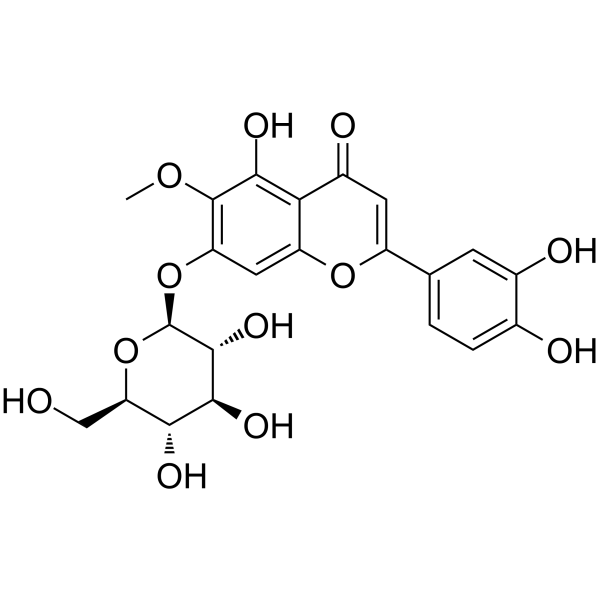
Nepitrin (Nepetin-7-glucoside) is an orally active bradykinin and angiotensin antagonist isolated from Scrophularia striata. Nepitrin antagonizes the spasmogenic effects of Bradykinin and Angiotensin, thereby inhibiting inflammatory mediator pathways. Nepitrin is applicable to arthritis-related research.
Nur für Forschungszwecke. Wir verkaufen nicht an Patienten.
- Reinheit : 99.36%
- CAS. Nr.: 569-90-4
- Formel: C22H22O12
- Molecular Weight:478.40
-
Speicherung:
4°C, sealed storage, away from moisture and light
* In solvent : -80°C, 6 months; -20°C, 1 month (sealed storage, away from moisture and light)

To place orders, for customer services and technical support, please contact: MedChemExpress USA
Tel: 609-228-6898 E-mail: [email protected] [email protected]


-
 Biologische Aktivität
-
Chemical Information
-
Lösungsmittel & Löslichkeit
- Protokoll
- Reinheit & Dokumentation
- Verweise
-
 Help & FAQs


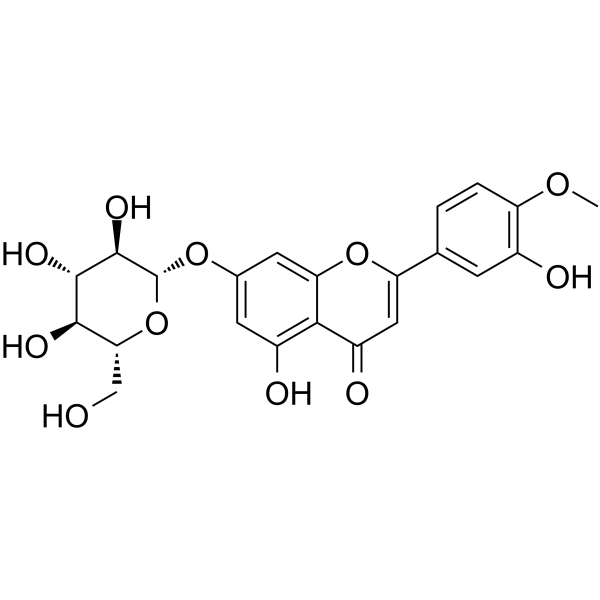
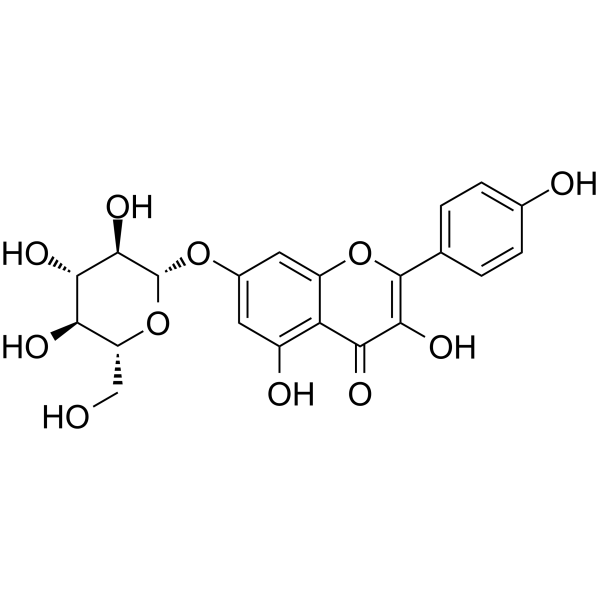
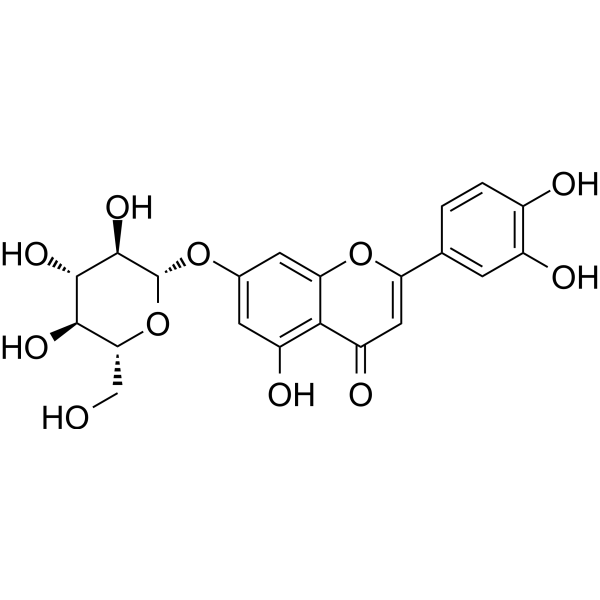

Alle Angiotensin Receptor Isoform-spezifische Produkte anzeigen
MoreAlle Endogenous Metabolite Isoform-spezifische Produkte anzeigen
More

Biologische Aktivität
Beschreibung
Cellular Effect
|
Cell Line

|
Type | Value | Description | References |
|---|---|---|---|---|
| HL-60 | IC50 |
24.3 μg/mL
Compound: 8
|
Antioxidant activity in human HL60 cells assessed as reduction of cytochrome-c release
Antioxidant activity in human HL60 cells assessed as reduction of cytochrome-c release
|
[PMID: 10650074] |
In Vitro
MedChemExpress (MCE) has not independently confirmed the accuracy of these methods. They are for reference only.
In Vivo
Nepitrin (40 mg/kg; i.p.; once daily; for 10 consecutive days) slows the development of edema in a formaldehyde-induced chronic arthritis model of albino rats[2].
Nepitrin (10-20 mg/kg; i.p.; once daily; for 7 days) significantly inhibits granuloma formation in the cotton pellet granuloma model of albino rats[2].
Nepitrin (10-20 mg/kg; i.p.; once daily; 14 days) exhibits significant anti-chronic inflammatory and anti-arthritic activities in a Mycobacterium adjuvant-induced arthritis model of albino rats[2].
Nepitrin (3-30 mg/kg; i.p.; single dose; 5 h) exerts hypothermic effects in the normal body temperature model of normal albino mice[2].
Nepitrin (3-30 mg/kg; oral administration; single dose; 5 h) exerts antipyretic effects in yeast-induced fever models of albino rats[2].
Nepitrin (3-30 mg/kg; i.p.; single dose) exerts extremely weak analgesic effects in the tail-clamp model of albino mice[2].
MedChemExpress (MCE) has not independently confirmed the accuracy of these methods. They are for reference only.
-
Animal Model:Albino rats (120-200 g)[2]
-
Dosage:20 mg/kg; 40 mg/kg
-
Administration:i.p.; single dose; 3 h
-
Result:Inhibited carrageenin-induced edema by 54%.
Inhibited carrageenin-induced edema by 65%.
-
Animal Model:Albino rats (120-200 g)[2]
-
Dosage:40 mg/kg
-
Administration:i.p.; once daily; 10 days
-
Result:Slowed the development of edema compared to controls but showed 0% inhibition of inflammation by day 10.
-
Animal Model:Albino rats (120-160 g)[2]
-
Dosage:10 mg/kg; 20 mg/kg
-
Administration:i.p.; once daily; 7 days
-
Result:Reduced mean dry granuloma pellet weight to 32.2 mg.
Reduced mean dry granuloma pellet weight to 24.4 mg (control mean weight was 36.4 mg).
-
Animal Model:Albino rats (120-200 g)[2]
-
Dosage:10 mg/kg; 20 mg/kg
-
Administration:i.p.; once daily; 14 days
-
Result:Inhibited adjuvant-induced paw swelling by 32% on day 13.
Inhibited adjuvant-induced paw swelling by 75% on day 13, inhibited severity and development of secondary lesions, and had an ED50 of 14.2 mg/kg.
Left adrenal weight unchanged.
-
Animal Model:Albino mice (20-30 g; both sexes)[2]
-
Dosage:3 mg/kg; 10 mg/kg; 30 mg/kg
-
Administration:i.p.; single dose; 5 h
-
Result:Lowered rectal temperature by 2.3 to 3°F at the 30 mg/kg dose, and this hypothermia lasted for 2 to 3 hours.
-
Animal Model:Albino rats (100-120 g)[2]
-
Dosage:3 mg/kg; 10 mg/kg; 30 mg/kg
-
Administration:p.o.; single dose; 5 h
-
Result:Inhibited yeast-induced hyperthermia at 30 mg/kg, with significant temperature reductions starting at 1 hour post-administration and lasting through 5 hours.


Chemical Information
-
CAS. Nr. 569-90-4
-
Appearance Solid
-
Molecular Weight 478.40
-
Formel C22H22O12
-
Color Off-white to light yellow
-
SMILES
O=C1C=C(C2=CC=C(O)C(O)=C2)OC3=CC(O[C@H]4[C@@H]([C@H]([C@@H]([C@@H](CO)O4)O)O)O)=C(OC)C(O)=C13
-
Synonyms
Nepetin-7-glucoside
-
Structure Classification
-
Initial Source
-
Versand
Room temperature in continental US; may vary elsewhere.
-
Speicherung
4°C, sealed storage, away from moisture and light
* In solvent : -80°C, 6 months; -20°C, 1 month (sealed storage, away from moisture and light)


Lösungsmittel & Löslichkeit
In Vitro:
DMSO : 100 mg/mL (209.03 mM; Need ultrasonic; Hygroscopic DMSO has a significant impact on the solubility of product, please use newly opened DMSO)
Please refer to the solubility information to select the appropriate solvent. Once prepared, please aliquot and store the solution to prevent product inactivation from repeated freeze-thaw cycles.
Storage method and period of stock solution: -80°C, 6 months; -20°C, 1 month (sealed storage, away from moisture and light). When stored at -80°C, please use it within 6 months. When stored at -20°C, please use it within 1 month.
Please refer to the solubility information to select the appropriate solvent. Once prepared, please aliquot and store the solution to prevent product inactivation from repeated freeze-thaw cycles.
Storage method and period of stock solution: -80°C, 6 months; -20°C, 1 month (sealed storage, away from moisture and light). When stored at -80°C, please use it within 6 months. When stored at -20°C, please use it within 1 month.
Konzentration (Stammlösung) × Volumen (Stammlösung) = Konzentration (Ziellösung) × Volumen (Ziellösung)
In Vivo:
Select the appropriate dissolution method based on your experimental animal and administration route.
- For the following dissolution methods, please ensure to first prepare a clear stock solution using an In Vitro approach and then sequentially add co-solvents:
- To ensure reliable experimental results, the clarified stock solution can be appropriately stored based on storage conditions. As for the working solution for In Vivo experiments, it is recommended to prepare freshly and use it on the same day.
- The percentages shown for the solvents indicate their volumetric ratio in the final prepared solution. If precipitation or phase separation occurs during preparation, heat and/or sonication can be used to aid dissolution.
Add each solvent one by one: 10% DMSO 40% PEG300 5% Tween-80 45% Saline
Solubility: ≥ 2.5 mg/mL (5.23 mM); Clear solution
This protocol yields a clear solution of ≥ 2.5 mg/mL (saturation unknown).
Taking 1 mL working solution as an example, add 100 μL DMSO stock solution (25.0 mg/mL) to 400 μL PEG300, and mix evenly; then add 50 μL Tween-80 and mix evenly; then add 450 μL Saline to adjust the volume to 1 mL.
Preparation of Saline: Dissolve 0.9 g sodium chloride in ddH₂O and dilute to 100 mL to obtain a clear Saline solution.
Add each solvent one by one: 10% DMSO 90% (20% SBE-β-CD in Saline)
Solubility: ≥ 2.5 mg/mL (5.23 mM); Clear solution
This protocol yields a clear solution of ≥ 2.5 mg/mL (saturation unknown).
Taking 1 mL working solution as an example, add 100 μL DMSO stock solution (25.0 mg/mL) to 900 μL 20% SBE-β-CD in Saline, and mix evenly.
Preparation of 20% SBE-β-CD in Saline (4°C, storage for one week): 2 g SBE-β-CD powder is dissolved in 10 mL Saline, completely dissolve until clear.
In Vivo Dissolution Calculator
Please enter the basic information of animal experiments:
-
-
-
-
Recommended: Prepare an additional quantity of animals to account for potential losses during experiments.
Please enter your animal formula composition:
-
%DMSO +
Recommended: Keep the proportion of DMSO in working solution below 2% if your animal is weak.
-
%+
-
+%Tween-80 + +
-
%Saline +
The co-solvents required include: DMSO, . All of co-solvents are available by MedChemExpress (MCE). , Tween 80. All of co-solvents are available by MedChemExpress (MCE).
Working solution concentration: 0.22 mg/mL
Method for preparing stock solution: mg drug dissolved in μL DMSO. Stock solution concentration: mg/mL. * In solvent : -80°C, 6 months; -20°C, 1 month (sealed storage, away from moisture and light)
1. Take μL DMSO stock solution;
2. Add μL .
μL , mix evenly;
3. Then add μL Tween 80, mix evenly;
4. Then add μL
Please ensure that the stock solution in the first step is dissolved to a clear state, and add co-solvents in sequence. You can use ultrasonic heating (ultrasonic cleaner, recommended frequency 20-40 kHz), vortexing, etc. to assist dissolution.


Reinheit & Dokumentation
-
Data Sheet (291 KB)
-
SDS (396 KB)
- English - EN (396 KB)
- Français - FR (396 KB)
- Deutsch - DE (396 KB)
- Norwegian - NO (396 KB)
- Español - ES (396 KB)
- Swedish - SV (396 KB)
- Italian - IT (396 KB)
- Korean - KR (396 KB)
- Portuguese - PT (396 KB)
-
Handling Instructions (2659 KB)
Verweise


Complete Stock Solution Preparation Table
Please refer to the solubility information to select the appropriate solvent. Once prepared, please aliquot and store the solution to prevent product inactivation from repeated freeze-thaw cycles.
Storage method and period of stock solution: -80°C, 6 months; -20°C, 1 month (sealed storage, away from moisture and light). When stored at -80°C, please use it within 6 months. When stored at -20°C, please use it within 1 month.
| Optional Solvent | Concentration Solvent Mass | 1 mg | 5 mg | 10 mg | 25 mg |
|---|---|---|---|---|---|
| DMSO | 1 mM | 2.0903 mL | 10.4515 mL | 20.9030 mL | 52.2575 mL |
| 5 mM | 0.4181 mL | 2.0903 mL | 4.1806 mL | 10.4515 mL | |
| 10 mM | 0.2090 mL | 1.0452 mL | 2.0903 mL | 5.2258 mL | |
| 15 mM | 0.1394 mL | 0.6968 mL | 1.3935 mL | 3.4838 mL | |
| 20 mM | 0.1045 mL | 0.5226 mL | 1.0452 mL | 2.6129 mL | |
| 25 mM | 0.0836 mL | 0.4181 mL | 0.8361 mL | 2.0903 mL | |
| 30 mM | 0.0697 mL | 0.3484 mL | 0.6968 mL | 1.7419 mL | |
| 40 mM | 0.0523 mL | 0.2613 mL | 0.5226 mL | 1.3064 mL | |
| 50 mM | 0.0418 mL | 0.2090 mL | 0.4181 mL | 1.0452 mL | |
| 60 mM | 0.0348 mL | 0.1742 mL | 0.3484 mL | 0.8710 mL | |
| 80 mM | 0.0261 mL | 0.1306 mL | 0.2613 mL | 0.6532 mL | |
| 100 mM | 0.0209 mL | 0.1045 mL | 0.2090 mL | 0.5226 mL |


Nepitrin Related Classifications
HY-N5010 Related Classifications
 Powered by Bioz