



Mocravimod hydrochloride
Based on 2 publication(s) in Google Scholar
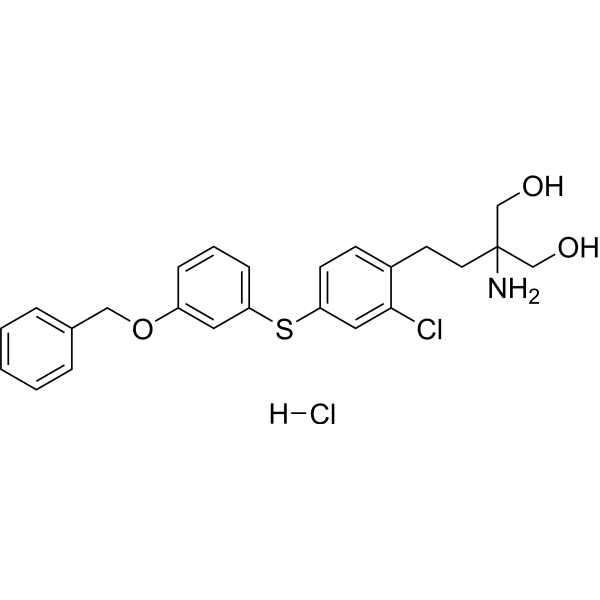
Mocravimod (hydrochloride) is an orally active sphingosine-1-phosphate receptor (S1PR) modulator that blocks the signal required by T cells to egress from lymph nodes and other lymphoid organs. Mocravimod (hydrochloride) preferentially binds to S1PR1 over S1PR2 and S1PR3 in cardiomyocytes. Mocravimod (hydrochloride) significantly lowered the concentration of reactive oxygen species (ROS), prevented mitochondrial permeability transition pore opening, boosted mitochondrial membrane potential (MMP), and increased phosphorylation of AKT, EKR, GSK-3β, JAK2, and STAT3. Mocravimod (hydrochloride) retains T cell effector function. Mocravimod (hydrochloride) can be used for the study of acute myelogenous leukemia, diabetes and Myocardial Ischemia-Reperfusion Injury (MIRI).
For research use only. We do not sell to patients.
- Purity: 99.99%
- CAS No.: 509088-69-1
- Formula: C24H27Cl2NO3S
- Molecular Weight:480.45
-
Storage:
4°C, sealed storage, away from moisture
* In solvent : -80°C, 6 months; -20°C, 1 month (sealed storage, away from moisture)


-
 Biological Activity
-
Chemical Information
-
Solvent & Solubility
- Purity & Documentation
- References
-
 Help & FAQs
-

Epigenetics Compound Library
HY-L005
-
GPCR/G Protein Compound Library
HY-L006
-
Immunology/Inflammation Compound Library
HY-L007
-
JAK/STAT Compound Library
HY-L008
-
Metabolism/Protease Compound Library
HY-L012
-
NF-κB Signaling Compound Library
HY-L014
-
PI3K/Akt/mTOR Compound Library
HY-L015
-
Protein Tyrosine Kinase Compound Library
HY-L016
-
Stem Cell Signaling Compound Library
HY-L017
-
Wnt/Hedgehog/Notch Compound Library
HY-L020
-
Anti-Cancer Compound Library
HY-L025
-
Clinical Compound Library
HY-L026
-
Autophagy Compound Library
HY-L029
-
Anti-Aging Compound Library
HY-L034
-
Drug Repurposing Compound Library
HY-L035
-
Differentiation Inducing Compound Library
HY-L038
-
Anti-diabetic Compound Library
HY-L040
-
Oxygen Sensing Compound Library
HY-L045
-
Glycolysis Compound Library
HY-L058
-
Cytoskeleton Compound Library
HY-L060
-
Orally Active Compound Library
HY-L061
-
Glutamine Metabolism Compound Library
HY-L064
-
Neuroprotective Compound Library
HY-L070
-
Anti-Breast Cancer Compound Library
HY-L074
-
Anti-Lung Cancer Compound Library
HY-L075
-
Anti-Pancreatic Cancer Compound Library
HY-L077
-
Anti-Blood Cancer Compound Library
HY-L079
-
Anti-Cancer Metabolism Compound Library
HY-L083
-
Angiogenesis-Related Compound Library
HY-L088
-
Transcription Factor-Targeted Library
HY-L090
-
Glucose Metabolism Compound Library
HY-L092
-
Antidepressant Compound Library
HY-L108
-
Osteogenesis Compound Library
HY-L131
-
Pain-Related Compound Library
HY-L139
-
Mitochondrial Protection Compound Library
HY-L144
-
Metabolic Enzyme Compound Library
HY-L146
-
Membrane Protein-targeted Compound Library
HY-L149
-
Membrane Receptor-targeted Compound Library
HY-L150
-
Autoimmune Disease Compound Library
HY-L156
-
Anti-Hematopathy Compound Library
HY-L171
-
Multi-Target Compound Library
HY-L176
-
Bioactive Compound Library Max
HY-L181
-
MCE Bioactive Compound Library
HY-L001V
-
Drug Repurposing Compound Library Plus
HY-L035P
-
Clinical Compound Library Plus
HY-L026P
-
Bioactive Compound Library
HY-L001
-
Protein Kinase Compound Library
HY-L196
-
Non-Alcoholic Fatty Liver Disease (NAFLD) Compound Library
HY-L199
-
Cell Proliferation Compound Library
HY-L201
-
High-Throughput Bioactive Compound Library
HY-L205
-
Lactylation Compound Library
HY-L249


Publications Citing Use of MedChemExpress (MCE) Mocravimod hydrochloride
More

Biological Activity
S1PR1[1]
Mocravimod (KRP203) (0.2-5 μM, 24 h) (hydrochloride) significantly improves the survival rate of the hypoxia-reoxygenation (H/R) H9c2 cells, reduces lactate dehydrogenase (LDH) release, and decreases apoptosis[4].
Mocravimod (0.2-1 μM, 24 h) (hydrochloride) significantly reduces reactive oxygen species (ROS) levels, improves mitochondrial membrane potential, and inhibits the opening of the mitochondrial permeability transition pore (mPTP) in hypoxia-reoxygenation (H/R) H9c2 cells[4].
Mocravimod (0.2-1 μM, 24 h) (hydrochloride) inhibits the expression of mitochondrial-mediated apoptosis pathway proteins such as cytochrome C, caspase-9, and caspase-3[4].
Mocravimod (0.2-1 μM, 24 h) (hydrochloride) significantly increases the phosphorylation levels of key signaling pathway proteins in hypoxia-reoxygenation (H/R) H9c2 cells, including AKT (Ser473), ERK (Thr202/Tyr204), GSK-3β (Ser9), JAK2 (Tyr1007/1008), and STAT3 (Ser727)[4].
MedChemExpress (MCE) has not independently confirmed the accuracy of these methods. They are for reference only.
-
Cell Line:Hypoxia-Reoxygenation (H/R) H9c2 Cells
-
Concentration:0.2 μM, 1 μM, 5 μM
-
Incubation Time:24 h
-
Result:Induced apoptosis.
-
Cell Line:Hypoxia-Reoxygenation (H/R) H9c2 Cells
-
Concentration:0.2 μM, 1 μM
-
Incubation Time:24 h
-
Result:Inhibited the expression of mitochondrial-mediated apoptosis pathway proteins such as cytochrome C, caspase-9, and caspase-3.
Mocravimod (3.0 mg/kg, i.p., thrice weekly) (hydrochloride) significantly inhibits the development of atherosclerotic lesions in mice on a high-cholesterol diet, and this effect was independent of changes in blood lipids, but rather by regulating the infiltration of inflammatory cells within plaques[3].
MedChemExpress (MCE) has not independently confirmed the accuracy of these methods. They are for reference only.
-
Animal Model:Low-density lipoprotein receptor-deficient mice (LDL-R-/-) on cholesterol-rich diet[3].
-
Dosage:3 mg/kg
-
Administration:I.p., thrice weekly for 6-16 weeks
-
Result:Significantly reduced the lesion area of the aortic root and the entire aorta.
Decreased levels of macrophages (MOMA-2 positive) and T cells (CD3 positive) in plaques.
No effect on plasma lipid levels (total cholesterol, HDL cholesterol, triglycerides), body weight, or liver and kidney function parameters (such as ALT, BUN, creatinine).
Decreased CD4+ and CD8+ T cells in the spleen and lymph nodes, with decreased expression of the activation marker CD69.
Decreased MHC-II expression (activation marker) in F4/80+ macrophages and CD11c+ dendritic cells; reduced cytokine (TNF-α, MCP-1, IL-6) production after in vitro stimulation.
| NCT Number | Sponsor | Condition | Start Date |
Phase

|
|---|---|---|---|---|
| NCT01329991 | Plexxikon| | 2011-05 | PHASE1 |


Chemical Information
-
CAS No. 509088-69-1
-
Appearance Solid
-
Molecular Weight 480.45
-
Formula C24H27Cl2NO3S
-
Color White to off-white
-
SMILES
OCC(CCC1=CC=C(SC2=CC=CC(OCC3=CC=CC=C3)=C2)C=C1Cl)(N)CO.[H]Cl
-
Synonyms
KRP-203
-
Shipping
Room temperature in continental US; may vary elsewhere.
-
Storage
4°C, sealed storage, away from moisture
* In solvent : -80°C, 6 months; -20°C, 1 month (sealed storage, away from moisture)


Publications (2)
-
Journal Impact Factor
-
Most Recent
-
Cell Biol Toxicol
The novel sphingosine-1-phosphate receptor modulator KRP-203 prevents myocardial ischemia-reperfusion injury by preserving mitochondrial function through activation of the RISK and SAFE signaling pathways. [Abstract]2025 Nov 27;41(1):159. PMID: 41307722 -
bioRxiv
Sphingosine-1-phosphate receptor modulators resensitize FLT3-ITD acute myeloid leukemia cells with NRAS mutations to FLT3 inhibitors. [Abstract]2025 Nov 24:2025.11.21.689510. PMID: 41341164


Solvent & Solubility
DMSO : 200 mg/mL (416.28 mM; Need ultrasonic; Hygroscopic DMSO has a significant impact on the solubility of product, please use newly opened DMSO)
Please refer to the solubility information to select the appropriate solvent. Once prepared, please aliquot and store the solution to prevent product inactivation from repeated freeze-thaw cycles.
Storage method and period of stock solution: -80°C, 6 months; -20°C, 1 month (sealed storage, away from moisture). When stored at -80°C, please use it within 6 months. When stored at -20°C, please use it within 1 month.
Please refer to the solubility information to select the appropriate solvent. Once prepared, please aliquot and store the solution to prevent product inactivation from repeated freeze-thaw cycles.
Storage method and period of stock solution: -80°C, 6 months; -20°C, 1 month (sealed storage, away from moisture). When stored at -80°C, please use it within 6 months. When stored at -20°C, please use it within 1 month.
Concentration (start) × Volume (start) = Concentration (final) × Volume (final)
Select the appropriate dissolution method based on your experimental animal and administration route.
- For the following dissolution methods, please ensure to first prepare a clear stock solution using an In Vitro approach and then sequentially add co-solvents:
- To ensure reliable experimental results, the clarified stock solution can be appropriately stored based on storage conditions. As for the working solution for In Vivo experiments, it is recommended to prepare freshly and use it on the same day.
- The percentages shown for the solvents indicate their volumetric ratio in the final prepared solution. If precipitation or phase separation occurs during preparation, heat and/or sonication can be used to aid dissolution.
Add each solvent one by one: 10% DMSO 40% PEG300 5% Tween-80 45% Saline
Solubility: ≥ 2.5 mg/mL (5.20 mM); Clear solution
This protocol yields a clear solution of ≥ 2.5 mg/mL (saturation unknown).
Taking 1 mL working solution as an example, add 100 μL DMSO stock solution (25.0 mg/mL) to 400 μL PEG300, and mix evenly; then add 50 μL Tween-80 and mix evenly; then add 450 μL Saline to adjust the volume to 1 mL.
Preparation of Saline: Dissolve 0.9 g sodium chloride in ddH₂O and dilute to 100 mL to obtain a clear Saline solution.
Add each solvent one by one: 10% DMSO 90% (20% SBE-β-CD in Saline)
Solubility: 2.5 mg/mL (5.20 mM); Suspended solution; Need ultrasonic
This protocol yields a suspended solution of 2.5 mg/mL. Suspended solution can be used for oral and intraperitoneal injection.
Taking 1 mL working solution as an example, add 100 μL DMSO stock solution (25.0 mg/mL) to 900 μL 20% SBE-β-CD in Saline, and mix evenly.
Preparation of 20% SBE-β-CD in Saline (4°C, storage for one week): 2 g SBE-β-CD powder is dissolved in 10 mL Saline, completely dissolve until clear.
Please enter the basic information of animal experiments:
-
-
-
-
Recommended: Prepare an additional quantity of animals to account for potential losses during experiments.
Please enter your animal formula composition:
-
%DMSO +
Recommended: Keep the proportion of DMSO in working solution below 2% if your animal is weak.
-
%+
-
+%Tween-80 + +
-
%Saline +
The co-solvents required include: DMSO, . All of co-solvents are available by MedChemExpress (MCE). , Tween 80. All of co-solvents are available by MedChemExpress (MCE).
Working solution concentration: 0.22 mg/mL
Method for preparing stock solution: mg drug dissolved in μL DMSO. Stock solution concentration: mg/mL. * In solvent : -80°C, 6 months; -20°C, 1 month (sealed storage, away from moisture)
1. Take μL DMSO stock solution;
2. Add μL .
μL , mix evenly;
3. Then add μL Tween 80, mix evenly;
4. Then add μL
Please ensure that the stock solution in the first step is dissolved to a clear state, and add co-solvents in sequence. You can use ultrasonic heating (ultrasonic cleaner, recommended frequency 20-40 kHz), vortexing, etc. to assist dissolution.


Purity & Documentation
-
Data Sheet (279 KB)
-
SDS (393 KB)
- English - EN (393 KB)
- Français - FR (393 KB)
- Deutsch - DE (393 KB)
- Norwegian - NO (393 KB)
- Español - ES (393 KB)
- Swedish - SV (393 KB)
- Italian - IT (393 KB)
- Portuguese - PT (393 KB)
-
Handling Instructions (2659 KB)
References
[1]. Dertschnig S, et al. Mocravimod, a Selective Sphingosine-1-Phosphate Receptor Modulator, in Allogeneic Hematopoietic Stem Cell Transplantation for Malignancy. Transplant Cell Ther. 2023 Jan;29(1):41.e1-41.e9. [Content Brief]
[3]. Potì F, et al. Mocravimod, sphingosine 1-phosphate receptor type 1 agonist, ameliorates atherosclerosis in LDL-R-/- mice. Arterioscler Thromb Vasc Biol. 2013 Jul;33(7):1505-12. [Content Brief]
[4]. Wu N, et al. The novel sphingosine-1-phosphate receptor modulator Mocravimod prevents myocardial ischemia-reperfusion injury by preserving mitochondrial function through activation of the RISK and SAFE signaling pathways. Cell Biol Toxicol. 2025 Nov 27;41(1):159. [Content Brief]


Complete Stock Solution Preparation Table
Please refer to the solubility information to select the appropriate solvent. Once prepared, please aliquot and store the solution to prevent product inactivation from repeated freeze-thaw cycles.
Storage method and period of stock solution: -80°C, 6 months; -20°C, 1 month (sealed storage, away from moisture). When stored at -80°C, please use it within 6 months. When stored at -20°C, please use it within 1 month.
| Optional Solvent | Concentration Solvent Mass | 1 mg | 5 mg | 10 mg | 25 mg |
|---|---|---|---|---|---|
| DMSO | 1 mM | 2.0814 mL | 10.4069 mL | 20.8138 mL | 52.0345 mL |
| 5 mM | 0.4163 mL | 2.0814 mL | 4.1628 mL | 10.4069 mL | |
| 10 mM | 0.2081 mL | 1.0407 mL | 2.0814 mL | 5.2035 mL | |
| 15 mM | 0.1388 mL | 0.6938 mL | 1.3876 mL | 3.4690 mL | |
| 20 mM | 0.1041 mL | 0.5203 mL | 1.0407 mL | 2.6017 mL | |
| 25 mM | 0.0833 mL | 0.4163 mL | 0.8326 mL | 2.0814 mL | |
| 30 mM | 0.0694 mL | 0.3469 mL | 0.6938 mL | 1.7345 mL | |
| 40 mM | 0.0520 mL | 0.2602 mL | 0.5203 mL | 1.3009 mL | |
| 50 mM | 0.0416 mL | 0.2081 mL | 0.4163 mL | 1.0407 mL | |
| 60 mM | 0.0347 mL | 0.1734 mL | 0.3469 mL | 0.8672 mL | |
| 80 mM | 0.0260 mL | 0.1301 mL | 0.2602 mL | 0.6504 mL | |
| 100 mM | 0.0208 mL | 0.1041 mL | 0.2081 mL | 0.5203 mL |


Mocravimod hydrochloride Related Classifications
Cat. No.: HY-13660
 Powered by Bioz
- Mocravimod
- 509088-69-1
- KRP-203
- KRP203
- KRP 203
- LPL Receptor
- Reactive Oxygen Species (ROS)
- Akt
- GSK-3
- JAK
- STAT
- S1PR
- Sphingosine-1-phosphate receptor agonist
- Myocardial ischemia–reperfusion injury
- Mitochondrial function
- Reperfusion injury salvage kinase signaling pathway
- Survivor activating factor enhancement signaling pathway
- Inhibitor
- inhibitor
- inhibit