



S1PR2
S1PR2 is a sphingosine-1-phosphate receptor that mediates immune cell trafficking, angiogenesis, and vascular function through the S1P receptor family[1]. Mechanistically, S1PR2 activates Rho-ROCK and PTEN signaling, disrupts adherens junctions, stimulates stress fibers, and increases endothelial paracellular permeability[2]. In CNS autoimmunity models, increased S1PR2 expression destabilizes blood-brain barrier adherens junctions, while pharmacological blockade or genetic loss reduces EAE severity by improving endothelial barrier function[3]. In germinal centers, S1P2/S1PR2 inhibits Akt activation and migration, thereby restricting B-cell survival and localization within an S1P-low follicular niche[4]. Compared with related isoforms, S1PR2 contrasts with S1PR1-dependent endothelial barrier enhancement and with S1PR1/S1PR3 activation by S1P in receptor-internalization assays[2][5]. For experimental applications, JTE-013 has been used as an S1PR2 antagonist, whereas CYM-5478 activates S1PR2 selectively and reduces cisplatin-mediated cell death by lowering ROS in neural-derived cell assays[5][6].
References:
- [1]. Chen H, et al. Structure of S1PR2-heterotrimeric G13 signaling complex. Sci Adv. 2022 Apr;8(13):eabn0067. [Content Brief]
- [2]. Sanchez T, et al. Induction of vascular permeability by the sphingosine-1-phosphate receptor-2 (S1P2R) and its downstream effectors ROCK and PTEN. Arterioscler Thromb Vasc Biol. 2007 Jun;27(6):1312-8. [Content Brief]
- [3]. Cruz-Orengo L, et al. Enhanced sphingosine-1-phosphate receptor 2 expression underlies female CNS autoimmunity susceptibility. J Clin Invest. 2014 Jun;124(6):2571-84. [Content Brief]
- [4]. Green JA, et al. The sphingosine 1-phosphate receptor S1P₂ maintains the homeostasis of germinal center B cells and promotes niche confinement. Nat Immunol. 2011 Jun 5;12(7):672-80. [Content Brief]
- [5]. Satsu H, et al. A sphingosine 1-phosphate receptor 2 selective allosteric agonist. Bioorg Med Chem. 2013 Sep 1;21(17):5373-82. [Content Brief]
- [6]. Herr DR, et al. Sphingosine 1-phosphate receptor 2 (S1P2) attenuates reactive oxygen species formation and inhibits cell death: implications for otoprotective therapy. Sci Rep. 2016 Apr 15;6:24541. [Content Brief]
-
S1PR2 Related Products (9)
Related Products (9)

-
Siponimod
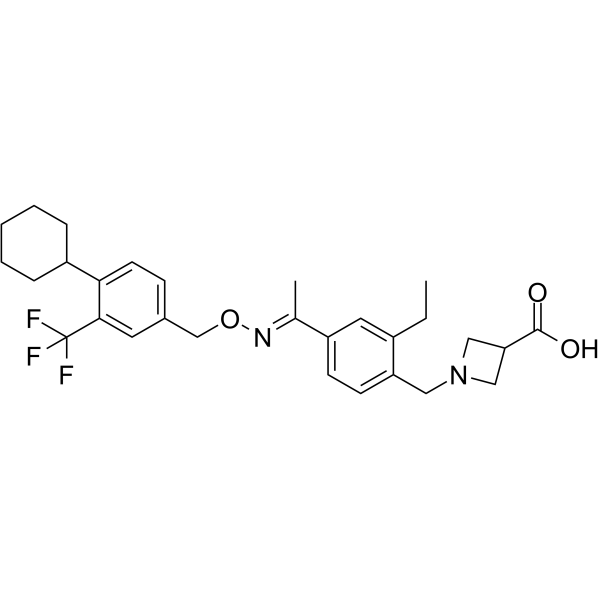 0 ImagesSynonyms: BAF-312Siponimod (BAF-312) is an orally active, blood-brain barrier penetrant dual agonist of S1P1/S1P5, with EC50 values of 0.39 nM and 0.98 nM, respectively. Siponimod induces S1P1 internalization, activates GIRK channels, inhibits lymphocyte egress, reduces peripheral lymphocyte counts, triggers transient bradycardia, prevents synaptic neurodegeneration, promotes remyelination, alleviates demyelination, and prevents the loss of GABAergic interneurons. Siponimod can be used in research related to multiple sclerosis.
-
CYM-5478
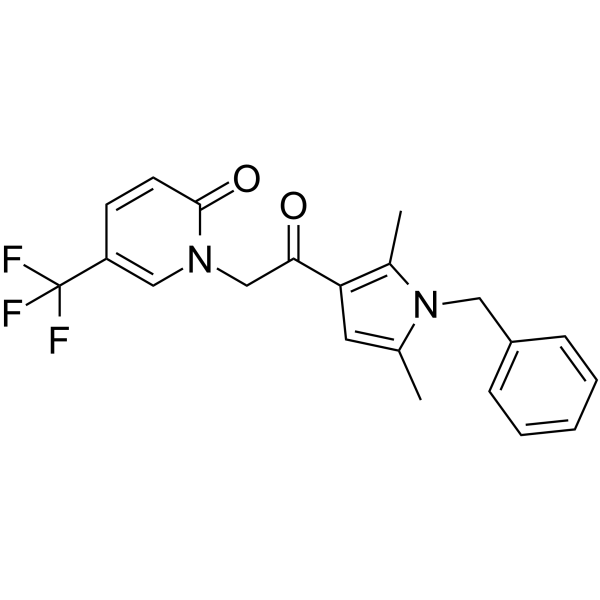 0 ImagesCYM-5478 is a potent and highly selective S1P2 agonist with an EC50 of 119 nM in a TGFα-shedding assay. CYM-5478 protects neural-derived cell lines against Cisplatin toxicity.
-
GLPG2938
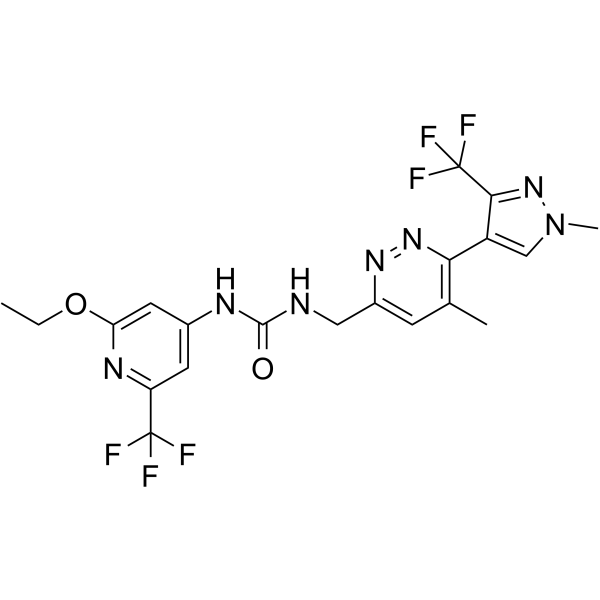 0 ImagesGLPG2938 is a potent and selective S1P2 antagonist. GLPG2938 can be used for the research of idiopathic pulmonary fibrosis.
-
S1PR5-IN-1
 0 ImagesS1PR5-IN-1 (Compound 7a) is a highly selective S1PR5 antagonist and orally bioavailable inhibitor with a human S1PR5 IC50 of 85.4 nM and human S1PR5 Kd of 2.173 nM.S1PR5-IN-1 binds to S1PR5 and inhibits natural killer cell migration toward sphingosine-1-phosphate.S1PR5-IN-1 can be used for the research of multiple sclerosis.
-
Glycocholic acid hydrate
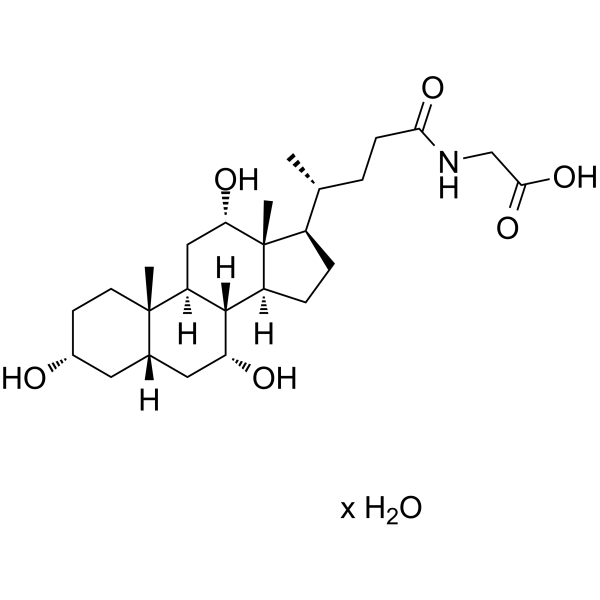 0 ImagesGlycocholic acid hydrate is a bile acid derivative. Glycocholic acid hydrate downregulates MDR1, Bcl-2, MRP1, MRP2 and FXR, upregulates Bax, p53, caspase-9, caspase-3, TGR5 and S1PR2. Glycocholic acid hydrate inhibits multidrug resistance and efflux pumps, induces mitochondrial apoptosis, and enhances chemosensitivity. Glycocholic acid hydrate modulates related bile acid receptor signaling. Glycocholic acid hydrate suppresses growth and conjugation of Enterobacteriaceae and increases their antibiotic susceptibility. Glycocholic acid hydrate can be used for the research of colon adenocarcinoma and cholangiocarcinoma (CCA).
-
Siponimod hemifumarate
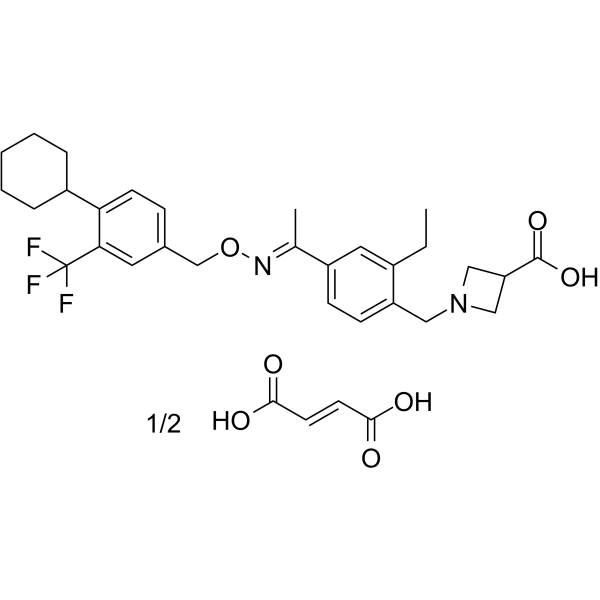 0 ImagesSynonyms: BAF-312 hemifumarateSiponimod (BAF-312) hemifumarate is an orally active, blood-brain barrier penetrant dual agonist of S1P1/S1P5, with EC50 values of 0.39 nM and 0.98 nM, respectively. Siponimod hemifumarate induces S1P1 internalization, activates GIRK channels, inhibits lymphocyte egress, reduces peripheral lymphocyte counts, triggers transient bradycardia, prevents synaptic neurodegeneration, promotes remyelination, alleviates demyelination, and prevents the loss of GABAergic interneurons. Siponimod hemifumarate can be used in research related to multiple sclerosis.
-
L-threo Lysosphingomyelin (d18:1)
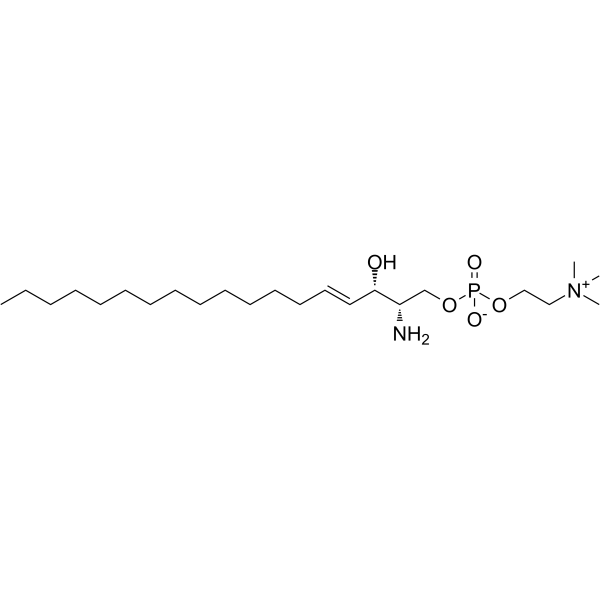 0 ImagesSynonyms: L-threo-SphingosylphosphorylcholineL-threo Lysosphingomyelin (d18:1) (L-threo-Sphingosylphosphorylcholine) is an endogenous bioactive sphingolipid. L-threo Lysosphingomyelin (d18:1) is a potent S1P receptor agonist with EC50s of 19.3, 131.8, and 313.3 nM for hS1P1, hS1P3, and hS1P2, respectively.
-
AB1
 0 ImagesCat. No.: HY-120409CAS No.: 1463912-49-3




