



KPT-251

Based on 1 Customer Validation
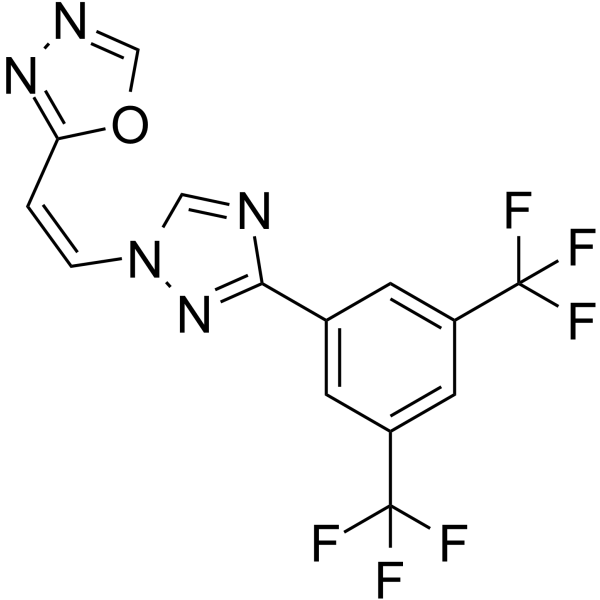
KPT-251 is an orally active chromosome region maintenance 1 protein (CRM1) inhibitor. KPT-251 induces cancer cell apoptosis and shows antileukemic activity.
Nos produits utilisent uniquement pour la recherche. Nous ne vendons pas aux patients.
- Pureté: 99.92%
- CAS No.: 1388841-50-6
- Formule: C14H7F6N5O
- Masse moléculaire:375.23
-
Stockage:
4°C, protect from light
* In solvent : -80°C, 6 months; -20°C, 1 month (protect from light)

To place orders, for customer services and technical support, please contact: MedChemExpress USA
Tel: 609-228-6898 E-mail: [email protected] [email protected]


-
 Activité biologique
-
Chemical Information
-
Solvant et solubilité
- Pureté et documentation
- Références
-
 Help & FAQs


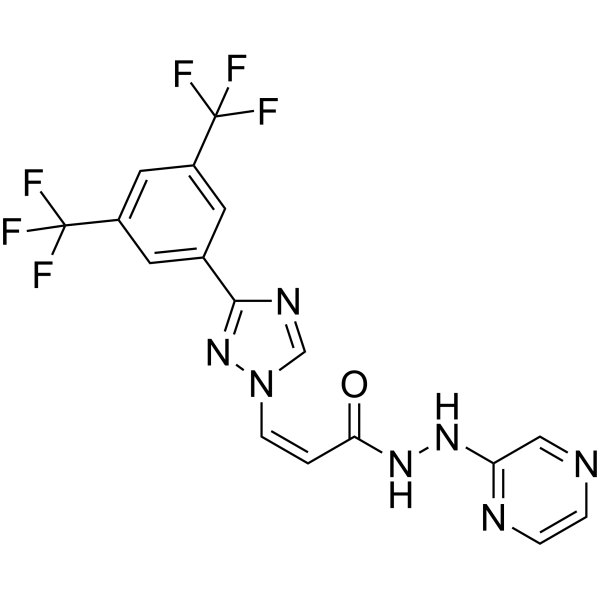

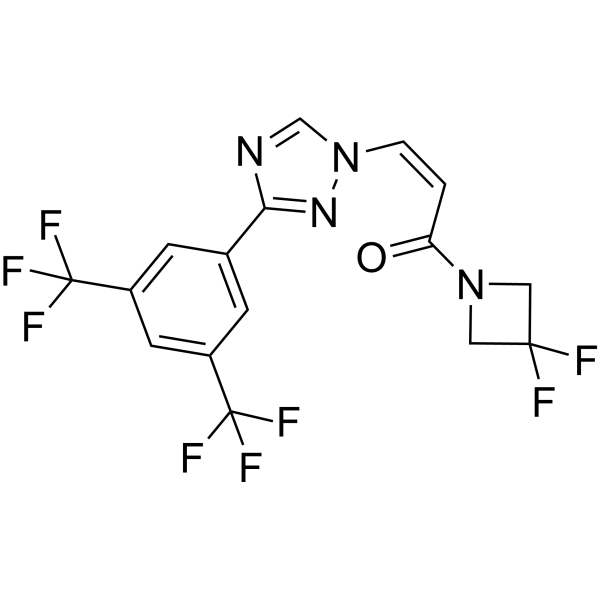


Activité biologique
KPT-251 binds in the NES-binding groove, which is located on the central, convex side of the CRM1 ring[1].
KPT-251 (72 h) suppresses melanoma cell proliferation[2].
KPT-251 (1 μM; 0-48 h) modulates levels of p53, pRb, survivin, and ERK phosphorylation[2].
KPT-251 (0.1 and 1 μM; 0-72 h) induces cell-cycle arrest and apoptosis[2].
MedChemExpress (MCE) has not independently confirmed the accuracy of these methods. They are for reference only.
-
Cell Line:Melanoma BRAF WT (Mewo) and mutant cells (A375)
-
Concentration:1 μM
-
Incubation Time:4, 8, 24 and 48 h
-
Result:Prevented cytoplasmic p53 degradation, decreased survivin levels, increased ERK phosphorylation in both BRAF WT and mutant and reduced pRb and p-pRb levels.
-
Cell Line:Mewo and A375 cells
-
Concentration:1 μM
-
Incubation Time:24, 48 and 72 h
-
Result:Reduced S-phase, both G1 and/or G2 cell-cycle arrest can be observed.
-
Cell Line:Mel-Juso, SK-MEL-28, SK-MEL-5 and A375 cells
-
Concentration:0.1 and 1 μM
-
Incubation Time:24, 48 and 72 h
-
Result:Increased caspase-3 and -7 activity in the tested melanoma cell lines in a dose- and time-related manner.
KPT-251 (50 mg/kg; p.o.; every other day for 21 days) suppresses tumor growth in mice melanoma xenograft models[2].
MedChemExpress (MCE) has not independently confirmed the accuracy of these methods. They are for reference only.
-
Animal Model:7-weekold female NOD-SCID-IL2Rcγnull (NSG) mice, introduced 2 × 10⁶ luciferase-expressing MV4-11 cells via tail-vein injections[1]
-
Dosage:75 mg/kg/day
-
Administration:Gavage, three times per week for 5 weeks
-
Result:Exhibited significantly increased survival with leukemia progression occurring only after cessation of treatment, prevented infiltration of leukemia cells into mouse bone marrow and spleen, and spared normal hematopoietic cells.
-
Animal Model:Athymic nude mice Nu/Nu, melanoma xenograft models[2]
-
Dosage:50 mg/kg
-
Administration:Oral, every other day for 21 days
-
Result:Suppressed tumor growth, increased cleaved caspase-3 and decreased Ki67.


Chemical Information
-
CAS No. 1388841-50-6
-
Appearance Solid
-
Masse moléculaire 375.23
-
Formule C14H7F6N5O
-
Color White to yellow
-
SMILES
FC(C1=CC(C(F)(F)F)=CC(C2=NN(/C=C\C3=NN=CO3)C=N2)=C1)(F)F
-
Livraison
Room temperature in continental US; may vary elsewhere.
-
Stockage
4°C, protect from light
* In solvent : -80°C, 6 months; -20°C, 1 month (protect from light)


Solvant et solubilité
DMSO : 100 mg/mL (266.50 mM; ultrasonic and warming and heat to 60°C; Hygroscopic DMSO has a significant impact on the solubility of product, please use newly opened DMSO)
Please refer to the solubility information to select the appropriate solvent. Once prepared, please aliquot and store the solution to prevent product inactivation from repeated freeze-thaw cycles.
Storage method and period of stock solution: -80°C, 6 months; -20°C, 1 month (protect from light). When stored at -80°C, please use it within 6 months. When stored at -20°C, please use it within 1 month.
Please refer to the solubility information to select the appropriate solvent. Once prepared, please aliquot and store the solution to prevent product inactivation from repeated freeze-thaw cycles.
Storage method and period of stock solution: -80°C, 6 months; -20°C, 1 month (protect from light). When stored at -80°C, please use it within 6 months. When stored at -20°C, please use it within 1 month.
Concentration (start) × Volume (start) = Concentration (final) × Volume (final)
Select the appropriate dissolution method based on your experimental animal and administration route.
- For the following dissolution methods, please ensure to first prepare a clear stock solution using an In Vitro approach and then sequentially add co-solvents:
- To ensure reliable experimental results, the clarified stock solution can be appropriately stored based on storage conditions. As for the working solution for In Vivo experiments, it is recommended to prepare freshly and use it on the same day.
- The percentages shown for the solvents indicate their volumetric ratio in the final prepared solution. If precipitation or phase separation occurs during preparation, heat and/or sonication can be used to aid dissolution.
Add each solvent one by one: 10% DMSO 90% (20% SBE-β-CD in Saline)
Solubility: ≥ 2.5 mg/mL (6.66 mM); Clear solution
This protocol yields a clear solution of ≥ 2.5 mg/mL (saturation unknown).
Taking 1 mL working solution as an example, add 100 μL DMSO stock solution (25.0 mg/mL) to 900 μL 20% SBE-β-CD in Saline, and mix evenly.
Preparation of 20% SBE-β-CD in Saline (4°C, storage for one week): 2 g SBE-β-CD powder is dissolved in 10 mL Saline, completely dissolve until clear.
Please enter the basic information of animal experiments:
-
-
-
-
Recommended: Prepare an additional quantity of animals to account for potential losses during experiments.
Please enter your animal formula composition:
-
%DMSO +
Recommended: Keep the proportion of DMSO in working solution below 2% if your animal is weak.
-
%+
-
+%Tween-80 + +
-
%Saline +
The co-solvents required include: DMSO, . All of co-solvents are available by MedChemExpress (MCE). , Tween 80. All of co-solvents are available by MedChemExpress (MCE).
Working solution concentration: 0.22 mg/mL
Method for preparing stock solution: mg drug dissolved in μL DMSO. Stock solution concentration: mg/mL. * In solvent : -80°C, 6 months; -20°C, 1 month (protect from light)
1. Take μL DMSO stock solution;
2. Add μL .
μL , mix evenly;
3. Then add μL Tween 80, mix evenly;
4. Then add μL
Please ensure that the stock solution in the first step is dissolved to a clear state, and add co-solvents in sequence. You can use ultrasonic heating (ultrasonic cleaner, recommended frequency 20-40 kHz), vortexing, etc. to assist dissolution.


Pureté et documentation
-
Fiche technique (281 KB)
-
SDS (252 KB)
- English - EN (252 KB)
- Français - FR (252 KB)
- Deutsch - DE (252 KB)
- Norwegian - NO (252 KB)
- Español - ES (252 KB)
- Swedish - SV (252 KB)
- Italian - IT (252 KB)
- Korean - KR (252 KB)
- Portuguese - PT (252 KB)
-
Instruction de manipulation (2659 KB)
Références
[1]. Etchin J, et al. Antileukemic activity of nuclear export inhibitors that spare normal hematopoietic cells. Leukemia. 2013 Jan;27(1):66-74. [Content Brief]
[2]. Salas Fragomeni RA, et al. CRM1 and BRAF inhibition synergize and induce tumor regression in BRAF-mutant melanoma. Mol Cancer Ther. 2013 Jul;12(7):1171-9. [Content Brief]


Complete Stock Solution Preparation Table
Please refer to the solubility information to select the appropriate solvent. Once prepared, please aliquot and store the solution to prevent product inactivation from repeated freeze-thaw cycles.
Storage method and period of stock solution: -80°C, 6 months; -20°C, 1 month (protect from light). When stored at -80°C, please use it within 6 months. When stored at -20°C, please use it within 1 month.
| Optional Solvent | Concentration Solvent Mass | 1 mg | 5 mg | 10 mg | 25 mg |
|---|---|---|---|---|---|
| DMSO | 1 mM | 2.6650 mL | 13.3252 mL | 26.6503 mL | 66.6258 mL |
| 5 mM | 0.5330 mL | 2.6650 mL | 5.3301 mL | 13.3252 mL | |
| 10 mM | 0.2665 mL | 1.3325 mL | 2.6650 mL | 6.6626 mL | |
| 15 mM | 0.1777 mL | 0.8883 mL | 1.7767 mL | 4.4417 mL | |
| 20 mM | 0.1333 mL | 0.6663 mL | 1.3325 mL | 3.3313 mL | |
| 25 mM | 0.1066 mL | 0.5330 mL | 1.0660 mL | 2.6650 mL | |
| 30 mM | 0.0888 mL | 0.4442 mL | 0.8883 mL | 2.2209 mL | |
| 40 mM | 0.0666 mL | 0.3331 mL | 0.6663 mL | 1.6656 mL | |
| 50 mM | 0.0533 mL | 0.2665 mL | 0.5330 mL | 1.3325 mL | |
| 60 mM | 0.0444 mL | 0.2221 mL | 0.4442 mL | 1.1104 mL | |
| 80 mM | 0.0333 mL | 0.1666 mL | 0.3331 mL | 0.8328 mL | |
| 100 mM | 0.0267 mL | 0.1333 mL | 0.2665 mL | 0.6663 mL |


KPT-251 Related Classifications
HY-117996 Related Classifications
 Powered by Bioz