



AVE-0118

Based on 1 Customer Validation
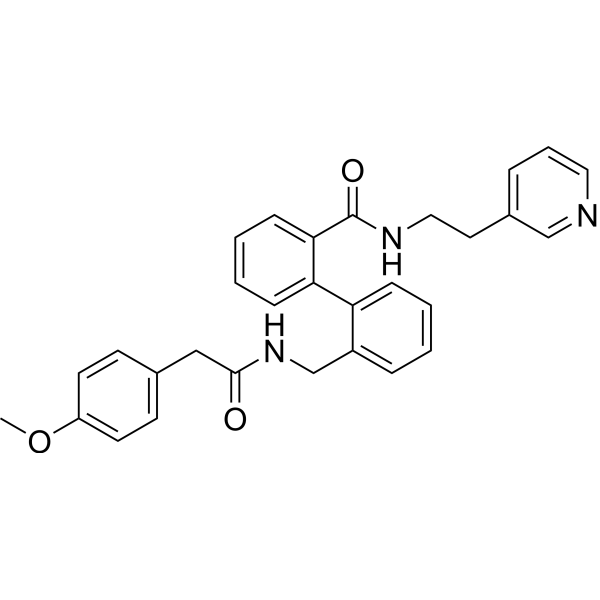
AVE-0118 is a Kv1.5 potassium channel blocker and antiarrhythmic agent. AVE-0118 blocks neuronal Kv1.5 potassium channels, thereby enhancing the release of norepinephrine. AVE-0118 enhances field stimulation-induced neurogenic contraction, an effect sensitive to α1-adrenergic receptor blockade. AVE-0118 terminates persistent atrial fibrillation in some dogs. AVE-0118 is applicable to research related to atrial fibrillation and persistent atrial fibrillation.
Nos produits utilisent uniquement pour la recherche. Nous ne vendons pas aux patients.
- Pureté : 98.93%
- CAS No.: 498577-53-0
- Formule: C30H29N3O3
- Masse moléculaire:479.57
-
Stockage:Powder -20°C, 3 years , 4°C, 2 years ; In solvent -80°C, 6 months , -20°C, 1 month

To place orders, for customer services and technical support, please contact: MedChemExpress USA
Tel: 609-228-6898 E-mail: [email protected] [email protected]


-
 Activité biologique
-
Chemical Information
-
Solvant et solubilité
- Pureté et documentation
- Références
-
 Help & FAQs




Activité biologique
Description
IC50 & Target
[1]|
Kv1.5 |
In Vitro
AVE-0118 (0.1 μM; 20 min) does not alter basal tone or noradrenaline-induced contractions in isolated third- or fourth-order rat small mesenteric artery ring segments[1].
AVE-0118 (0.1 μM; 20 min) significantly potentiates electrical field stimulation-induced neurogenic contractions in isolated third- or fourth-order rat small mesenteric artery ring segments, increasing the 16 Hz EFS response from 19.7% to 44.9% of maximum phenylephrine-induced tone[1].
MedChemExpress (MCE) has not independently confirmed the accuracy of these methods. They are for reference only.
In Vivo
MedChemExpress (MCE) has not independently confirmed the accuracy of these methods. They are for reference only.
-
Animal Model:Beagle (chronic atrioventricular block, persistent atrial fibrillation induced by left atrial tachypacing)[2]
-
Dosage:6 mg/kg
-
Administration:i.v.; infused over 10 minutes
-
Result:Terminated persistent AF in 3 out of 7 animals, at 12 minutes, 12.4 hours, and 16 minutes after administration start.
Resulted in a cardioversion rate of 43% (3/7).
Maintained sustained sinus rhythm (no recurrence) in 29% (2/7) of animals.
Saw AF recurrence in 1 of the 3 successfully cardioverted animals at 34 minutes after AF termination.


Chemical Information
-
CAS No. 498577-53-0
-
Appearance Solid
-
Masse moléculaire 479.57
-
Formule C30H29N3O3
-
Color White to off-white
-
SMILES
O=C(NCCC1=CC=CN=C1)C2=CC=CC=C2C3=CC=CC=C3CNC(CC4=CC=C(C=C4)OC)=O
-
Livraison
Room temperature in continental US; may vary elsewhere.
-
Stockage
Powder -20°C 3 years 4°C 2 years In solvent -80°C 6 months -20°C 1 month


Solvant et solubilité
In Vitro:
DMSO : 100 mg/mL (208.52 mM; Need ultrasonic; Hygroscopic DMSO has a significant impact on the solubility of product, please use newly opened DMSO)
Please refer to the solubility information to select the appropriate solvent. Once prepared, please aliquot and store the solution to prevent product inactivation from repeated freeze-thaw cycles.
Storage method and period of stock solution: -80°C, 6 months; -20°C, 1 month. When stored at -80°C, please use it within 6 months. When stored at -20°C, please use it within 1 month.
Please refer to the solubility information to select the appropriate solvent. Once prepared, please aliquot and store the solution to prevent product inactivation from repeated freeze-thaw cycles.
Storage method and period of stock solution: -80°C, 6 months; -20°C, 1 month. When stored at -80°C, please use it within 6 months. When stored at -20°C, please use it within 1 month.
Concentration (start) × Volume (start) = Concentration (final) × Volume (final)
In Vivo:
Select the appropriate dissolution method based on your experimental animal and administration route.
- For the following dissolution methods, please ensure to first prepare a clear stock solution using an In Vitro approach and then sequentially add co-solvents:
- To ensure reliable experimental results, the clarified stock solution can be appropriately stored based on storage conditions. As for the working solution for In Vivo experiments, it is recommended to prepare freshly and use it on the same day.
- The percentages shown for the solvents indicate their volumetric ratio in the final prepared solution. If precipitation or phase separation occurs during preparation, heat and/or sonication can be used to aid dissolution.
Add each solvent one by one: 10% DMSO 40% PEG300 5% Tween-80 45% Saline
Solubility: ≥ 2.5 mg/mL (5.21 mM); Clear solution
This protocol yields a clear solution of ≥ 2.5 mg/mL (saturation unknown).
Taking 1 mL working solution as an example, add 100 μL DMSO stock solution (25.0 mg/mL) to 400 μL PEG300, and mix evenly; then add 50 μL Tween-80 and mix evenly; then add 450 μL Saline to adjust the volume to 1 mL.
Preparation of Saline: Dissolve 0.9 g sodium chloride in ddH₂O and dilute to 100 mL to obtain a clear Saline solution.
Add each solvent one by one: 10% DMSO 90% (20% SBE-β-CD in Saline)
Solubility: ≥ 2.5 mg/mL (5.21 mM); Clear solution
This protocol yields a clear solution of ≥ 2.5 mg/mL (saturation unknown).
Taking 1 mL working solution as an example, add 100 μL DMSO stock solution (25.0 mg/mL) to 900 μL 20% SBE-β-CD in Saline, and mix evenly.
Preparation of 20% SBE-β-CD in Saline (4°C, storage for one week): 2 g SBE-β-CD powder is dissolved in 10 mL Saline, completely dissolve until clear.
In Vivo Dissolution Calculator
Please enter the basic information of animal experiments:
-
-
-
-
Recommended: Prepare an additional quantity of animals to account for potential losses during experiments.
Please enter your animal formula composition:
-
%DMSO +
Recommended: Keep the proportion of DMSO in working solution below 2% if your animal is weak.
-
%+
-
+%Tween-80 + +
-
%Saline +
The co-solvents required include: DMSO, . All of co-solvents are available by MedChemExpress (MCE). , Tween 80. All of co-solvents are available by MedChemExpress (MCE).
Working solution concentration: 0.22 mg/mL
Method for preparing stock solution: mg drug dissolved in μL DMSO. Stock solution concentration: mg/mL.
1. Take μL DMSO stock solution;
2. Add μL .
μL , mix evenly;
3. Then add μL Tween 80, mix evenly;
4. Then add μL
Please ensure that the stock solution in the first step is dissolved to a clear state, and add co-solvents in sequence. You can use ultrasonic heating (ultrasonic cleaner, recommended frequency 20-40 kHz), vortexing, etc. to assist dissolution.


Pureté et documentation
-
Fiche technique (274 KB)
-
SDS (252 KB)
- English - EN (252 KB)
- Français - FR (252 KB)
- Deutsch - DE (252 KB)
- Norwegian - NO (252 KB)
- Español - ES (252 KB)
- Swedish - SV (252 KB)
- Italian - IT (252 KB)
- Korean - KR (252 KB)
- Portuguese - PT (252 KB)
-
Instruction de manipulation (2659 KB)
Références
[1]. Kun A, et al. Neurogenic contraction induced by the antiarrhythmic compound, AVE 0118, in rat small mesenteric arteries. Basic Clin Pharmacol Toxicol. 2014;115(4):315-320. [Content Brief]
[2]. Kambayashi R, et al. Roles of IK,ACh for perpetuating atrial fibrillation: Effects of atrial-selective K+ channel inhibitor AVE0118 and class I drugs on the persistent atrial fibrillation canine model. J Pharmacol Sci. 2022;149(4):175-178. [Content Brief]


Complete Stock Solution Preparation Table
Please refer to the solubility information to select the appropriate solvent. Once prepared, please aliquot and store the solution to prevent product inactivation from repeated freeze-thaw cycles.
Storage method and period of stock solution: -80°C, 6 months; -20°C, 1 month. When stored at -80°C, please use it within 6 months. When stored at -20°C, please use it within 1 month.
| Optional Solvent | Concentration Solvent Mass | 1 mg | 5 mg | 10 mg | 25 mg |
|---|---|---|---|---|---|
| DMSO | 1 mM | 2.0852 mL | 10.4260 mL | 20.8520 mL | 52.1300 mL |
| 5 mM | 0.4170 mL | 2.0852 mL | 4.1704 mL | 10.4260 mL | |
| 10 mM | 0.2085 mL | 1.0426 mL | 2.0852 mL | 5.2130 mL | |
| 15 mM | 0.1390 mL | 0.6951 mL | 1.3901 mL | 3.4753 mL | |
| 20 mM | 0.1043 mL | 0.5213 mL | 1.0426 mL | 2.6065 mL | |
| 25 mM | 0.0834 mL | 0.4170 mL | 0.8341 mL | 2.0852 mL | |
| 30 mM | 0.0695 mL | 0.3475 mL | 0.6951 mL | 1.7377 mL | |
| 40 mM | 0.0521 mL | 0.2607 mL | 0.5213 mL | 1.3033 mL | |
| 50 mM | 0.0417 mL | 0.2085 mL | 0.4170 mL | 1.0426 mL | |
| 60 mM | 0.0348 mL | 0.1738 mL | 0.3475 mL | 0.8688 mL | |
| 80 mM | 0.0261 mL | 0.1303 mL | 0.2607 mL | 0.6516 mL | |
| 100 mM | 0.0209 mL | 0.1043 mL | 0.2085 mL | 0.5213 mL |


AVE-0118 Related Classifications
HY-118387 Related Classifications
 Powered by Bioz