



DKK-1 Protein, Mouse (HEK293, His)
Based on 2 publication(s) in Google Scholar
DKK-1 protein antagonizes canonical Wnt signaling by inhibiting LRP5/6-Wnt interaction and forming a ternary complex with KREMEN, thereby promoting LRP5/6 internalization. In addition to its Wnt-dependent role, DKK1 has Wnt-independent anti-apoptotic activity by inhibiting the pro-apoptotic function of KREMEN1. DKK-1 Protein, Mouse (HEK293, His) is the recombinant mouse-derived DKK1 protein, expressed by HEK293 , with C-His labeled tag.
- Species: Mouse
- Source: HEK293
-
Storage:Stored at -20°C for 2 years from date of receipt. After reconstitution, it is stable at 4°C for 1 week or -20°C for longer (with carrier protein). It is recommended to freeze aliquots at -20°C or -80°C for extended storage.


To place orders, for customer services and technical support, please contact: MedChemExpress USA
Tel: 609-228-6898 E-mail: [email protected] [email protected]


-
 Biological Activity
-
Technical Parameters
-
Product Properties
- Documentation
- Help & FAQs





Biological Activity
Description
DKK-1 protein antagonizes canonical Wnt signaling by inhibiting LRP5/6-Wnt interaction and forming a ternary complex with KREMEN, thereby promoting LRP5/6 internalization. In addition to its Wnt-dependent role, DKK1 has Wnt-independent anti-apoptotic activity by inhibiting the pro-apoptotic function of KREMEN1. DKK-1 Protein, Mouse (HEK293, His) is the recombinant mouse-derived DKK1 protein, expressed by HEK293 , with C-His labeled tag.
Background
DKK1 protein serves as a potent antagonist of canonical Wnt signaling through multiple mechanisms, including inhibiting the interaction between LRP5/6 and Wnt and forming a ternary complex with the transmembrane protein KREMEN, which facilitates the internalization of LRP5/6. Additionally, DKK1 exhibits Wnt-independent anti-apoptotic activity by inhibiting the pro-apoptotic function of KREMEN1. In limb development, DKK1 plays a crucial role by attenuating Wnt signaling, contributing to normal limb patterning. The protein's interactions with LRP5, LRP6, and KREM1, especially in the presence of MESD, highlight its involvement in the intricate regulation of Wnt-mediated signaling pathways, underscoring its significance in various cellular processes and developmental contexts.
Verified Bioactivity
Measured by its ability to inhibit recombinant rmWnt3a induced alkaline phosphatase production by C3H10T 1/2 cells and the ED50 is 0.05-0.3 μg/mL.
MCE Validation Data
-
Purity - SDS-PAGE
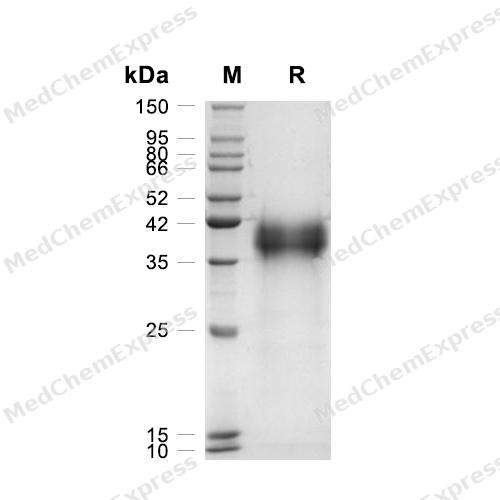
Purity - SDS-PAGE
-
Bioactivity - Cell-Based Assay
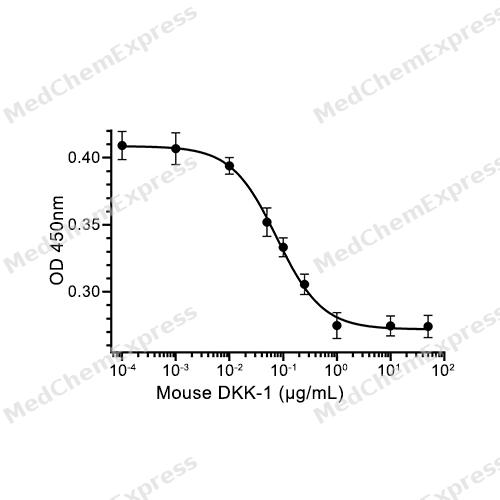
Bioactivity - Cell-Based Assay


Publications (2)
-
Journal Impact Factor
-
Most Recent
-
Sci Bull
2025 Jul 30;70(14):2297-2311. PMID: 40441968 -
Int J Med Sci
HK2-mediated Glycolysis Inhibits Mineralization of Cementoblasts Under Compression by Suppressing the Piezo1/Wnt Signaling. [Abstract]2025 Jul 11;22(13):3316-3328. PMID: 40765550


Technical Parameters
-
Species Mouse
-
Source HEK293
-
Tag C-His
-
Accession
O54908 (T32-H272)
-
Molecular Construction
-
N-term
-
DKK1 (T32-H272)
Accession # O54908 -
His
-
C-term
-
-
Protein Length
Full Length of Mature Protein
-
Synonyms
DKK1; Dickkopf 1 Homolog (Xenopus Laevis); Dickkopf Wnt Signaling Pathway Inhibitor 1; Dickkopf 1 Homolog; SK; Dickkopf-1 Like; DKK-1; Dickkopf-1; Dickkopf-Related Protein 1; HDkk-1; Dickkopf-Like Protein 1; Dkk-1; Dickkopf (Xenopus Laevis) Homolog 1
-
AA Sequence
TLNSVLINSNAIKNLPPPLGGAGGQPGSAVSVAPGVLYEGGNKYQTLDNYQPYPCAEDEECGSDEYCSSPSRGAAGVGGVQICLACRKRRKRCMRHAMCCPGNYCKNGICMPSDHSHFPRGEIEESIIENLGNDHNAAAGDGYPRRTTLTSKIYHTKGQEGSVCLRSSDCAAGLCCARHFWSKICKPVLKEGQVCTKHKRKGSHGLEIFQRCYCGEGLACRIQKDHHQASNSSRLHTCQRH
-
Molecular Weight
Approximately 41-45 kDa, based on SDS-PAGE under reducing conditions, due to the glycosylation.
-
Glycosylation
Yes
-
Purity
≥ 95%, as determined by reducing SDS-PAGE.


Product Properties
Lyophilized powder.
1.Lyophilized from a 0.22 μm filtered solution of PBS, pH 7.4, 5% trehalose, 5% mannitol, 0.01% Tween 80.
2.Lyophilized from a 0.22 μm filtered solution of 20 mM PB, 150 mM NaCl, pH 7.4.
Please refer to the lot-specific COA for specific buffer information.
<1 EU/μg, determined by LAL method.
It is not recommended to reconstitute to a concentration less than 100 μg/mL in ddH2O.
Stored at -20°C for 2 years from date of receipt. After reconstitution, it is stable at 4°C for 1 week or -20°C for longer (with carrier protein). It is recommended to freeze aliquots at -20°C or -80°C for extended storage.
Room temperature in continental US; may vary elsewhere.


Documentation
-
Data Sheet (237 KB)
-
SDS (252 KB)
- English - EN (252 KB)
- Français - FR (252 KB)
- Deutsch - DE (252 KB)
- Norwegian - NO (252 KB)
- Español - ES (252 KB)
- Swedish - SV (252 KB)
- Italian - IT (252 KB)
- Korean - KR (252 KB)
- Portuguese - PT (252 KB)
-
Handling Instructions (2659 KB)

Calculators
Concentration (start) × Volume (start) = Concentration (final) × Volume (final)


 Powered by Bioz

