



FAP Protein, Mouse (HEK293, His)
Based on 1 publication(s) in Google Scholar
FAP protein is a cell surface glycoprotein serine protease that regulates tissue remodeling, fibrosis, inflammation, and tumor growth. It cleaves post-proline residues, degrades SERPINF2 and SPRY2, and exhibits dipeptidyl peptidase activity. FAP Protein, Mouse (HEK293, His) is the recombinant mouse-derived FAP protein, expressed by HEK293 , with N-His labeled tag.
- Species: Mouse
- Source: HEK293
-
Storage:Stored at -20°C for 2 years from date of receipt. After reconstitution, it is stable at 4°C for 1 week or -20°C for longer (with carrier protein). It is recommended to freeze aliquots at -20°C or -80°C for extended storage.


To place orders, for customer services and technical support, please contact: MedChemExpress USA
Tel: 609-228-6898 E-mail: [email protected] [email protected]


-
 Biological Activity
-
Technical Parameters
-
Product Properties
- Documentation
- Help & FAQs




Biological Activity
Description
FAP protein is a cell surface glycoprotein serine protease that regulates tissue remodeling, fibrosis, inflammation, and tumor growth. It cleaves post-proline residues, degrades SERPINF2 and SPRY2, and exhibits dipeptidyl peptidase activity. FAP Protein, Mouse (HEK293, His) is the recombinant mouse-derived FAP protein, expressed by HEK293 , with N-His labeled tag.
Background
FAP Protein is a cell surface glycoprotein serine protease that is involved in various cellular processes such as tissue remodeling, fibrosis, wound healing, inflammation, and tumor growth. It exhibits endopeptidase activity, particularly cleaving post-proline residues, and can degrade substances like alpha-2-antiplasmin SERPINF2 and SPRY2. FAP Protein also has dipeptidyl peptidase activity, with a preference for specific dipeptide substrates. It interacts with other proteins like DPP4, PLAUR, and integrins to promote pericellular proteolysis of the extracellular matrix, leading to cell adhesion, migration, and invasion. Additionally, FAP Protein plays a role in tissue remodeling, wound healing, and cell invasiveness in malignant melanoma cancers. It also enhances tumor growth by promoting angiogenesis, collagen fiber degradation, and apoptosis while reducing the immune system's antitumor response. In melanocytic cells, FAP Protein acts as a tumor suppressor by regulating cell proliferation and survival independently of its serine protease activity.
Verified Bioactivity
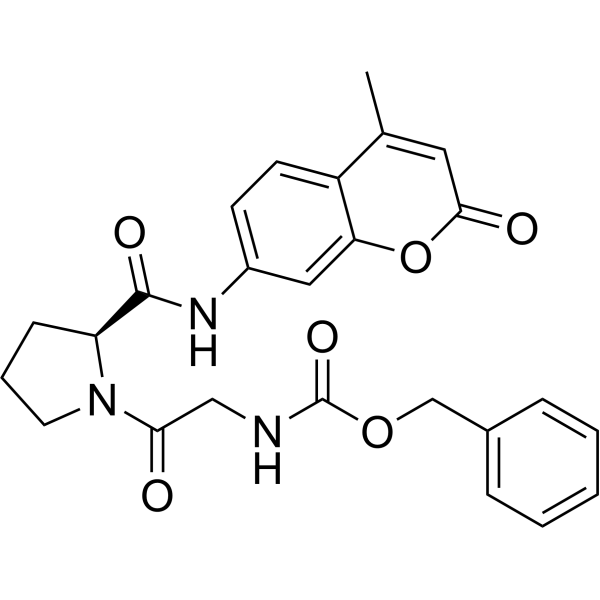
1.Measured by its ability to convert the substrate benzyloxycarbonyl-Gly-Pro-7-amido-4-methylcoumarin (Z-GP-AMC) to Z-Gly-Pro and 7-amino-4-methylcoumarin (AMC). The specific activity is >2000 pmol/min/µg.
2.Immobilized Mouse FAP, His Tag at 1 μg/mL (100 μl/well) on the plate. Dose response curve for Anti-FAP Antibody, hFc Tag with the EC50 of 4.6 ng/mL determined by ELISA.
3.Western blot analysis of FAP (lane2 (50 ng), FAP (lane3 (100 ng), FAP (lane4 (200 ng) using Anti-His tag Antibody (HRP). Proteins were transferred to a PVDF membrane and blocked with 5% non-fat milk in TBST for 2 hour at room temperature. Anti-His tag Antibody (HRP) (1/10000) was used for 2 hour at room temperature.

Assay Procedure
Materials
Assay buffer: 50 mM Tris, 1 M NaCl, 1 mg/mL BSA, pH 7.5
Test protein: FAP Protein, Mouse (HEK293, His) (HY-P77934)
Substrate: Dissolve Z-Gly-Pro-AMC (HY-D1670) in DMSO to a concentration of 10 mM.
Standard: 7-Amino, 4-Methyl Coumarin (HY-D0027)
Procedure
1. Standard Curve: Dilute standard in assay buffer to concentrations of 0, 0.78, 1.5625, 3.125, 6.25, 12.5, 25, and 50 μmol/L. Add 100 μL of each dilution to a black microplate well. Measure fluorescence in kinetic mode for 5 minutes at excitation and emission wavelengths of 380 nm and 460 nm, respectively. Plot the measured RFU values on the y-axis and the standard concentrations on the x-axis to generate a standard curve and obtain the curve equation.
2. Dilute Mouse FAP to 0.2 μg/mL in assay buffer.
3. Dilute the substrate to 100 μM in assay buffer.
Experimental group: Add 50 μL of 2 μg/mL FAP to the plate and initiate the reaction by adding 50 μL of 100 μM substrate.
Substrate blank group: 50 μL assay buffer + 50 μL, 100 μM substrate.
4. Read in kinetic mode for 5 minutes at excitation and emission wavelengths of 380 nm and 460 nm, respectively.
5. Calculate Specific Activity:
Specific Activity (pmol/min/μg) = | Adjusted Vmax* (RFU/min) x Conversion Factor ** (pmol/RFU) |
| amount of enzyme (μg) |
*Adjusted for Control
**Derived using calibration standard


Publications (1)
-
Journal Impact Factor
-
Most Recent
-
Stem Cells
Fibroblast activation protein-α interacts with CXCL12 to inactivate canonical Wnt signaling and regulate osteoblast differentiation. [Abstract]2025 Jul 21;43(8):sxaf027. PMID: 40327708


Technical Parameters
-
Species Mouse
-
Source HEK293
-
Tag N-His
-
Accession
P97321-1 (L26-D761)
-
Molecular Construction
-
N-term
-
His
-
FAP (L26-D761)
Accession # P97321 -
C-term
-
-
Protein Length
Extracellular Domain
-
Synonyms
FAP; Prolyl Endopeptidase FAP; Fibroblast Activation Protein Alpha; Dipeptidyl Peptidase FAP; Seprase; FAPalpha; DPPIV; SIMP; 170 KDa Melanoma Membrane-Bound Gelatinase; CDNA FLJ60298, Highly Similar To Seprase; Gelatine Degradation Protease FAP; Fibrobla
-
AA Sequence
LRPSRVYKPEGNTKRALTLKDILNGTFSYKTYFPNWISEQEYLHQSEDDNIVFYNIETRESYIILSNSTMKSVNATDYGLSPDRQFVYLESDYSKLWRYSYTATYYIYDLQNGEFVRGYELPRPIQYLCWSPVGSKLAYVYQNNIYLKQRPGDPPFQITYTGRENRIFNGIPDWVYEEEMLATKYALWWSPDGKFLAYVEFNDSDIPIIAYSYYGDGQYPRTINIPYPKAGAKNPVVRVFIVDTTYPHHVGPMEVPVPEMIASSDYYFSWLTWVSSERVCLQWLKRVQNVSVLSICDFREDWHAWECPKNQEHVEESRTGWAGGFFVSTPAFSQDATSYYKIFSDKDGYKHIHYIKDTVENAIQITSGKWEAIYIFRVTQDSLFYSSNEFEGYPGRRNIYRISIGNSPPSKKCVTCHLRKERCQYYTASFSYKAKYYALVCYGPGLPISTLHDGRTDQEIQVLEENKELENSLRNIQLPKVEIKKLKDGGLTFWYKMILPPQFDRSKKYPLLIQVYGGPCSQSVKSVFAVNWITYLASKEGIVIALVDGRGTAFQGDKFLHAVYRKLGVYEVEDQLTAVRKFIEMGFIDEERIAIWGWSYGGYVSSLALASGTGLFKCGIAVAPVSSWEYYASIYSERFMGLPTKDDNLEHYKNSTVMARAEYFRNVDYLLIHGTADDNVHFQNSAQIAKALVNAQVDFQAMWYSDQNHGISSGRSQNHLYTHMTHFLKQCFSLSD
-
Molecular Weight
Approximately 80-100 kDa, based on SDS-PAGE under reducing conditions, due to the glycosylation.
-
Glycosylation
Yes
-
Purity
≥ 95%, as determined by reducing SDS-PAGE or Bis-Tris PAGE.


Product Properties
Lyophilized powder
1.Lyophilized from a 0.22 μm filtered solution of 50 mM Tris-HCl, 300 mM NaCl, pH 8.0.
2.Lyophilized from a 0.22 μm filtered solution of PBS, 8% trehalose, pH 7.4.
3.Lyophilized from a 0.22 μm filtered solution of PBS, pH 7.4.
4.Lyophilized from a 0.22 μm filtered solution of PBS, pH 7.4, 8% trehalose.
Please refer to the lot-specific COA for specific buffer information.
Note: For SPR assay, please replace the buffer. Primary amine components (e.g., Tris, imidazole) can affect protein-coupled chips.
<1 EU/μg, determined by LAL method.
It is not recommended to reconstitute to a concentration less than 100 μg/mL in ddH2O.
Stored at -20°C for 2 years from date of receipt. After reconstitution, it is stable at 4°C for 1 week or -20°C for longer (with carrier protein). It is recommended to freeze aliquots at -20°C or -80°C for extended storage.
Room temperature in continental US; may vary elsewhere.


Documentation
-
Data Sheet (241 KB)
-
SDS (252 KB)
- English - EN (252 KB)
- Français - FR (252 KB)
- Deutsch - DE (252 KB)
- Norwegian - NO (252 KB)
- Español - ES (252 KB)
- Swedish - SV (252 KB)
- Italian - IT (252 KB)
- Korean - KR (252 KB)
- Portuguese - PT (252 KB)
-
Handling Instructions (2659 KB)

Calculators
Concentration (start) × Volume (start) = Concentration (final) × Volume (final)


 Powered by Bioz

