



HSPA5/GRP-78 Protein, Human (His)

Based on 1 Customer Validation
HSPA5/GRP-78 is an endoplasmic reticulum chaperone that coordinates protein folding and quality control. It cooperates with DNAJC10/ERdj5 to facilitate correct protein folding and participates in the degradation of misfolded proteins, potentially releasing DNAJC10/ERdj5. HSPA5/GRP-78 Protein, Human (His) is the recombinant human-derived HSPA5/GRP-78 protein, expressed by E. coli , with N-6*His labeled tag.
- Species: Human
- Source: E. coli
-
Storage:Stored at -20°C for 2 years from date of receipt. After reconstitution, it is stable at 4°C for 1 week or -20°C for longer (with carrier protein). It is recommended to freeze aliquots at -20°C or -80°C for extended storage.


To place orders, for customer services and technical support, please contact: MedChemExpress USA
Tel: 609-228-6898 E-mail: [email protected] [email protected]


-
 Biological Activity
-
Technical Parameters
-
Product Properties
- Documentation
- Help & FAQs




Biological Activity
Description
HSPA5/GRP-78 is an endoplasmic reticulum chaperone that coordinates protein folding and quality control. It cooperates with DNAJC10/ERdj5 to facilitate correct protein folding and participates in the degradation of misfolded proteins, potentially releasing DNAJC10/ERdj5. HSPA5/GRP-78 Protein, Human (His) is the recombinant human-derived HSPA5/GRP-78 protein, expressed by E. coli , with N-6*His labeled tag.
Background
HSPA5/GRP-78, an endoplasmic reticulum chaperone, assumes a pivotal role in orchestrating protein folding and quality control within the endoplasmic reticulum lumen. Partnering with DNAJC10/ERdj5, it contributes to the proper folding of proteins and participates in the degradation of misfolded counterparts, potentially facilitating the release of DNAJC10/ERdj5 from its substrate. Functioning as a critical suppressor of the unfolded protein response (UPR) mediated by ERN1/IRE1, HSPA5/GRP-78 is recruited to the luminal region of ERN1/IRE1 by DNAJB9/ERdj4 under unstressed conditions, disrupting ERN1/IRE1 dimerization and thereby inactivating ERN1/IRE1. However, the accumulation of misfolded proteins prompts the release of HSPA5/BiP from ERN1/IRE1, allowing for homodimerization and subsequent activation of ERN1/IRE1. Additionally, HSPA5/GRP-78 serves as an auxiliary player in the post-translational transport of small presecretory proteins across the endoplasmic reticulum and is implicated in apoptosis, cell proliferation, and viral infection, acting as a cellular receptor for several flaviviruses, including Dengue virus, Zika virus, and Japanese encephalitis virus.
Verified Bioactivity
1. HSPA5 has ATPase activity at the time of manufacture of 35.972 µM phosphate liberated/hr/µg protein in a 200 µL reaction at 37°C (pH7.5) in the presence of 10 μL of 4 mM ATP, using a Malachite Green assay.
2. HSPA5 has ATPase activity at the time of manufacture of 13.779 µM phosphate liberated/hr/µg protein in a 240 µL reaction at 37°C (pH7.5) in the presence of 10 µL of 4 mM ATP, using a Malachite Green assay.
MCE Validation Data
-
Purity - SDS-PAGE
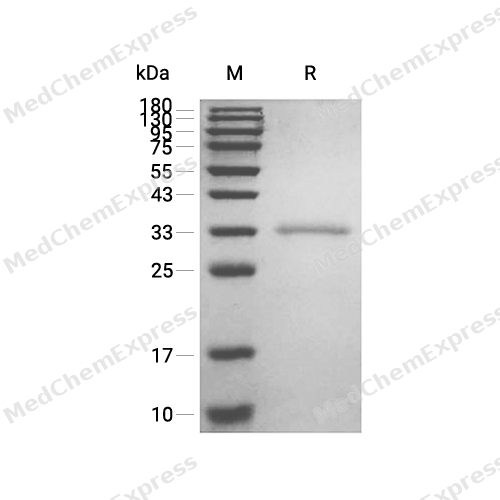
Purity - SDS-PAGE


Technical Parameters
-
Species Human
-
Source E. coli
-
Tag N-6*His
-
Accession
P11021 (E25-E293)
-
Molecular Construction
-
N-term
-
6*His
-
HSPA5 (E25-E293)
Accession # P11021 -
C-term
-
-
Protein Length
Partial
-
Synonyms
HSPA5; Heat Shock 70kDa Protein 5 (Glucose-Regulated Protein, 78kDa); Prev. GRP78; HSP70 Family Protein 5; BiP; Heat Shock 70kD Protein 5 (Glucose-Regulated Protein, 78kD); Immunoglobulin Heavy Chain-Binding Protein; Endoplasmic Reticulum Lumenal Ca(2+)-B
-
AA Sequence
EDVGTVVGIDLGTTYSCVGVFKNGRVEIIANDQGNRITPSYVAFTPEGERLIGDAAKNQLTSNPENTVFDAKRLIGRTWNDPSVQQDIKFLPFKVVEKKTKPYIQVDIGGGQTKTFAPEEISAMVLTKMKETAEAYLGKKVTHAVVTVPAYFNDAQRQATKDAGTIAGLNVMRIINEPTAAAIAYGLDKREGEKNILVFDLGGGTFDVSLLTIDNGVFEVVATNGDTHLGGEDFDQRVMEHFIKLYKKKTGKDVRKDNRAVQKLRREVE
-
Molecular Weight
Approximately 33 kDa, based on SDS-PAGE under reducing conditions.
-
Purity
≥ 90%, as determined by reducing SDS-PAGE.


Product Properties
Lyophilized powder
Lyophilized from a 0.22 μm solution of PBS, 6% Trehalose, pH 7.4.
<1 EU/μg, determined by LAL method.
It is not recommended to reconstitute to a concentration less than 100 μg/mL in ddH2O.
Stored at -20°C for 2 years from date of receipt. After reconstitution, it is stable at 4°C for 1 week or -20°C for longer (with carrier protein). It is recommended to freeze aliquots at -20°C or -80°C for extended storage.
Room temperature in continental US; may vary elsewhere.


Documentation
-
Data Sheet (237 KB)
-
SDS (254 KB)
- English - EN (254 KB)
- Français - FR (254 KB)
- Deutsch - DE (254 KB)
- Norwegian - NO (254 KB)
- Español - ES (254 KB)
- Swedish - SV (254 KB)
- Italian - IT (254 KB)
- Korean - KR (254 KB)
- Portuguese - PT (254 KB)
-
Handling Instructions (2659 KB)

Calculators
Concentration (start) × Volume (start) = Concentration (final) × Volume (final)


 Powered by Bioz

