



PFKFB3 Protein, Human (His)
Based on 1 publication(s) in Google Scholar
The PFKFB3 protein is a key player in cellular energy metabolism as it exerts dual functions by catalyzing the synthesis and degradation of fructose 2,6-bisphosphate (F-2,6-BP). F-2,6-BP is an important allosteric regulator of glycolysis, controlling glucose utilization for energy production. PFKFB3 Protein, Human (His) is the recombinant human-derived PFKFB3 protein, expressed by E. coli , with N-6*His labeled tag.
- Species: Human
- Source: E. coli
-
Storage:Stored at -80°C for 1 year from date of receipt. It is stable at -20°C for 3 months after opening. It is recommended to freeze aliquots at -80°C for extended storage. Avoid repeated freeze-thaw cycles.


To place orders, for customer services and technical support, please contact: MedChemExpress USA
Tel: 609-228-6898 E-mail: [email protected] [email protected]


-
 Biological Activity
-
Technical Parameters
-
Product Properties
- Documentation
- Help & FAQs




Biological Activity
Description
The PFKFB3 protein is a key player in cellular energy metabolism as it exerts dual functions by catalyzing the synthesis and degradation of fructose 2,6-bisphosphate (F-2,6-BP). F-2,6-BP is an important allosteric regulator of glycolysis, controlling glucose utilization for energy production. PFKFB3 Protein, Human (His) is the recombinant human-derived PFKFB3 protein, expressed by E. coli , with N-6*His labeled tag.
Background
PFKFB3 protein is a key player in cellular energy metabolism as it serves a dual function by catalyzing both the synthesis and degradation of fructose 2,6-bisphosphate (F-2,6-BP). F-2,6-BP is a crucial allosteric regulator of glycolysis, exerting control over the rate of glucose utilization for energy production. PFKFB3 acts as a kinase to generate F-2,6-BP, promoting the activation of phosphofructokinase-1 (PFK-1), a rate-limiting enzyme in glycolysis. This results in enhanced glycolytic flux and increased energy production. Conversely, PFKFB3 can also act as a phosphatase to degrade F-2,6-BP, exerting inhibitory effects on PFK-1 and subsequently slowing down glycolysis. The tight regulation of PFKFB3 activity is crucial for maintaining cellular energy homeostasis and has implications in various physiological and pathological processes, including cancer and metabolic disorders. Understanding the intricate regulatory mechanisms governing PFKFB3 can provide insights into therapeutic strategies targeting glycolytic metabolism.
Verified Bioactivity
Measured by its ability to phosphorylate fructose-6-phosphate. that incubate at room temperature for 10 minutes. The specific activity is 22.278 pmol/min/μg.
MCE Validation Data
-
Purity - SDS-PAGE
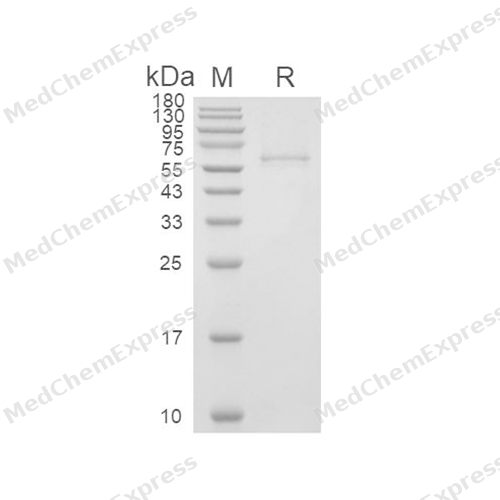
Purity - SDS-PAGE


Publications (1)
-
Journal Impact Factor
-
Most Recent
-
Cell Death Dis
Targeting Aurora-A inhibits tumor progression and sensitizes thyroid carcinoma to Sorafenib by decreasing PFKFB3-mediated glycolysis. [Abstract]2023 Mar 29;14(3):224. PMID: 36990998


Technical Parameters
-
Species Human
-
Source E. coli
-
Tag N-6*His
-
Accession
Q16875-1 (M1-H520)
-
Molecular Construction
-
N-term
-
6*His
-
PFKFB3 (M1-H520)
Accession # Q16875-1 -
C-term
-
-
Protein Length
Full Length
-
Synonyms
PFKFB3; PFK/FBPase 3; 6-Phosphofructo-2-Kinase/Fructose-2,6-Biphosphatase 3; IPFK-2; 6-Phosphofructo-2-Kinase/Fructose-2,6-Bisphosphatase 3; Inducible 6-Phosphofructo-2-Kinase/Fructose-2,6-Bisphosphatase; 6-Phosphofructo-2-Kinase/ Fructose-2,6-Bisphosphat
-
AA Sequence
MPLELTQSRVQKIWVPVDHRPSLPRSCGPKLTNSPTVIVMVGLPARGKTYISKKLTRYLNWIGVPTKVFNVGEYRREAVKQYSSYNFFRPDNEEAMKVRKQCALAALRDVKSYLAKEGGQIAVFDATNTTRERRHMILHFAKENDFKAFFIESVCDDPTVVASNIMEVKISSPDYKDCNSAEAMDDFMKRISCYEASYQPLDPDKCDRDLSLIKVIDVGRRFLVNRVQDHIQSRIVYYLMNIHVQPRTIYLCRHGENEHNLQGRIGGDSGLSSRGKKFASALSKFVEEQNLKDLRVWTSQLKSTIQTAEALRLPYEQWKALNEIDAGVCEELTYEEIRDTYPEEYALREQDKYYYRYPTGESYQDLVQRLEPVIMELERQENVLVICHQAVLRCLLAYFLDKSAEEMPYLKCPLHTVLKLTPVAYGCRVESIYLNVESVCTHRERSEDAKKGPNPLMRRNSVTPLASPEPTKKPRINSFEEHVASTSAALPSCLPPEVPTQLPGQNMKGSRSSADSSRKH
-
Molecular Weight
Approximately 57-62 kDa, based on SDS-PAGE under reducing conditions.
-
Purity
≥ 90%, as determined by reducing SDS-PAGE.


Product Properties
Solution
Supplied as a 0.22 μm filtered solution of 20 mM PB, 50 mM KCl, 5 mM DTT, 0.1 mM EDTA, 50% glycerol, 0.1% TritonX-100, pH 6.0.
<1 EU/μg, determined by LAL method.
Stored at -80°C for 1 year from date of receipt. It is stable at -20°C for 3 months after opening. It is recommended to freeze aliquots at -80°C for extended storage. Avoid repeated freeze-thaw cycles.
Shipping with dry ice.


Documentation
-
Data Sheet (238 KB)
-
SDS (251 KB)
- English - EN (251 KB)
- Français - FR (251 KB)
- Deutsch - DE (251 KB)
- Norwegian - NO (251 KB)
- Español - ES (251 KB)
- Swedish - SV (251 KB)
- Italian - IT (251 KB)
- Korean - KR (251 KB)
- Portuguese - PT (251 KB)
-
Handling Instructions (2659 KB)

Calculators
Concentration (start) × Volume (start) = Concentration (final) × Volume (final)


 Powered by Bioz

