



NAP-2/CXCL7 Protein, Rat

Based on 1 Customer Validation
CXCL7 (also known as neutrophil activating peptide 2, NAP-2) is a platelet-derived growth factor that belongs to the ELR+ CXC chemokine family, functioning as a potent chemoattractant and activator of neutrophils through binding to its receptor CXCR2. NAP-2/CXCL7 Protein, Rat is produced in E. coli , and consists of 62 amino acids (I46-I107).
- Species: Rat
- Source: E. coli
-
Storage:Stored at -20°C for 2 years from date of receipt. After reconstitution, it is stable at 4°C for 1 week or -20°C for longer (with carrier protein). It is recommended to freeze aliquots at -20°C or -80°C for extended storage.


To place orders, for customer services and technical support, please contact: MedChemExpress USA
Tel: 609-228-6898 E-mail: [email protected] [email protected]


-
 Biological Activity
-
Technical Parameters
-
Product Properties
- Documentation
- References
- Help & FAQs




Biological Activity
Description
CXCL7 (also known as neutrophil activating peptide 2, NAP-2) is a platelet-derived growth factor that belongs to the ELR+ CXC chemokine family, functioning as a potent chemoattractant and activator of neutrophils through binding to its receptor CXCR2[1]. NAP-2/CXCL7 Protein, Rat is produced in E. coli , and consists of 62 amino acids (I46-I107).
Background
CXCL7 is an important chemoattractant cytokine, which signals through binding to its receptor CXCR2. Many cells, including leucocytes and stromal cells, express CXCL7. CXCL7 is a potent chemoattractant and activator of neutrophil function[1][2].
CXCL7, a member of the CXC chemokine subfamily, is translated as a proprotein and cleaved into several smaller forms, each with particular functions. In humans, the CXCL7 gene is translated as a 14 kDa proprotein, designated leucocytederived growth factor (LDGF), which is cleaved into several smaller forms, platelet basic protein (PBP), connective tissue activating protein III (CTAP-III) and β-thrombogulin (β-TG), and NAP-2. The longest form, PBP or LDGF, is expressed in platelets and megakaryocytes and is reported to be a fibroblast mitogen. CTAP-III is a 85 amino acid protein and can be converted to 70 amino acid NAP-2 by enzymatic removal of 15 residues. CTAP-III is suggested to support megakaryocyte maturation and platelet production and is involved in resistance to mycobacteria by augmenting reactive oxygen production. NAP-2, the smallest protein in this series, is a neutrophil-activating mediator, stimulating functions such as lysosomal enzyme degranulation, but is reported to inhibit megakaryocytopoiesis[2].
CXCL7 has been demonstrated to participate in a variety of cellular processes, such as DNA synthesis, glycolysis, mitosis, intracellular cAMP accumulation, prostaglandin E2 secretion, as well as the synthesis of hyaluronic acid and plasminogen activator. Moreover, it is also an antimicrobial protein with bactericidal and antifungal activity. Recently, CXCL7 has been found to be deregulated in human cancers, and plays a role in tumor growth. For instance, CXCL7 is found to promote the growth of clear cell renal cell carcinoma. The CXCL7/CXCR2 signaling plays a promoting role in several common malignancies, including lung, renal, colon, and breast cancer[1].
Verified Bioactivity
1. The ED50 is <200 ng/mL as measured by CHO-K1/Gα15/rCXCR2 cells (human Gα15 and Rat CXCR2 stably expressed in CHO-K1 cells).
2. Fully biologically active when compared to standard. Determined by its ability to chemoattract THP-1 cells. The ED50 for this effect is 23.25 ng/mL, corresponding to a specific activity is 4.301×10^3 U/mg.
MCE Validation Data
-
Purity - SDS-PAGE
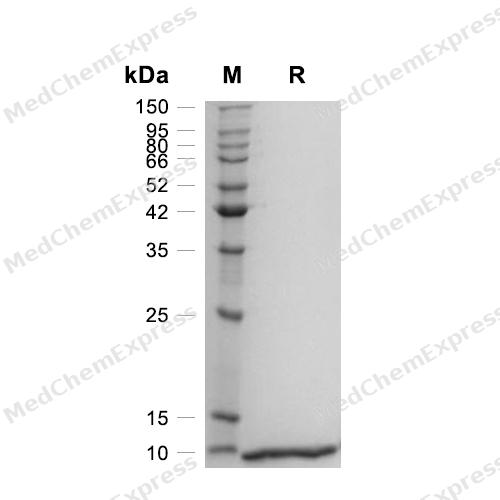
Purity - SDS-PAGE
-
Bioactivity - Cell-Based Assay
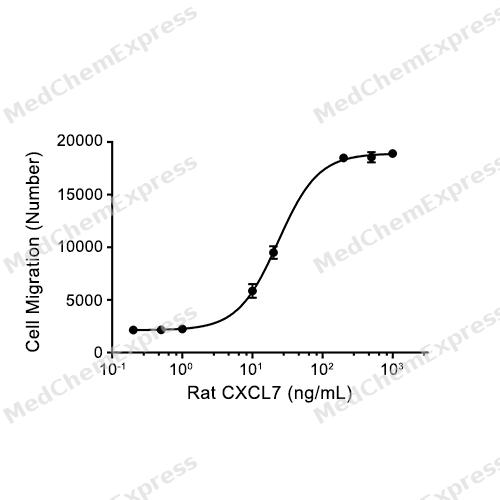
Bioactivity - Cell-Based Assay


Technical Parameters
-
Species Rat
-
Source E. coli
-
Tag Tag Free
-
Accession
Q99ME0 (I46-I107)
-
Molecular Construction
-
N-term
-
CXCL7 (I46-I107)
Accession # Q99ME0 -
C-term
-
-
Protein Length
Full Length of Chemokine interleukin-8-like Domain
-
Synonyms
PPBP; Macrophage-Derived Growth Factor; Prev. THBGB1; C-X-C Motif Chemokine 7; SCYB7; Beta-Thromboglobulin; CTAP3; NAP-2-L1; CXCL7; Small Inducible Cytokine Subfamily B, Member 7; MDGF; Neutrophil-Activating Peptide-2; LDGF; Low-Affinity Platelet Factor I
-
AA Sequence
IELRCRCTNTLSGIPLNSISRVNVFRPGAHCDNVEVIATLKNGKEVCLDPTAPMIKKIVKKI
-
Molecular Weight
Approximately 10 kDa, based on SDS-PAGE under reducing conditions.
-
Purity
≥ 95%, as determined by reducing SDS-PAGE.


Product Properties
Lyophilized powder.
Lyophilized from a 0.22 μm filtered solution of 20 mM PB, 150 mM NaCl, pH 7.4.
<1 EU/μg, determined by LAL method.
It is not recommended to reconstitute to a concentration less than 100 μg/mL in ddH2O. For long term storage it is recommended to add a carrier protein (0.1% BSA, 5% HSA, 10% FBS or 5% Trehalose).
Stored at -20°C for 2 years from date of receipt. After reconstitution, it is stable at 4°C for 1 week or -20°C for longer (with carrier protein). It is recommended to freeze aliquots at -20°C or -80°C for extended storage.
Room temperature in continental US; may vary elsewhere.


Documentation
-
Data Sheet (263 KB)
-
SDS (251 KB)
- English - EN (251 KB)
- Français - FR (251 KB)
- Deutsch - DE (251 KB)
- Norwegian - NO (251 KB)
- Español - ES (251 KB)
- Swedish - SV (251 KB)
- Italian - IT (251 KB)
- Korean - KR (251 KB)
- Portuguese - PT (251 KB)
-
Handling Instructions (2659 KB)


References
[1]. Qian Guo, et al. CXCL7 promotes proliferation and invasion of cholangiocarcinoma cells. Oncol Rep. 2017 Feb;37(2):1114-1122. [Content Brief]
[2]. Oda M, et al. Thrombopoietin-induced CXC chemokines, NAP-2 and PF4, suppress polyploidization and proplatelet formation during megakaryocyte maturation. Genes Cells. 2003 Jan;8(1):9-15. [Content Brief]
[3]. Yu-Shan Wang, et al. Canine CXCL7 and its functional expression in dendritic cells undergoing maturation. Vet Immunol Immunopathol. 2010 May 15;135(1-2):128-136. [Content Brief]

Calculators
Concentration (start) × Volume (start) = Concentration (final) × Volume (final)


 Powered by Bioz

