



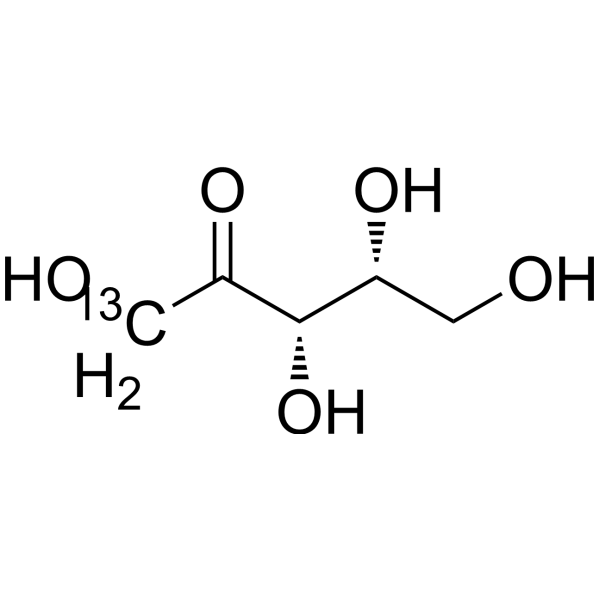
D-Xylulose-1-13C

Based on 1 Customer Validation
D-Xylulose-1-13C is the 13C-labeled D-Xylulose (HY-W010256). D-Xylulose is a toxic pentose. D-Xylulose does not induce pentitol production in cells. D-Xylulose can induce ATP and intracellular Pi depletion through the accumulation of Sedoheptulose 7-P.
For research use only. We do not sell to patients.
- Purity : 99.22%
- CAS No.: 131771-46-5
- Formula: C413CH10O5
- Molecular Weight:151.12
-
Storage:
Solution, -20°C, 2 years

To place orders, for customer services and technical support, please contact: MedChemExpress USA
Tel: 609-228-6898 E-mail: [email protected] [email protected]


-
 Biological Activity
-
Chemical Information
- Purity & Documentation
- References
-
 Help & FAQs




Biological Activity
Description
Application
1. This compound can be used as a tracer
2. This compound can be used as an internal standard for quantitative analysis by NMR, GC-MS, or LC-MS.


Chemical Information
-
CAS No. 131771-46-5
-
Unlabeled CAS 551-84-8
-
Appearance Liquid
-
Molecular Weight 151.12
-
Formula C413CH10O5
-
Color Colorless to light yellow
-
SMILES
OC[C@@H](O)[C@H](O)C([13CH2]O)=O
-
Shipping
Room temperature in continental US; may vary elsewhere.
-
Storage
Solution, -20°C, 2 years


Purity & Documentation
-
Data Sheet (266 KB)
-
SDS (392 KB)
- English - EN (392 KB)
- Français - FR (392 KB)
- Deutsch - DE (392 KB)
- Norwegian - NO (392 KB)
- Español - ES (392 KB)
- Swedish - SV (392 KB)
- Italian - IT (392 KB)
- Korean - KR (392 KB)
- Portuguese - PT (392 KB)
-
Handling Instructions (2659 KB)
References
[1]. Huck JH, et al. Evaluation of pentitol metabolism in mammalian tissues provides new insight into disorders of human sugar metabolism. Molecular genetics and metabolism. 2004 Jul;82(3):231-7. [Content Brief]
[2]. Vincent MF, et al. D-xylulose-induced depletion of ATP and Pi in isolated rat hepatocytes. FASEB journal : official publication of the Federation of American Societies for Experimental Biology. 1989 May;3(7):1855-61. [Content Brief]

Calculators
Concentration (start) × Volume (start) = Concentration (final) × Volume (final)


D-Xylulose-1-13C Related Classifications
HY-W010256S Related Classifications
 Powered by Bioz