



Derazantinib dihydrochloride
Based on 3 publication(s) in Google Scholar
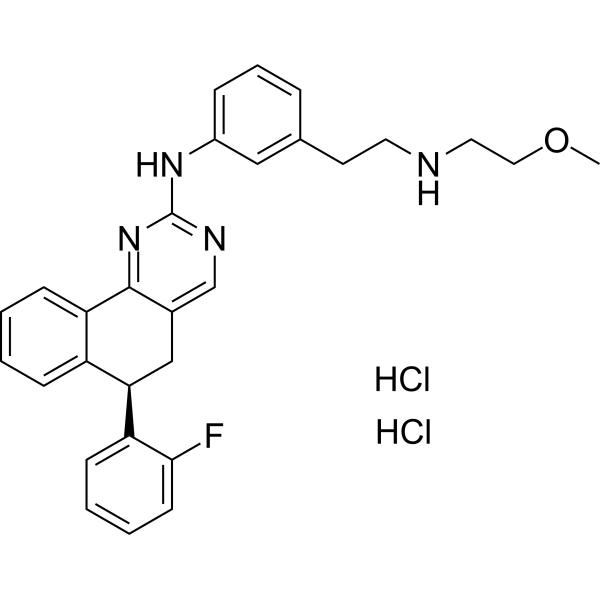
Derazantinib (ARQ-087) dihydrochloride is an ATP competitive and orally activeFGFR inhibitor (IC50s: 1.8 nM for FGFR2, 4.5 nM for FGFR1 and 3). Derazantinib dihydrochloride inhibits FGFR phosphorylation. Derazantinib dihydrochloride inhibits tumor growth in multiple xenograft models.
For research use only. We do not sell to patients.
- CAS No.: 1821329-75-2
- Formula: C29H31Cl2FN4O
- Molecular Weight:541.49
-
Storage:
Please store the product under the recommended conditions in the Certificate of Analysis.

To place orders, for customer services and technical support, please contact: MedChemExpress USA
Tel: 609-228-6898 E-mail: [email protected] [email protected]


-
 Biological Activity
-
Chemical Information
- Purity & Documentation
- References
-
 Help & FAQs


Publications Citing Use of MedChemExpress (MCE) Derazantinib dihydrochloride
MoreAll EGFR Isoforms
More

Biological Activity
Description
IC50 & Target
1.8 nM for FGFR2, 4.5 nM for FGFR1 and 3 nM[1]


Chemical Information
-
CAS No. 1821329-75-2
-
Molecular Weight 541.49
-
Formula C29H31Cl2FN4O
-
SMILES
COCCNCCC1=CC(NC2=NC=C3C[C@@H](C4=CC=CC=C4F)C5=CC=CC=C5C3=N2)=CC=C1.Cl.Cl
-
Synonyms
ARQ-087 dihydrochloride
-
Shipping
Room temperature in continental US; may vary elsewhere.
-
Storage
Please store the product under the recommended conditions in the Certificate of Analysis.


Publications (3)
-
Journal Impact Factor
-
Most Recent
-
Arthritis Res Ther
Roles of VWA1 and Rac2 in compensatory and decompensatory responses via FGF9/FGFR3 and p38 MAPK signaling pathways in condylar chondrocytes under distinct mechanical stress. [Abstract]2025 May 31;27(1):118. PMID: 40450276 -
ACS Infect Dis
Derazantinib Inhibits the Planktonic Growth and Biofilm Formation of Staphylococcus aureus by Binding Membrane Phospholipids and Disrupting the Cell Membrane. [Abstract]2025 Jun 13;11(6):1473-1485. PMID: 40367508 -


Purity & Documentation
References
[1]. Hall TG, et al. Preclinical Activity of ARQ-087, a Novel Inhibitor Targeting FGFR Dysregulation. PLoS One. 2016 Sep 14;11(9):e0162594. [Content Brief]
[2]. Balek L, et al. ARQ-087 inhibits FGFR signaling and rescues aberrant cell proliferation and differentiation in experimental models of craniosynostoses and chondrodysplasias caused by activating mutations in FGFR1, FGFR2 and FGFR3. Bone. 2017 Dec;105:57-66. [Content Brief]

Calculators
Concentration (start) × Volume (start) = Concentration (final) × Volume (final)


Derazantinib dihydrochloride Related Classifications
HY-19981B Related Classifications
 Powered by Bioz