



DOPG
Based on 3 publication(s) in Google Scholar
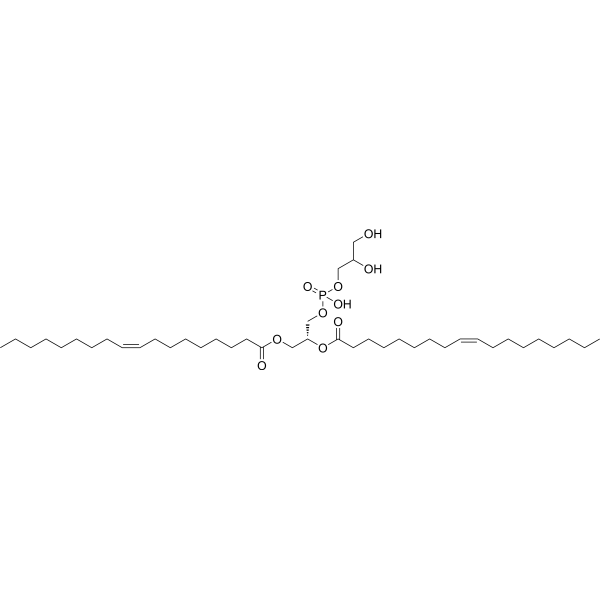
DOPG (Dioleoylphosphatidylglycerol) is a negatively charged phosphatidylglycerol phospholipid. DOPG is abundant in prokaryotic cell membranes and mitochondria, and has a low phase transition temperature and a tendency to form stable vesicles. DOPG inhibits the production of inflammatory mediators in macrophages in response to heat shock protein B4 (HSPB4)-activated toll-like receptor 2 (TLR2). DOPG is applicable to studies of membrane biology, drug-membrane interactions (especially in systems targeting negatively charged membranes), construction of drug delivery carriers, as well as research on sterile corneal inflammation and wound healing promotion.
For research use only. We do not sell to patients.
- CAS No.: 62700-69-0
- Formula: C42H79O10P
- Molecular Weight:775.04
-
Storage:
Please store the product under the recommended conditions in the Certificate of Analysis.

To place orders, for customer services and technical support, please contact: MedChemExpress USA
Tel: 609-228-6898 E-mail: [email protected] [email protected]


-
 Biological Activity
-
Chemical Information
- Purity & Documentation
- References
-
 Help & FAQs


Publications Citing Use of MedChemExpress (MCE) DOPG
More

Biological Activity
Description
In Vitro
DOPG (10 µg/mL) inhibits the production of macrophage inflammatory mediators induced by heat shock protein B4 via activation of Toll-like receptor 2[2].
MedChemExpress (MCE) has not independently confirmed the accuracy of these methods. They are for reference only.


Chemical Information
-
CAS No. 62700-69-0
-
Molecular Weight 775.04
-
Formula C42H79O10P
-
SMILES
OCC(O)COP(OC[C@@H](COC(CCCCCCC/C=C\CCCCCCCC)=O)OC(CCCCCCC/C=C\CCCCCCCC)=O)(O)=O
-
Synonyms
Dioleoylphosphatidylglycerol
-
Shipping
Room temperature in continental US; may vary elsewhere.
-
Storage
Please store the product under the recommended conditions in the Certificate of Analysis.


Publications (3)
-
Journal Impact Factor
-
Most Recent
-
Biomaterials
AI agent-based discovery of D-enantiomeric antimicrobial peptides against multidrug-resistant bacterial infection. [Abstract]2026 Jun:329:123927. PMID: 41443039 -
ACS Appl Mater Interfaces
Self-Assembling Lauroylated Antimicrobial Peptide with Superior Antimicrobial Activity, Stability, and Selectivity. [Abstract]2025 Mar 5;17(9):13646-13659. PMID: 39964258 -
J Photochem Photobiol B
Disinfection mechanisms of gram-negative and gram-positive bacteria through multi-target damage under UV-C light at 222 and 254 nm. [Abstract]2026 Feb:275:113362. PMID: 41520611


Purity & Documentation
References

Calculators
Concentration (start) × Volume (start) = Concentration (final) × Volume (final)


DOPG Related Classifications
HY-142980 Related Classifications
 Powered by Bioz