



Auxinole
Based on 20 publication(s) in Google Scholar
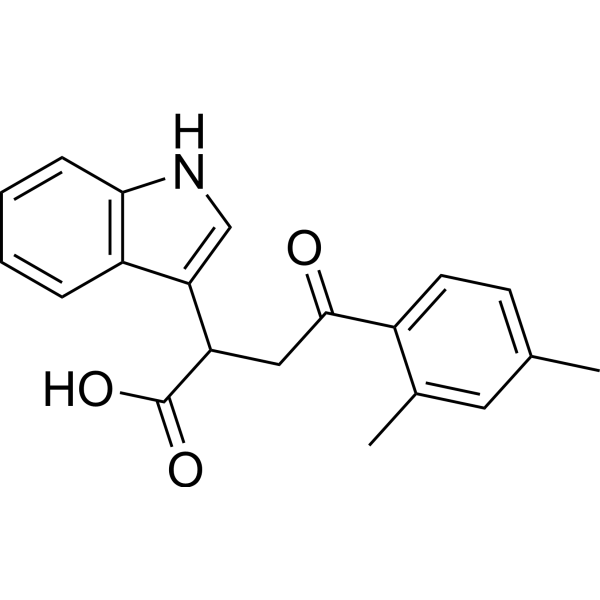
Auxinole is a potent auxin antagonist of TIR1/AFB receptors, binding TIR1 to block the formation of the TIR1-IAA-Aux/IAA complex and so inhibits auxin-responsive gene expression.
For research use only. We do not sell to patients.
- Purity: 99.82%
- CAS No.: 86445-22-9
- Formula: C20H19NO3
- Molecular Weight:321.37
-
Storage:Powder -20°C, 3 years , 4°C, 2 years ; In solvent -80°C, 2 years , -20°C, 1 year

To place orders, for customer services and technical support, please contact: MedChemExpress USA
Tel: 609-228-6898 E-mail: [email protected] [email protected]


-
 Biological Activity
-
Chemical Information
-
Solvent & Solubility
- Purity & Documentation
- References
-
 Help & FAQs


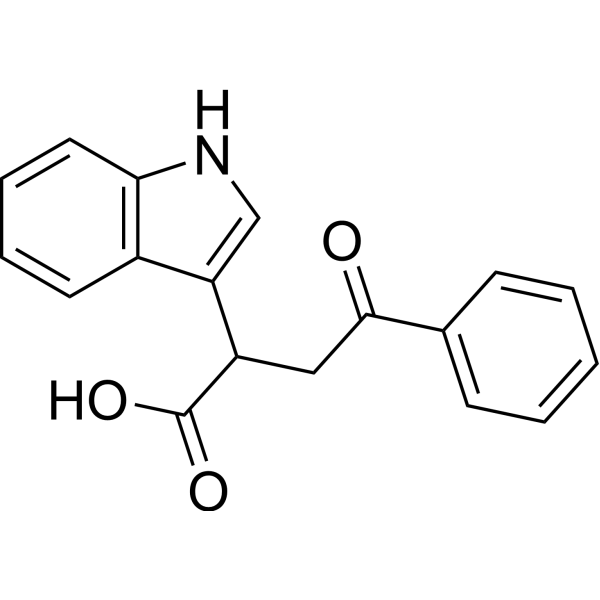
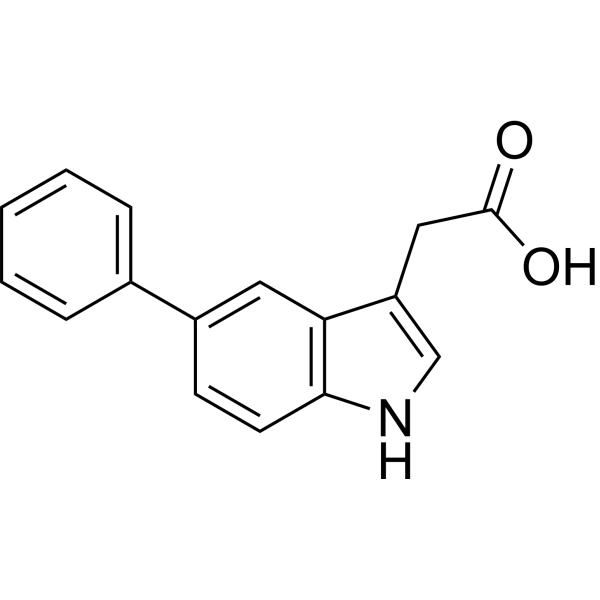
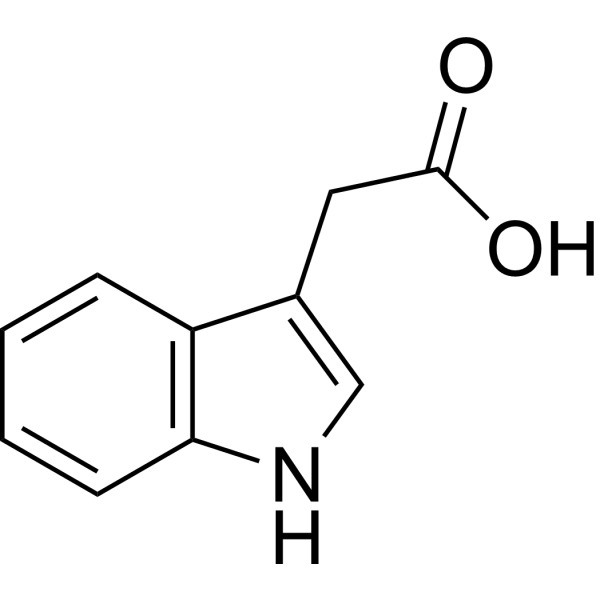
Publications Citing Use of MedChemExpress (MCE) Auxinole
More- Nat Commun. 2026 May 11.
- Mol Cell. 2022 Jan 6;82(1):140-158.e12. [Abstract]
- Mol Cell. 2021 Dec 16;81(24):5007-5024.e9. [Abstract]
- J Integr Plant Biol. 2022 Jan;64(1):5-22. [Abstract]
- Nat Struct Mol Biol. 2025 Jan;32(1):48-61. [Abstract]
- New Phytol. 2019 Oct;224(1):258-273. [Abstract]
- Plant Physiol. 2022 Mar 4;188(3):1563-1585. [Abstract]
- Curr Biol. 2022 May 9;32(9):1883-1894.e7. [Abstract]
- Curr Biol. 2021 Mar 22;31(6):1154-1164.e3. [Abstract]
- Genetics. 2026 May 11:iyag120. [Abstract]
- SCI HORTIC-AMSTERDAM. 2023 Jul 1, 112085.
- bioRxiv. 2026 Jun 6.
- bioRxiv. 2026 Apr 6.
- bioRxiv. 2026 Jan 2.
- bioRxiv. 2025 Jul 18.
- bioRxiv. 2025 April 29.
- biorxiv. 2024 Jun 08.
- biorxiv. 2024 Jun 07.
- Methods Mol Biol. 2023:2557:365-390. [Abstract]
- Authorea. October 10, 2022.


Biological Activity
Description
IC50 & Target
TIR1/AFB receptor[1]
In Vitro
Auxinole is a potent auxin antagonist of TIR1/AFB receptors, and binds TIR1 to block the formation of the TIR1-IAA-Aux/IAA complex and then inhibits auxin-responsive gene expression. In addition, Auxinole competitively inhibits various auxin responses in planta[1]. Auxinole causes reduction in IAA-triggered depolarization in root hair cells. Auxinole (20 μM) also represses the transient increase in [Ca2+]cyt completely, and blocks Ca2+ response[2].
MedChemExpress (MCE) has not independently confirmed the accuracy of these methods. They are for reference only.


Chemical Information
-
CAS No. 86445-22-9
-
Appearance Solid
-
Molecular Weight 321.37
-
Formula C20H19NO3
-
Color White to off-white
-
SMILES
O=C(O)C(CC(C1=CC=C(C)C=C1C)=O)C2=CNC3=C2C=CC=C3
-
Shipping
Room temperature in continental US; may vary elsewhere.
-
Storage
Powder -20°C 3 years 4°C 2 years In solvent -80°C 2 years -20°C 1 year


Publications (20)
-
Journal Impact Factor
-
Most Recent
-
-
Mol Cell
2022 Jan 6;82(1):140-158.e12. PMID: 34890565 -
Mol Cell
Topoisomerase 1 activity during mitotic transcription favors the transition from mitosis to G1. [Abstract]2021 Dec 16;81(24):5007-5024.e9. PMID: 34767771 -
J Integr Plant Biol
Growth asymmetry precedes differential auxin response during apical hook initiation in Arabidopsis. [Abstract]2022 Jan;64(1):5-22. PMID: 34786851 -
Nat Struct Mol Biol
Topoisomerase-modulated genome-wide DNA supercoiling domains colocalize with nuclear compartments and regulate human gene expression. [Abstract]2025 Jan;32(1):48-61. PMID: 39152238 -
New Phytol
Phosphoethanolamine N-methyltransferase 1 contributes to maintenance of root apical meristem by affecting ROS and auxin-regulated cell differentiation in Arabidopsis. [Abstract]2019 Oct;224(1):258-273. PMID: 31246280 -
Plant Physiol
ROOT HAIR DEFECTIVE 2 vesicular delivery to the apical plasma membrane domain during Arabidopsis root hair development. [Abstract]2022 Mar 4;188(3):1563-1585. PMID: 34986267 -
Curr Biol
Cell-wall damage activates DOF transcription factors to promote wound healing and tissue regeneration in Arabidopsis thaliana. [Abstract]2022 May 9;32(9):1883-1894.e7. PMID: 35320706 -
Curr Biol
2021 Mar 22;31(6):1154-1164.e3. PMID: 33417884 -
Genetics
Auxin promotes robust founder cell specification during Arabidopsis lateral root initiation. [Abstract]2026 May 11:iyag120. PMID: 42114106 -
-
-
-
-
-
-
-
-
Methods Mol Biol
2023:2557:365-390. PMID: 36512227 -


Solvent & Solubility
In Vitro:
DMSO : ≥ 125 mg/mL (388.96 mM; Hygroscopic DMSO has a significant impact on the solubility of product, please use newly opened DMSO)
Ethanol : 2.5 mg/mL (7.78 mM; ultrasonic and warming and heat to 60°C)
* "≥" means soluble, but saturation unknown.
Please refer to the solubility information to select the appropriate solvent. Once prepared, please aliquot and store the solution to prevent product inactivation from repeated freeze-thaw cycles.
Storage method and period of stock solution: -80°C, 2 years; -20°C, 1 year. When stored at -80°C, please use it within 2 years. When stored at -20°C, please use it within 1 year.
Please refer to the solubility information to select the appropriate solvent. Once prepared, please aliquot and store the solution to prevent product inactivation from repeated freeze-thaw cycles.
Storage method and period of stock solution: -80°C, 2 years; -20°C, 1 year. When stored at -80°C, please use it within 2 years. When stored at -20°C, please use it within 1 year.
Concentration (start) × Volume (start) = Concentration (final) × Volume (final)
In Vivo:
Select the appropriate dissolution method based on your experimental animal and administration route.
- For the following dissolution methods, please ensure to first prepare a clear stock solution using an In Vitro approach and then sequentially add co-solvents:
- To ensure reliable experimental results, the clarified stock solution can be appropriately stored based on storage conditions. As for the working solution for In Vivo experiments, it is recommended to prepare freshly and use it on the same day.
- The percentages shown for the solvents indicate their volumetric ratio in the final prepared solution. If precipitation or phase separation occurs during preparation, heat and/or sonication can be used to aid dissolution.
Add each solvent one by one: 10% DMSO 40% PEG300 5% Tween-80 45% Saline
Solubility: ≥ 2.08 mg/mL (6.47 mM); Clear solution
This protocol yields a clear solution of ≥ 2.08 mg/mL (saturation unknown).
Taking 1 mL working solution as an example, add 100 μL DMSO stock solution (20.8 mg/mL) to 400 μL PEG300, and mix evenly; then add 50 μL Tween-80 and mix evenly; then add 450 μL Saline to adjust the volume to 1 mL.
Preparation of Saline: Dissolve 0.9 g sodium chloride in ddH₂O and dilute to 100 mL to obtain a clear Saline solution.
Add each solvent one by one: 10% DMSO 90% (20% SBE-β-CD in Saline)
Solubility: ≥ 2.08 mg/mL (6.47 mM); Clear solution
This protocol yields a clear solution of ≥ 2.08 mg/mL (saturation unknown).
Taking 1 mL working solution as an example, add 100 μL DMSO stock solution (20.8 mg/mL) to 900 μL 20% SBE-β-CD in Saline, and mix evenly.
Preparation of 20% SBE-β-CD in Saline (4°C, storage for one week): 2 g SBE-β-CD powder is dissolved in 10 mL Saline, completely dissolve until clear.
In Vivo Dissolution Calculator
Please enter the basic information of animal experiments:
-
-
-
-
Recommended: Prepare an additional quantity of animals to account for potential losses during experiments.
Please enter your animal formula composition:
-
%DMSO +
Recommended: Keep the proportion of DMSO in working solution below 2% if your animal is weak.
-
%+
-
+%Tween-80 + +
-
%Saline +
The co-solvents required include: DMSO, . All of co-solvents are available by MedChemExpress (MCE). , Tween 80. All of co-solvents are available by MedChemExpress (MCE).
Working solution concentration: 0.22 mg/mL
Method for preparing stock solution: mg drug dissolved in μL DMSO. Stock solution concentration: mg/mL.
1. Take μL DMSO stock solution;
2. Add μL .
μL , mix evenly;
3. Then add μL Tween 80, mix evenly;
4. Then add μL
Please ensure that the stock solution in the first step is dissolved to a clear state, and add co-solvents in sequence. You can use ultrasonic heating (ultrasonic cleaner, recommended frequency 20-40 kHz), vortexing, etc. to assist dissolution.


Purity & Documentation
-
Data Sheet (278 KB)
-
SDS (393 KB)
- English - EN (393 KB)
- Français - FR (393 KB)
- Deutsch - DE (393 KB)
- Norwegian - NO (393 KB)
- Español - ES (393 KB)
- Swedish - SV (393 KB)
- Italian - IT (393 KB)
- Korean - KR (393 KB)
- Portuguese - PT (393 KB)
-
Handling Instructions (2659 KB)
References
[1]. Hayashi K, et al. Rational design of an auxin antagonist of the SCF(TIR1) auxin receptor complex. ACS Chem Biol. 2012 Mar 16;7(3):590-8. [Content Brief]
[2]. Dindas J, et al. AUX1-mediated root hair auxin influx governs SCFTIR1/AFB-type Ca2+ signaling. Nat Commun. 2018 Mar 21;9(1):1174. [Content Brief]


Complete Stock Solution Preparation Table
Please refer to the solubility information to select the appropriate solvent. Once prepared, please aliquot and store the solution to prevent product inactivation from repeated freeze-thaw cycles.
Storage method and period of stock solution: -80°C, 2 years; -20°C, 1 year. When stored at -80°C, please use it within 2 years. When stored at -20°C, please use it within 1 year.
| Optional Solvent | Concentration Solvent Mass | 1 mg | 5 mg | 10 mg | 25 mg |
|---|---|---|---|---|---|
| Ethanol / DMSO | 1 mM | 3.1117 mL | 15.5584 mL | 31.1168 mL | 77.7920 mL |
| 5 mM | 0.6223 mL | 3.1117 mL | 6.2234 mL | 15.5584 mL | |
| DMSO | 10 mM | 0.3112 mL | 1.5558 mL | 3.1117 mL | 7.7792 mL |
| 15 mM | 0.2074 mL | 1.0372 mL | 2.0745 mL | 5.1861 mL | |
| 20 mM | 0.1556 mL | 0.7779 mL | 1.5558 mL | 3.8896 mL | |
| 25 mM | 0.1245 mL | 0.6223 mL | 1.2447 mL | 3.1117 mL | |
| 30 mM | 0.1037 mL | 0.5186 mL | 1.0372 mL | 2.5931 mL | |
| 40 mM | 0.0778 mL | 0.3890 mL | 0.7779 mL | 1.9448 mL | |
| 50 mM | 0.0622 mL | 0.3112 mL | 0.6223 mL | 1.5558 mL | |
| 60 mM | 0.0519 mL | 0.2593 mL | 0.5186 mL | 1.2965 mL | |
| 80 mM | 0.0389 mL | 0.1945 mL | 0.3890 mL | 0.9724 mL | |
| 100 mM | 0.0311 mL | 0.1556 mL | 0.3112 mL | 0.7779 mL |


Auxinole Related Classifications
HY-111444 Related Classifications
 Powered by Bioz