



Tylosin
Based on 1 publication(s) in Google Scholar
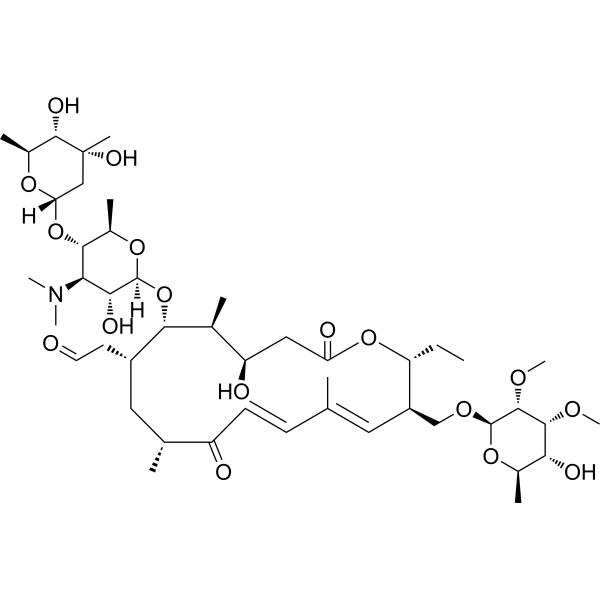
Tylosin (Tylosin A) is a macrolide antibiotic found naturally as a fermentation product of Streptomyces fradiae. Tylosin exerts potent antimicrobial activity against Gram-positive bacteria. Tylosin is widely used as a feed additive for promoting animal growth. Tylosin is used for veterinary purposes against bacterial dysentery and respiratory diseases in poultry, pigs and cattle.
Para uso exclusivo en investigación. No vendemos a pacientes.
- Pureza: 98.0%
- No. CAS: 1401-69-0
- Fòrmula: C46H77NO17
- Peso molecular:916.10
-
Almacenamiento:Powder -20°C, 3 years , 4°C, 2 years ; In solvent -80°C, 2 years , -20°C, 1 year

To place orders, for customer services and technical support, please contact: MedChemExpress USA
Tel: 609-228-6898 E-mail: [email protected] [email protected]


-
 Actividad biológica
-
Chemical Information
-
Solvente y solubilidad
- Pureza y Documentación
- Referencias
-
 Help & FAQs
-


Anti-Infection Compound Library
HY-L002
-
Natural Product Library
HY-L021
-
FDA-Approved Drug Library
HY-L022
-
Drug Repurposing Compound Library
HY-L035
-
Macrocyclic Compound Library
HY-L041
-
Lipid Compound Library
HY-L043
-
Antibacterial Compound Library
HY-L049
-
Medicine Food Homology Compound Library
HY-L055
-
Pyroptosis Compound Library
HY-L059
-
FDA Approved & Pharmacopeial Drug Library
HY-L066
-
Antibiotics Library
HY-L067
-
Microbial Metabolite Library
HY-L084
-
Food-Sourced Compound Library
HY-L094
-
Human Metabolite Library
HY-L123
-
Heterocyclic Compound Library
HY-L138
-
Off-patent Drug Library
HY-L141
-
Bioactive Compound Library Max
HY-L181
-
MCE Bioactive Compound Library
HY-L001V
-
Natural Product Library Plus
HY-L021P
-
Drug Repurposing Compound Library Plus
HY-L035P
-
FDA-Approved Drug Library Plus
HY-L022P
-
FDA-Approved Drug Library Mini
HY-L022M
-
Natural Product and Natural Product-Like Compound Library
HY-L021M
-
Bioactive Compound Library
HY-L001
-
High-Throughput Bioactive Compound Library
HY-L205
-
High-Throughput Natural Product Library
HY-L206
-
Mass Spectrometry Human Metabolite Library
HY-L215
-
Animal Drug Library
HY-L218
-
Mass Spectrometry Natural Product Library
HY-L262


Publications Citing Use of MedChemExpress (MCE) Tylosin
MoreVer todos los productos específicos de isoformas Antibiotic
More

Actividad biológica
|
Macrolide |
Tylosin exerts antibacterial effects by binding to 23S rRNA of the bacterial ribosomal 50S subunit [1].
Tylosin also prevents growth of Gram-negative strains, with MICs of 64 μg/mL, 32 μg/mL, 512 μg/mL and 1 μg/mL for M. haemolytica 11935, P. multocida 4407, E. coli ATCC 25922 and E. coli AS19rlmAI, respectively[3].
MedChemExpress (MCE) has not independently confirmed the accuracy of these methods. They are for reference only.
MedChemExpress (MCE) has not independently confirmed the accuracy of these methods. They are for reference only.
-
Animal Model:Balb/C mice (2-3 months old, 20-25 g)[4]
-
Dosage:10 mg/kg, 100 mg/kg, 500 mg/kg
-
Administration:Subcutaneous injection
-
Result:Reduced the elevated TNF-α and IL-1β in LPS (250 µg)-treated mice but increased their IL-10 levels.


Chemical Information
-
No. CAS 1401-69-0
-
Appearance Solid
-
Peso molecular 916.10
-
Fòrmula C46H77NO17
-
Color White to light yellow
-
SMILES
C[C@@H](O[C@@]1([H])O[C@H]([C@H]([C@@H](CC2=O)O)C)[C@H](C[C@H](C(/C=C/C(C)=C/[C@H](CO[C@H](O[C@H](C)[C@@H](O)[C@H]3OC)[C@@H]3OC)[C@@H](CC)O2)=O)C)CC=O)[C@H]([C@@H]([C@H]1O)N(C)C)O[C@@](O[C@@H](C)[C@@H]4O)([H])C[C@]4(O)C
-
Structure Classification
-
Initial Source
Streptomyces fradiae
-
Envío
Room temperature in continental US; may vary elsewhere.
-
Almacenamiento
Powder -20°C 3 years 4°C 2 years In solvent -80°C 2 years -20°C 1 year


Publications (1)
-
Journal Impact Factor
-
Most Recent
-
Chemosphere
Mass-balance-model-based evaluation of sewage treatment plant contribution to residual pharmaceuticals in environmental waters. [Abstract]2019 Jun:225:378-387. PMID: 30884299


Solvente y solubilidad
DMSO : ≥ 100 mg/mL (109.16 mM; Hygroscopic DMSO has a significant impact on the solubility of product, please use newly opened DMSO)
H2O : < 0.1 mg/mL (insoluble)
* "≥" means soluble, but saturation unknown.
Please refer to the solubility information to select the appropriate solvent. Once prepared, please aliquot and store the solution to prevent product inactivation from repeated freeze-thaw cycles.
Storage method and period of stock solution: -80°C, 2 years; -20°C, 1 year. When stored at -80°C, please use it within 2 years. When stored at -20°C, please use it within 1 year.
Please refer to the solubility information to select the appropriate solvent. Once prepared, please aliquot and store the solution to prevent product inactivation from repeated freeze-thaw cycles.
Storage method and period of stock solution: -80°C, 2 years; -20°C, 1 year. When stored at -80°C, please use it within 2 years. When stored at -20°C, please use it within 1 year.
Concentration (start) × Volume (start) = Concentration (final) × Volume (final)
Select the appropriate dissolution method based on your experimental animal and administration route.
- For the following dissolution methods, please ensure to first prepare a clear stock solution using an In Vitro approach and then sequentially add co-solvents:
- To ensure reliable experimental results, the clarified stock solution can be appropriately stored based on storage conditions. As for the working solution for In Vivo experiments, it is recommended to prepare freshly and use it on the same day.
- The percentages shown for the solvents indicate their volumetric ratio in the final prepared solution. If precipitation or phase separation occurs during preparation, heat and/or sonication can be used to aid dissolution.
Add each solvent one by one: 10% DMSO 40% PEG300 5% Tween-80 45% Saline
Solubility: ≥ 2.5 mg/mL (2.73 mM); Clear solution
This protocol yields a clear solution of ≥ 2.5 mg/mL (saturation unknown).
Taking 1 mL working solution as an example, add 100 μL DMSO stock solution (25.0 mg/mL) to 400 μL PEG300, and mix evenly; then add 50 μL Tween-80 and mix evenly; then add 450 μL Saline to adjust the volume to 1 mL.
Preparation of Saline: Dissolve 0.9 g sodium chloride in ddH₂O and dilute to 100 mL to obtain a clear Saline solution.
Add each solvent one by one: 10% DMSO 90% (20% SBE-β-CD in Saline)
Solubility: ≥ 2.5 mg/mL (2.73 mM); Clear solution
This protocol yields a clear solution of ≥ 2.5 mg/mL (saturation unknown).
Taking 1 mL working solution as an example, add 100 μL DMSO stock solution (25.0 mg/mL) to 900 μL 20% SBE-β-CD in Saline, and mix evenly.
Preparation of 20% SBE-β-CD in Saline (4°C, storage for one week): 2 g SBE-β-CD powder is dissolved in 10 mL Saline, completely dissolve until clear.
Please enter the basic information of animal experiments:
-
-
-
-
Recommended: Prepare an additional quantity of animals to account for potential losses during experiments.
Please enter your animal formula composition:
-
%DMSO +
Recommended: Keep the proportion of DMSO in working solution below 2% if your animal is weak.
-
%+
-
+%Tween-80 + +
-
%Saline +
The co-solvents required include: DMSO, . All of co-solvents are available by MedChemExpress (MCE). , Tween 80. All of co-solvents are available by MedChemExpress (MCE).
Working solution concentration: 0.22 mg/mL
Method for preparing stock solution: mg drug dissolved in μL DMSO. Stock solution concentration: mg/mL.
1. Take μL DMSO stock solution;
2. Add μL .
μL , mix evenly;
3. Then add μL Tween 80, mix evenly;
4. Then add μL
Please ensure that the stock solution in the first step is dissolved to a clear state, and add co-solvents in sequence. You can use ultrasonic heating (ultrasonic cleaner, recommended frequency 20-40 kHz), vortexing, etc. to assist dissolution.


Pureza y Documentación
-
Ficha de datos (279 KB)
-
SDS (597 KB)
- English - EN (597 KB)
- Français - FR (597 KB)
- Deutsch - DE (597 KB)
- Norwegian - NO (597 KB)
- Español - ES (597 KB)
- Swedish - SV (597 KB)
- Italian - IT (597 KB)
- Korean - KR (597 KB)
- Portuguese - PT (597 KB)
-
Instrucciones de manejo (2659 KB)
Referencias
[1]. Mingfu Liu, et al. Resistance to the macrolide antibiotic tylosin is conferred by single methylations at 23S rRNA nucleotides G748 and A2058 acting in synergy. Proc Natl Acad Sci U S A. 2002 Nov 12; 99(23): 14658-14663. [Content Brief]
[2]. Carlo Pinna, et al. In Vitro Evaluation of the Effects of Tylosin on the Composition and Metabolism of Canine Fecal Microbiota. Animals (Basel). 2020 Jan; 10(1): 98. [Content Brief]
[3]. Niels Møller Andersen, et al. Inhibition of Protein Synthesis on the Ribosome by Tildipirosin Compared with Other Veterinary Macrolides. Antimicrob Agents Chemother. 2012 Nov; 56(11): 6033-6036. [Content Brief]
[4]. Ayse Er, et al. Effects of tylosin on serum cytokine levels in healthy and lipopolysaccharide-treated mice. Acta Vet Hung. 2010 Mar;58(1):75-81. [Content Brief]


Complete Stock Solution Preparation Table
Please refer to the solubility information to select the appropriate solvent. Once prepared, please aliquot and store the solution to prevent product inactivation from repeated freeze-thaw cycles.
Storage method and period of stock solution: -80°C, 2 years; -20°C, 1 year. When stored at -80°C, please use it within 2 years. When stored at -20°C, please use it within 1 year.
| Optional Solvent | Concentration Solvent Mass | 1 mg | 5 mg | 10 mg | 25 mg |
|---|---|---|---|---|---|
| DMSO | 1 mM | 1.0916 mL | 5.4579 mL | 10.9158 mL | 27.2896 mL |
| 5 mM | 0.2183 mL | 1.0916 mL | 2.1832 mL | 5.4579 mL | |
| 10 mM | 0.1092 mL | 0.5458 mL | 1.0916 mL | 2.7290 mL | |
| 15 mM | 0.0728 mL | 0.3639 mL | 0.7277 mL | 1.8193 mL | |
| 20 mM | 0.0546 mL | 0.2729 mL | 0.5458 mL | 1.3645 mL | |
| 25 mM | 0.0437 mL | 0.2183 mL | 0.4366 mL | 1.0916 mL | |
| 30 mM | 0.0364 mL | 0.1819 mL | 0.3639 mL | 0.9097 mL | |
| 40 mM | 0.0273 mL | 0.1364 mL | 0.2729 mL | 0.6822 mL | |
| 50 mM | 0.0218 mL | 0.1092 mL | 0.2183 mL | 0.5458 mL | |
| 60 mM | 0.0182 mL | 0.0910 mL | 0.1819 mL | 0.4548 mL | |
| 80 mM | 0.0136 mL | 0.0682 mL | 0.1364 mL | 0.3411 mL | |
| 100 mM | 0.0109 mL | 0.0546 mL | 0.1092 mL | 0.2729 mL |


Tylosin Related Classifications
HY-B0519A Related Classifications
 Powered by Bioz