



HDAC-IN-49
Based on 1 publication(s) in Google Scholar
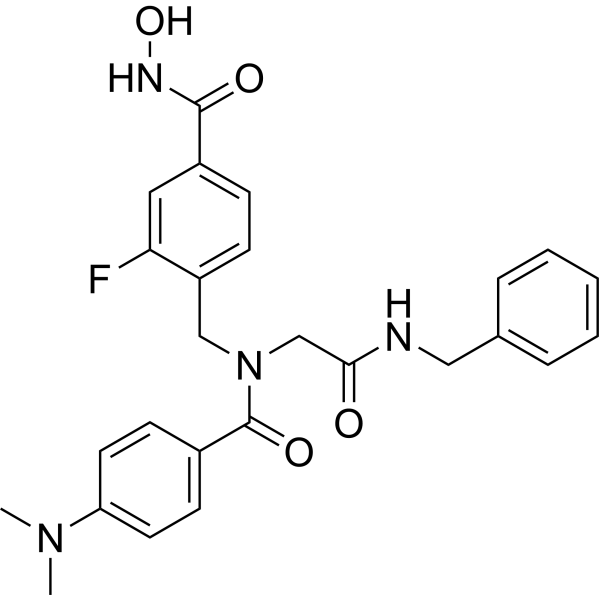
HDAC-IN-49 is a potent unselective HDAC (HDAC) inhibitor with IC50s of 13 nM, 14 nM, 21 nM, 1880 nM, and 10 nM for HDAC1, HDAC2, HDAC3, HDAC4, and HDAC6. HDAC-IN-49 demonstrates prominent antileukemic activity with low cytotoxic activity toward healthy cells.
商品は「研究用試薬」です。人や動物の医療用・臨床診断用・食品用の製品ではありません。
研究用途以外に使用した場合、当社は一切の責任を負いかねます。
- CAS 番号: 3035173-63-5
- 分子式: C26H27FN4O4
- 分子量:478.52
-
保管条件:
Please store the product under the recommended conditions in the Certificate of Analysis.

To place orders, for customer services and technical support, please contact: MedChemExpress USA
Tel: 609-228-6898 E-mail: [email protected] [email protected]


-
 生物活性
生物活性
-
化学情報
- プロトコル
- 純度とドキュメンテーション
- 参考文献
-
 Help & FAQs


MedChemExpress(MCE)の使用を引用している文献 HDAC-IN-49
More

生物活性
製品説明
IC50 & Target
[1]|
HDAC1 13 nM (IC50) |
HDAC2 14 nM (IC50) |
HDAC3 21 nM (IC50) |
HDAC4 1880 nM (IC50) |
HDAC6 10 nM (IC50) |
Cellular Effect
|
Cell Line

|
Type | Value | Description | References |
|---|---|---|---|---|
| HAL-01 | IC50 |
0.375 μM
Compound: 10h
|
Cytotoxicity against human HAL-01 cells assessed as inhibition of cell growth measured after 72 hrs by CellTiter-Glo luminescent assay
Cytotoxicity against human HAL-01 cells assessed as inhibition of cell growth measured after 72 hrs by CellTiter-Glo luminescent assay
|
[PMID: 36351184] |
| HL-60 | IC50 |
0.218 μM
Compound: 10h
|
Cytotoxicity against human HL-60 cells assessed as inhibition of cell growth measured after 72 hrs by CellTiter-Glo luminescent assay
Cytotoxicity against human HL-60 cells assessed as inhibition of cell growth measured after 72 hrs by CellTiter-Glo luminescent assay
|
[PMID: 36351184] |
| Jurkat | IC50 |
0.285 μM
Compound: 10h
|
Cytotoxicity against human Jurkat cells assessed as inhibition of cell growth measured after 72 hrs by CellTiter-Glo luminescent assay
Cytotoxicity against human Jurkat cells assessed as inhibition of cell growth measured after 72 hrs by CellTiter-Glo luminescent assay
|
[PMID: 36351184] |
体外実験
HDAC-IN-49 (compound 10h) shows remarkable cytotoxic potential against different therapy-resistant leukemia cell lines, with IC50 values of 0.375 μM, 0.218 μM, and 0.285 μM for HAL01, HL60 and Jurkat cells, respectively.
HDAC-IN-49 (compound 10h; 1-5 μM; 48 h) treatment results in a significant apoptosis induction in HL60 cells[1].
HDAC-IN-49 (compound 10h; 6-36 μM; 24 h) shows a dose-dependent increase in the level of acetylation of α-tubulin and histone 3 (H3) in HL60 cells[1].
MedChemExpress (MCE) has not independently confirmed the accuracy of these methods. They are for reference only. Further protocols information, click here.
-
Cell Line:HL60 cells
-
Concentration:1 μM and 5 μM
-
Incubation Time:48 h
-
Result:Resulted in a significant apoptosis induction.
-
Cell Line:HL60 cells
-
Concentration:6 μM, 12 μM, 24 μM, 36 μM
-
Incubation Time:24 h
-
Result:Increased in the level of acetylation of α-tubulin and histone 3 (H3).


化学情報
-
CAS 番号 3035173-63-5
-
分子量 478.52
-
分子式 C26H27FN4O4
-
SMILES
O=C(NO)C1=CC=C(CN(CC(NCC2=CC=CC=C2)=O)C(C3=CC=C(N(C)C)C=C3)=O)C(F)=C1
-
輸送条件
Room temperature in continental US; may vary elsewhere.
-
保管条件
Please store the product under the recommended conditions in the Certificate of Analysis.


Publications (1)
-
Journal Impact Factor
-
Most Recent

プロトコル
-
Cell Cytotoxicity Assay
Cytotoxicity assays are usually based on the assessment of cell membrane damage, which can also be indirectly detected by measuring cell viability. Detection methods include MTT assay, CKK-8 assay, LDH assay and ATP assay, etc.
-
Cell Viability Determination by MTT Colorimetric Assay
The following protocol uses the MTT colorimetric assay as a classic literature-established method for assessing cell viability/metabolic activity in cultured mammalian cells. MTT[3-(4,5-dimethylthiazol-2-yl)-2,5-diphenyltetrazolium bromide] is reduced by metabolically active cells to a colored formazan product; the amount of formazan is quantified spectrophotometrically and provides an indirect measure of metabolically active viable cells. Importantly, MTT reduction reflects cellular oxidoreductase/metabolic activity rather than an absolute direct count of living cells, so changes in cellular metabolism can alter the signal independently of cell number.


純度とドキュメンテーション
参考文献

Calculators
濃度 (開始) × 体積 (開始) = 濃度 (終了) × 体積 (終了)


HDAC-IN-49 関連分類
HY-151897 関連分類
 Powered by Bioz