



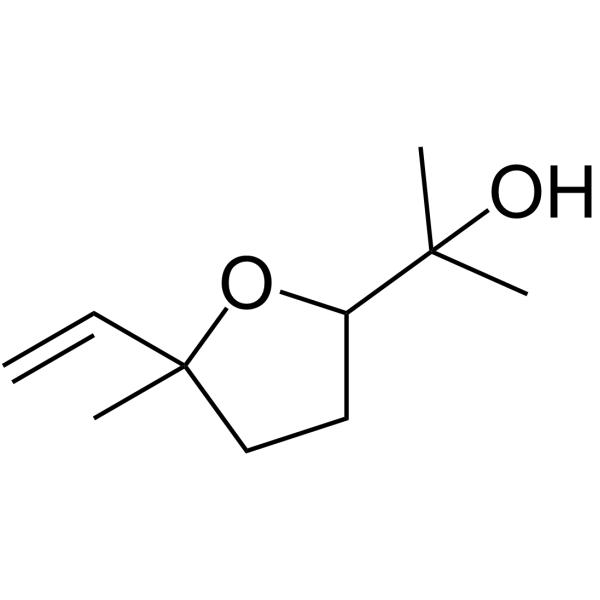
Linalool oxide

Based on 1 Customer Validation
Linalool oxide is a monoterpene and found in aromatic plant essential oils and is a secondary metabolite in elongating wheat plants. Linalool oxide has antinociceptive, anticonvulsant, and anxiolytic activity. Linalool oxide can be used for the research of pain, epilepsy, anxiety disorders.
For research use only. We do not sell to patients.
- Purity : 98.0%
- CAS No.: 60047-17-8
- Formula: C10H18O2
- Molecular Weight:170.25
-
Storage:Pure form -20°C, 3 years , 4°C, 2 years ; In solvent -80°C, 6 months , -20°C, 1 month

To place orders, for customer services and technical support, please contact: MedChemExpress USA
Tel: 609-228-6898 E-mail: [email protected] [email protected]


-
 Biological Activity
-
Chemical Information
-
Solvent & Solubility
- Protocols
- Purity & Documentation
- References
-
 Help & FAQs


-
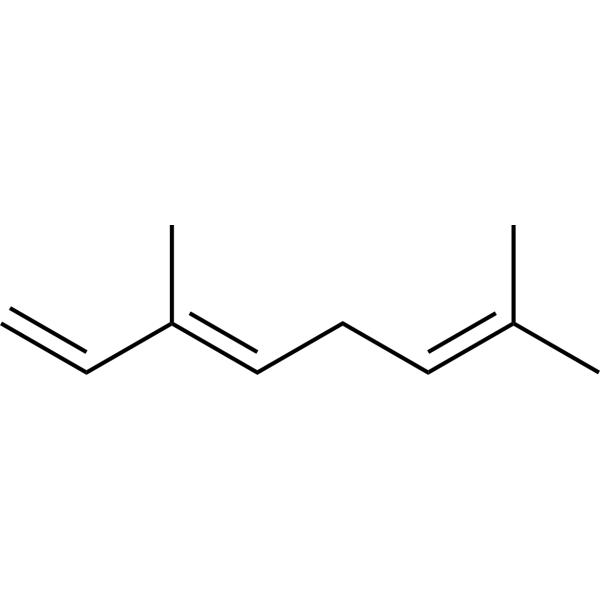
HY-117215
β-OcimeneBiochemical Assay Reagent -

HY-N9502R
Linalool oxide (Standard)Natural Product -
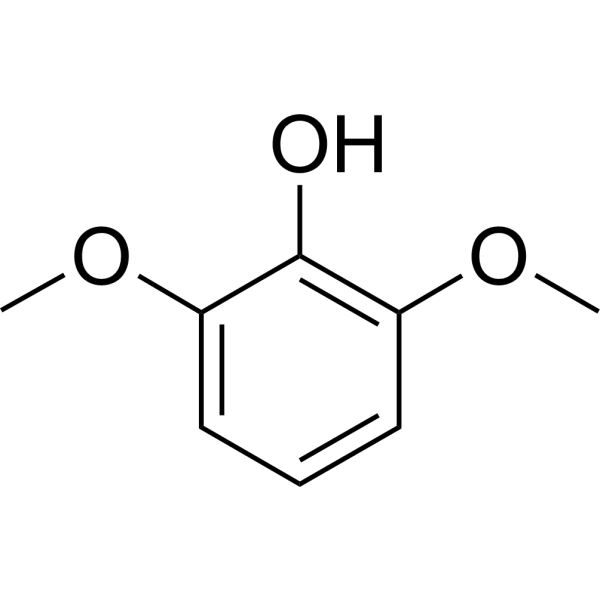
HY-W003972
2,6-DimethoxyphenolLaccase Substrate -

HY-N1953
Clove oilAntibacterial/Anti‑inflammatory/Antioxidant -

HY-W145661
Gum storaxBiochemical Assay Reagent -

HY-W003972R
2,6-Dimethoxyphenol (Standard)Standard of 2,6-Dimethoxyphenol -
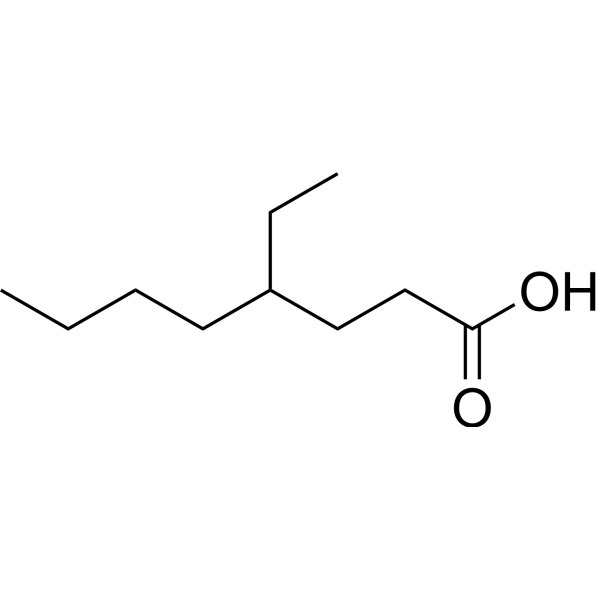
HY-W015307
4-Ethyloctanoic acidFragrance Ingredient -
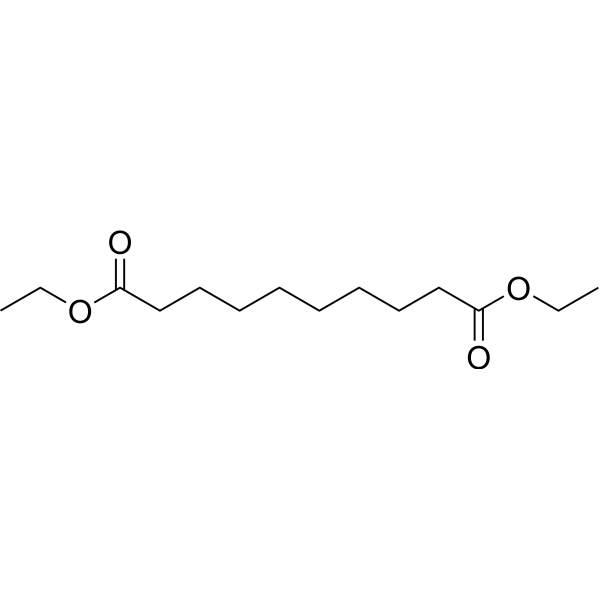
HY-W009443
Diethyl decanedioateBiochemical Assay Reagent -
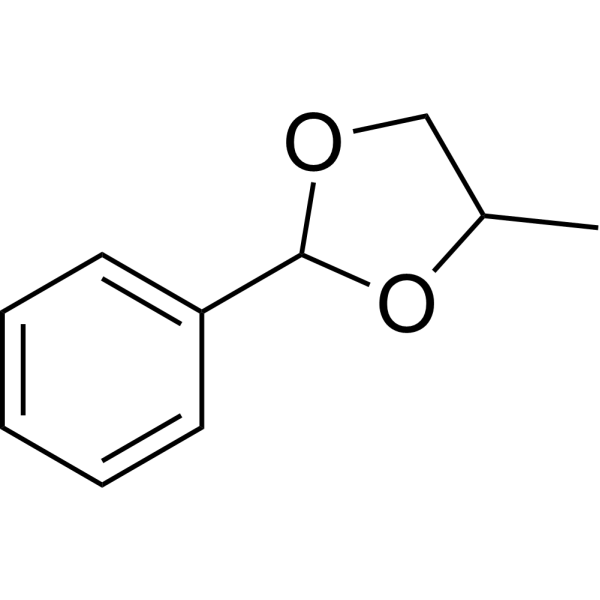
HY-W010119
4-Methyl-2-phenyl-1,3-dioxolaneBiochemical Assay Reagent
All Endogenous Metabolite Isoforms
More

Biological Activity
Description
In Vitro
In Vivo
Linalool oxide (50-150 mg/kg; i.p.; single dose) reduces paw-licking time in both the neurogenic and inflammatory phases of the formalin test in male Swiss mice[1].
Linalool oxide (50-150 mg/kg; i.p.; single dose) reduces the duration of maximum electroshock-induced tonic seizures in male Swiss mice[1].
Linalool oxide (50-150 mg/kg; i.p.; single dose) increases latency to the first pentylenetetrazol-induced seizure in male Swiss mice, with a mean latency of 235.4 s[1].
Linalool oxide (0.65-5.0% w/w; inhalation; single 7-minute exposure) produces anxiolytic-like effects in the mouse elevated plus-maze test, with all tested concentrations increasing time spent in open arms and most concentrations increasing open arm entries and total arm entries, without reducing locomotor activity[2].
Linalool oxide (0.65-5.0% w/w; inhalation; single 7-minute exposure) produces anxiolytic-like effects in the Mus musculus light/dark box test, with all tested concentrations increasing time spent in the brightly lit chamber and concentrations 0.65%, 2.5%, and 5.0% w/w increasing compartment transitions[2].
MedChemExpress (MCE) has not independently confirmed the accuracy of these methods. They are for reference only.
-
Animal Model:Acetic acid or formalin-induced Swiss mice (male, 2-3 months old, 25-35 g)[1]
-
Dosage:50 mg/kg; 100 mg/kg; 150 mg/kg
-
Administration:i.p.; single dose
-
Result:Reduced mean number of writhings to 19.3 at 100 mg/kg, with statistically significant reduction compared to control.
Reduced mean number of writhings to 15.1 at 150 mg/kg, with statistically significant reduction compared to control.\nReduced mean paw-licking time to 44.3 s at 100 mg/kg and 35.3 s at 150 mg/kg in the neurogenic phase, with statistically significant reduction compared to control.
Reduced mean paw-licking time to 102.3 s at 50 mg/kg, 105.8 s at 100 mg/kg and 73.5 s at 150 mg/kg in the inflammatory phase, with statistically significant reduction compared to control.
-
Animal Model:Swiss albino (male, 25-35 g)[2]
-
Dosage:0.65% w/w; 1.25% w/w; 2.5% w/w; 5.0% w/w
-
Administration:inhalation; single 7-minute exposure
-
Result:Significantly increased the number of open arm entries relative to controls at 0.65%, 2.5%, and 5.0% w/w.
Significantly increased the time spent in open arms relative to controls at all concentrations.
Significantly increased total arm entries relative to controls at 0.65%, 2.5%, and 5.0% w/w.
Significantly increased total arm entries relative to controls at 1.25% w/w.\n
Significantly increased the time spent in the brightly lit chamber relative to controls at all concentrations.
Significantly increased the number of transitions between compartments relative to controls at 0.65%, 2.5%, and 5.0% w/w.
Did not produce a significant effect on compartment transitions at 1.25% w/w.


Chemical Information
-
CAS No. 60047-17-8
-
Appearance Liquid (Density: 1.023±0.06 g/cm3)
-
Molecular Weight 170.25
-
Formula C10H18O2
-
Color Colorless to light yellow
-
SMILES
C=CC(OC1C(C)(O)C)(CC1)C
-
Structure Classification
-
Shipping
Room temperature in continental US; may vary elsewhere.
-
Storage
Pure form -20°C 3 years 4°C 2 years In solvent -80°C 6 months -20°C 1 month


Solvent & Solubility
In Vitro:
DMSO : 100 mg/mL (587.37 mM; Need ultrasonic; Hygroscopic DMSO has a significant impact on the solubility of product, please use newly opened DMSO)
Please refer to the solubility information to select the appropriate solvent. Once prepared, please aliquot and store the solution to prevent product inactivation from repeated freeze-thaw cycles.
Storage method and period of stock solution: -80°C, 6 months; -20°C, 1 month. When stored at -80°C, please use it within 6 months. When stored at -20°C, please use it within 1 month.
Please refer to the solubility information to select the appropriate solvent. Once prepared, please aliquot and store the solution to prevent product inactivation from repeated freeze-thaw cycles.
Storage method and period of stock solution: -80°C, 6 months; -20°C, 1 month. When stored at -80°C, please use it within 6 months. When stored at -20°C, please use it within 1 month.
Concentration (start) × Volume (start) = Concentration (final) × Volume (final)
In Vivo:
Select the appropriate dissolution method based on your experimental animal and administration route.
- For the following dissolution methods, please ensure to first prepare a clear stock solution using an In Vitro approach and then sequentially add co-solvents:
- To ensure reliable experimental results, the clarified stock solution can be appropriately stored based on storage conditions. As for the working solution for In Vivo experiments, it is recommended to prepare freshly and use it on the same day.
- The percentages shown for the solvents indicate their volumetric ratio in the final prepared solution. If precipitation or phase separation occurs during preparation, heat and/or sonication can be used to aid dissolution.
Add each solvent one by one: 10% DMSO 40% PEG300 5% Tween-80 45% Saline
Solubility: ≥ 2.5 mg/mL (14.68 mM); Clear solution
This protocol yields a clear solution of ≥ 2.5 mg/mL (saturation unknown).
Taking 1 mL working solution as an example, add 100 μL DMSO stock solution (25.0 mg/mL) to 400 μL PEG300, and mix evenly; then add 50 μL Tween-80 and mix evenly; then add 450 μL Saline to adjust the volume to 1 mL.
Preparation of Saline: Dissolve 0.9 g sodium chloride in ddH₂O and dilute to 100 mL to obtain a clear Saline solution.
Add each solvent one by one: 10% DMSO 90% (20% SBE-β-CD in Saline)
Solubility: ≥ 2.5 mg/mL (14.68 mM); Clear solution
This protocol yields a clear solution of ≥ 2.5 mg/mL (saturation unknown).
Taking 1 mL working solution as an example, add 100 μL DMSO stock solution (25.0 mg/mL) to 900 μL 20% SBE-β-CD in Saline, and mix evenly.
Preparation of 20% SBE-β-CD in Saline (4°C, storage for one week): 2 g SBE-β-CD powder is dissolved in 10 mL Saline, completely dissolve until clear.
In Vivo Dissolution Calculator
Please enter the basic information of animal experiments:
-
-
-
-
Recommended: Prepare an additional quantity of animals to account for potential losses during experiments.
Please enter your animal formula composition:
-
%DMSO +
Recommended: Keep the proportion of DMSO in working solution below 2% if your animal is weak.
-
%+
-
+%Tween-80 + +
-
%Saline +
The co-solvents required include: DMSO, . All of co-solvents are available by MedChemExpress (MCE). , Tween 80. All of co-solvents are available by MedChemExpress (MCE).
Working solution concentration: 0.22 mg/mL
Method for preparing stock solution: mg drug dissolved in μL DMSO. Stock solution concentration: mg/mL.
1. Take μL DMSO stock solution;
2. Add μL .
μL , mix evenly;
3. Then add μL Tween 80, mix evenly;
4. Then add μL
Please ensure that the stock solution in the first step is dissolved to a clear state, and add co-solvents in sequence. You can use ultrasonic heating (ultrasonic cleaner, recommended frequency 20-40 kHz), vortexing, etc. to assist dissolution.


Purity & Documentation
-
Data Sheet (276 KB)
-
SDS (555 KB)
- English - EN (555 KB)
- Français - FR (555 KB)
- Deutsch - DE (555 KB)
- Norwegian - NO (555 KB)
- Español - ES (555 KB)
- Swedish - SV (555 KB)
- Italian - IT (555 KB)
- Korean - KR (555 KB)
- Portuguese - PT (555 KB)
-
Handling Instructions (2659 KB)
References
[1]. Souto-Maior FN, et al. Antinociceptive and anticonvulsant effects of the monoterpene linalool oxide. Pharm Biol. 2017;55(1):63-67. [Content Brief]
[2]. Souto-Maior FN, et al. Anxiolytic-like effects of inhaled linalool oxide in experimental mouse anxiety models. Pharmacol Biochem Behav. 2011;100(2):259-263. [Content Brief]


Complete Stock Solution Preparation Table
Please refer to the solubility information to select the appropriate solvent. Once prepared, please aliquot and store the solution to prevent product inactivation from repeated freeze-thaw cycles.
Storage method and period of stock solution: -80°C, 6 months; -20°C, 1 month. When stored at -80°C, please use it within 6 months. When stored at -20°C, please use it within 1 month.
| Optional Solvent | Concentration Solvent Mass | 1 mg | 5 mg | 10 mg | 25 mg |
|---|---|---|---|---|---|
| DMSO | 1 mM | 5.8737 mL | 29.3686 mL | 58.7372 mL | 146.8429 mL |
| 5 mM | 1.1747 mL | 5.8737 mL | 11.7474 mL | 29.3686 mL | |
| 10 mM | 0.5874 mL | 2.9369 mL | 5.8737 mL | 14.6843 mL | |
| 15 mM | 0.3916 mL | 1.9579 mL | 3.9158 mL | 9.7895 mL | |
| 20 mM | 0.2937 mL | 1.4684 mL | 2.9369 mL | 7.3421 mL | |
| 25 mM | 0.2349 mL | 1.1747 mL | 2.3495 mL | 5.8737 mL | |
| 30 mM | 0.1958 mL | 0.9790 mL | 1.9579 mL | 4.8948 mL | |
| 40 mM | 0.1468 mL | 0.7342 mL | 1.4684 mL | 3.6711 mL | |
| 50 mM | 0.1175 mL | 0.5874 mL | 1.1747 mL | 2.9369 mL | |
| 60 mM | 0.0979 mL | 0.4895 mL | 0.9790 mL | 2.4474 mL | |
| 80 mM | 0.0734 mL | 0.3671 mL | 0.7342 mL | 1.8355 mL | |
| 100 mM | 0.0587 mL | 0.2937 mL | 0.5874 mL | 1.4684 mL |


Linalool oxide Related Classifications
HY-N9502 Related Classifications
 Powered by Bioz