



Clove oil

Based on 1 Customer Validation
Clove oil (Clove leaf oil,rectified) is a volatile aromatic essential oil with antibacterial, anti-inflammatory and antioxidant activities. Clove oil disrupts the integrity of bacterial cell membranes, releases intracellular nucleic acids and proteins, and inhibits bacterial growth and reproduction. Clove oil scavenges DPPH, ABTS, superoxide anions, hydrogen peroxide and hydroxyl radicals. Clove oil reduces Fe3+ to Fe2+, chelates Fe2+ and iron ions, and inhibits lipid peroxidation in linoleic acid emulsions. Clove oil acts as a natural preservative to reduce the loss of oxidation products. Clove oil can be isolated from the flowers, stems and leaves of Eugenia aromatica and Eugenia caryophyllus, which belong to the Myrtaceae family. Clove oil can be used in studies related to bacterial infection, antioxidation and preservation.
For research use only. We do not sell to patients.
- CAS No.: 8000-34-8
-
Storage:
Please store the product under the recommended conditions in the Certificate of Analysis.

To place orders, for customer services and technical support, please contact: MedChemExpress USA
Tel: 609-228-6898 E-mail: [email protected] [email protected]


-
 Biological Activity
-
Chemical Information
-
Solvent & Solubility
- Protocols
- Purity & Documentation
- References
-
 Help & FAQs


-

HY-Y1888
Corn oil -
HY-117215
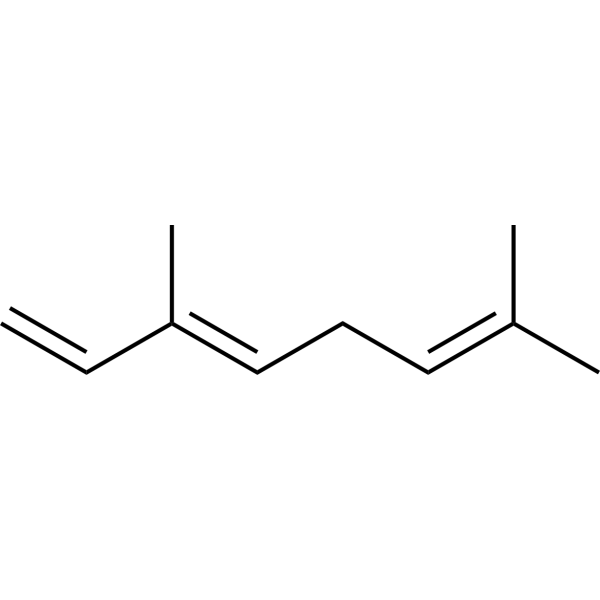
β-OcimeneBiochemical Assay Reagent -
HY-W003972
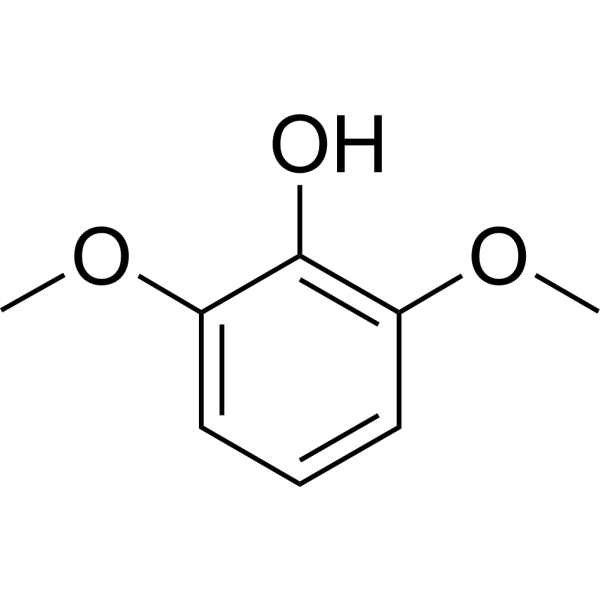
2,6-DimethoxyphenolLaccase Substrate -

HY-W145661
Gum storaxBiochemical Assay Reagent -

HY-W003972R
2,6-Dimethoxyphenol (Standard)Standard of 2,6-Dimethoxyphenol -

HY-159104
Cinnamon bark oil, from Cinnamonum zeylanicum BlumeAntifungal Agent -
HY-W015307
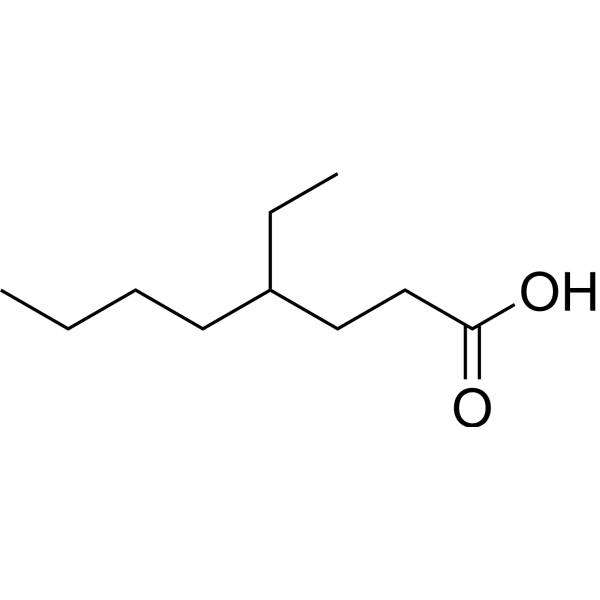
4-Ethyloctanoic acidFragrance Ingredient -
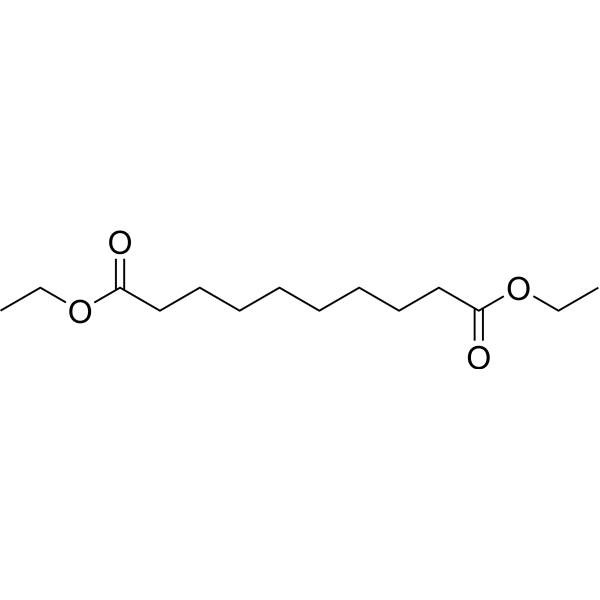
HY-W009443
Diethyl decanedioateBiochemical Assay Reagent -
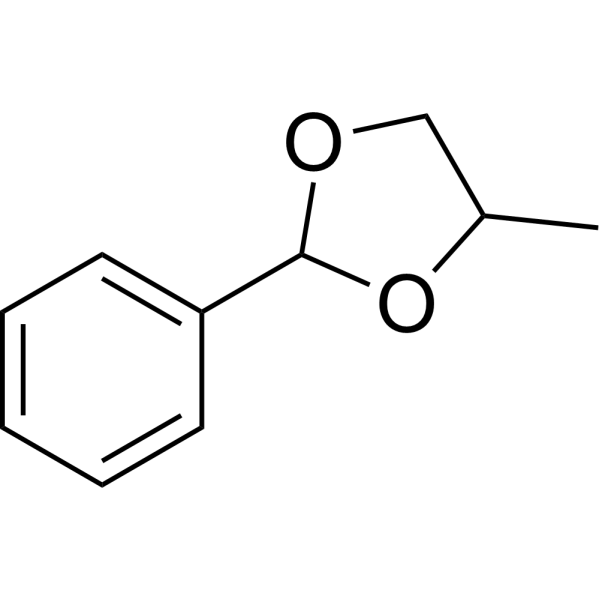
HY-W010119
4-Methyl-2-phenyl-1,3-dioxolaneBiochemical Assay Reagent -
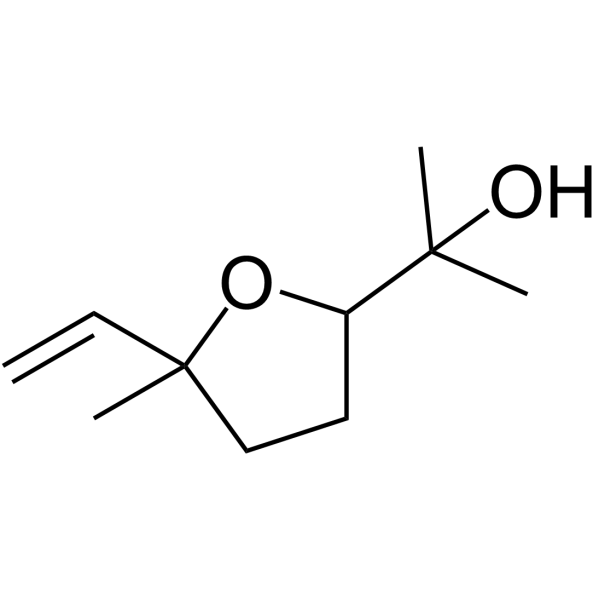
HY-N9502
Linalool oxideMonoterpene


Biological Activity
Description
In Vitro
Clove oil nanoemulsion (2 wt% clove oil content; 24 h) inhibits growth of Escherichia coli and Staphylococcus aureus via the filter paper diffusion method, with a larger inhibition zone (13.47 mm) observed for Staphylococcus aureus than for Escherichia coli (9.32 mm)[1].
Clove oil nanoemulsion (0.125-4.0 μL/mL; 24 h (MIC), 48 h (MBC)) inhibits growth of Escherichia coli with an MIC of 0.5 mg/mL and kills Escherichia coli with an MBC of 1 mg/mL; it inhibits growth of Staphylococcus aureus with an MIC of 0.25 mg/mL and kills Staphylococcus aureus with an MBC of 2 mg/mL[1].
Clove oil nanoemulsion (0.5 mg/mL (MIC), 1 mg/mL (MBC) for Escherichia coli; 0.25 mg/mL (MIC), 2 mg/mL (MBC) for Staphylococcus aureus; 3 h) disrupts the cell membrane integrity of Escherichia coli and Staphylococcus aureus, causing dose-dependent release of nucleic acids and proteins, with more pronounced nucleic acid release at MBC concentrations[1].
Clove oil (15-45 μg/mL; 30 h) potently inhibits lipid peroxidation of linoleic acid emulsion, with 97.9% inhibition at 15 μg/mL, 99.4% inhibition at 30 μg/mL, and 99.7% inhibition at 45 μg/mL[2].
Clove oil (0.01-0.5 μg/mL; 30 min) potently scavenges DPPH radicals in a cell-free assay with an IC50 of 0.08 μg/mL, achieving 91.2% inhibition at 0.5 μg/mL[3].
Clove oil (0.01-0.2 μg/mL; 1 h) potently scavenges hydroxyl radicals in a cell-free deoxyribose degradation assay with an IC50 of 0.02 μg/mL, achieving 93.7% inhibition at 0.2 μg/mL[3].
Clove oil (0.02-0.2 μg/mL; 1 h) acts as an iron chelator in a cell-free deoxyribose degradation assay, achieving 93% inhibition of metal-dependent hydroxyl radical generation at 0.2 μg/mL[3].
Clove oil (0.0025-0.01 wt%/vol; 10 days) inhibits both early and late stages of lipid peroxidation in a cell-free linoleic acid emulsion system, achieving up to 80.6% inhibition of TBARS formation at 0.01 wt%/vol and 73.91% inhibition of CD formation at 0.005 wt%/vol[3].
MedChemExpress (MCE) has not independently confirmed the accuracy of these methods. They are for reference only.
Clinical Trial
| NCT Number | Sponsor | Condition | Start Date |
Phase

|
|---|---|---|---|---|
| NCT01329991 | Plexxikon| | 2011-05 | PHASE1 |


Chemical Information
-
CAS No. 8000-34-8
-
Appearance Liquid (Density: 1.05 g/cm3)
-
Color Colorless to light yellow
-
SMILES
[Clove oil]
-
Synonyms
Clove leaf oil,rectified
-
Shipping
Room temperature in continental US; may vary elsewhere.
-
Storage
Please store the product under the recommended conditions in the Certificate of Analysis.


Solvent & Solubility
In Vitro:
DMSO : 100 mg/mL (Need ultrasonic; Hygroscopic DMSO has a significant impact on the solubility of product, please use newly opened DMSO)


Purity & Documentation
-
Data Sheet (279 KB)
-
SDS (393 KB)
- English - EN (393 KB)
- Français - FR (393 KB)
- Deutsch - DE (393 KB)
- Norwegian - NO (393 KB)
- Español - ES (393 KB)
- Swedish - SV (393 KB)
- Italian - IT (393 KB)
- Korean - KR (393 KB)
- Portuguese - PT (393 KB)
-
Handling Instructions (2659 KB)
References

Calculators
Concentration (start) × Volume (start) = Concentration (final) × Volume (final)


Clove oil Related Classifications
HY-N1953 Related Classifications
 Powered by Bioz