



L-Histidinol dihydrochloride (Standard)
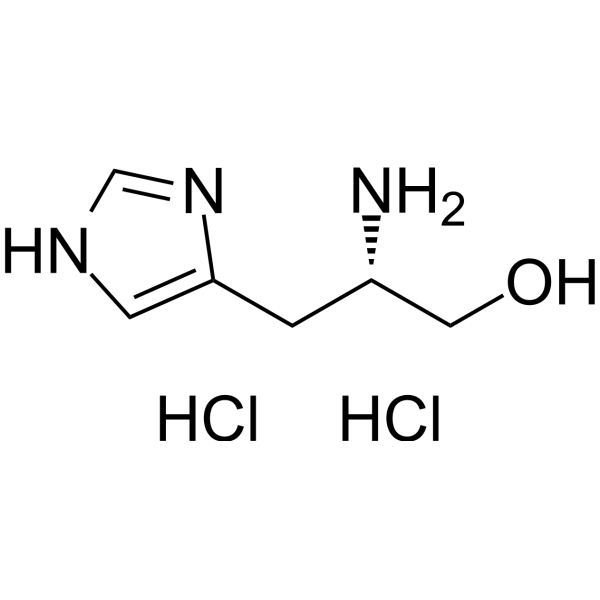
L-Histidinol (dihydrochloride) (Standard) is the analytical standard of L-Histidinol (dihydrochloride) (HY-W014233). This product is intended for research and analytical applications. L-Histidinol dihydrochloride is an orally active histidyl-tRNA synthetase inhibitor. L-Histidinol dihydrochloride interferes with the initiation stage of protein synthesis, thus affecting cell proliferation and metabolism. L-Histidinol dihydrochloride has the effect of modulating the sensitivity of tumor cells to chemotherapeutic agents. L-Histidinol dihydrochloride reduces the toxicity of certain chemotherapeutic agents to normal tissues and enhance the sensitivity of tumor cells to chemotherapeutic agents.
For research use only. We do not sell to patients.
- CAS No.: 1596-64-1
- Formula: C6H13Cl2N3O
- Molecular Weight:214.10
-
Storage:
Please store the product under the recommended conditions in the Certificate of Analysis.


To place orders, for customer services and technical support, please contact: MedChemExpress USA
Tel: 609-228-6898 E-mail: [email protected] [email protected]


-
 Product Information
-
Chemical Information
- Purity & Documentation
-
 Help & FAQs




Product Information
Information
Application
The compound is the grade of analytical standard, which is the reference standard supplied assay. It is commonly used in qualitative, quantitative and methodological research experiments in HPLC, GC and MS.


Chemical Information
-
CAS No. 1596-64-1
-
Molecular Weight 214.10
-
Formula C6H13Cl2N3O
-
SMILES
N[C@@H](CC1=CNC=N1)CO.Cl.Cl
-
Structure Classification
-
Initial Source
-
Shipping
Room temperature in continental US; may vary elsewhere.
-
Storage
Please store the product under the recommended conditions in the Certificate of Analysis.


Purity & Documentation
References
[1]. Kohnoe S, et al. L-histidinol potentiates hyperthermic cell-killing in-vitro. Int J Oncol. 1993 Nov;3(5):835-9. [Content Brief]
[2]. https://pubmed.ncbi.nlm.nih.gov/21573440/ [Content Brief]
[3]. Warrington RC, et al. Effects of L-histidinol on the susceptibility of P815 mastocytoma cells to selected anticancer drugs in vitro and in DBA/2J mice. J Natl Cancer Inst. 1987 Jun;78(6):1177-83. [Content Brief]
[4]. Warrington RC, et al. Reversal of the multidrug-resistant phenotype of Chinese hamster ovary cells by L-histidinol. J Natl Cancer Inst. 1989 May 10;81(10):798-803. doi: 10.1093/jnci/81.10.798. [Content Brief]
[5]. Warrington RC, et al. L-histidinol protection against cytotoxic action of cytosine arabinoside and 5-fluorouracil in cultured mouse spleen cells. J Natl Cancer Inst. 1982 Feb;68(2):279-86. [Content Brief]
[6]. Zaharko D, et al. L-histidinol: preclinical therapeutic studies in combination with antitumor agents and pharmacokinetic studies in mice. Cancer Res. 1992 Jul 1;52(13):3604-9. [Content Brief]
[7]. Stolfi RL, et al. Chemotherapeutic activity of L-histidinol against spontaneous, autochthonous murine breast tumors. Chemotherapy. 1990;36(6):435-40. [Content Brief]
[8]. Badary OA, et al. Effect of L-histidinol on cisplatin nephrotoxicity in the rat. Nephron. 1997;77(4):435-9. [Content Brief]
[9]. Badary OA. L-Histidinol attenuates Fanconi syndrome induced by ifosfamide in rats. Exp Nephrol. 1999 Jul-Aug;7(4):323-7. [Content Brief]
[10]. Warrington RC, et al. L-histidinol improves the selectivity and efficacy of alkylating agents and daunomycin in mice with P388 leukaemia. Br J Cancer. 1989 Nov;60(5):652-6. [Content Brief]

Calculators
Concentration (start) × Volume (start) = Concentration (final) × Volume (final)


L-Histidinol dihydrochloride (Standard) Related Classifications
HY-W014233R Related Classifications
 Powered by Bioz