



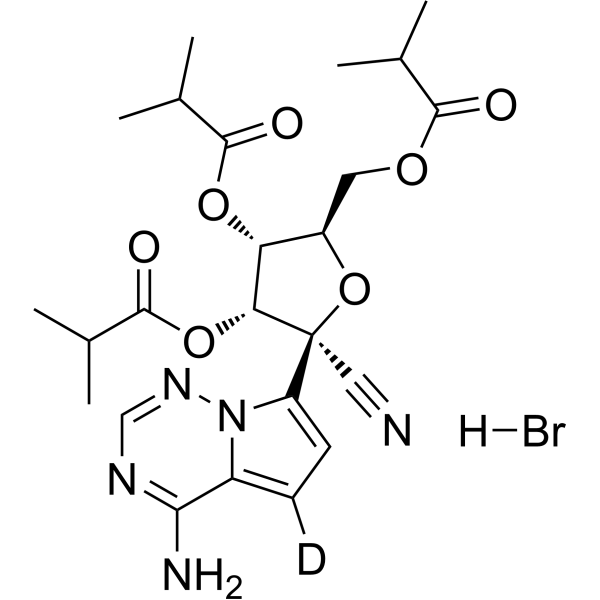
Mindeudesivir hydrobromide
Based on 1 Customer Validation
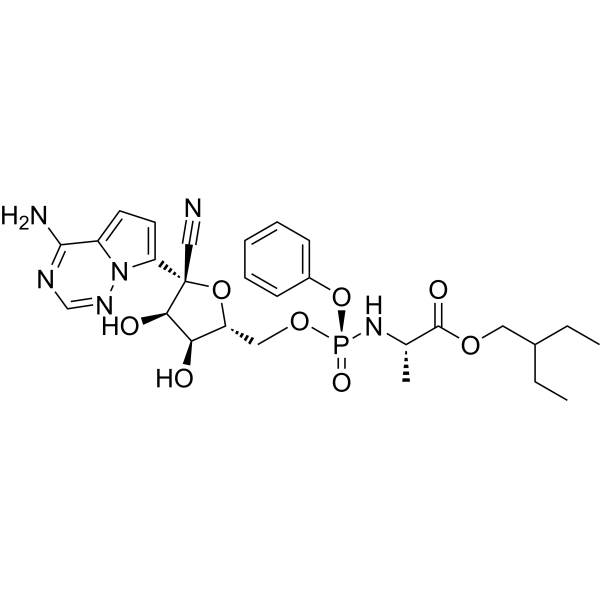
Mindeudesivir (JT001; VV116; GS-621763-d1) hydrobromide is a deuterated version of Remdesivir (HY-104077), a highly orally active nucleoside antiviral against SARS-CoV-2 and respiratory syncytial virus (RSV). Mindeudesivir hydrobromide retains the antiviral activity of Remdesivir against COVID-19, and is the first domestically produced deuterium targeting the COVID-19.
For research use only. We do not sell to patients.
- Purity: 98.16%
- CAS No.: 2779498-79-0
- Formula: C24H31DBrN5O7
- Molecular Weight:583.45
-
Storage:
4°C, sealed storage, away from moisture
* In solvent : -80°C, 6 months; -20°C, 1 month (sealed storage, away from moisture)

To place orders, for customer services and technical support, please contact: MedChemExpress USA
Tel: 609-228-6898 E-mail: [email protected] [email protected]


-
 Biological Activity
-
Chemical Information
-
Solvent & Solubility
- Purity & Documentation
- References
-
 Help & FAQs




Biological Activity
Description
IC50 & Target
In Vitro
Stable heavy isotopes of hydrogen, carbon, and other elements have been incorporated into drug molecules, largely as tracers for quantitation during the drug development process. Deuteration has gained attention because of its potential to affect the pharmacokinetic and metabolic profiles of drugs[1].
Potential advantages of deuterated compounds:
(1) Extend the half-life in vivo. Deuterated compounds may be able to prolong the pharmacokinetic characteristics of the compound, that is, prolong the half-life in vivo. This can improve compound safety, efficacy and tolerability, and increase ease of administration.
(2) Improve oral bioavailability. Deuterated compounds may reduce the degree of unwanted metabolism (first-pass metabolism) in the gut wall and liver, allowing a greater proportion of the unmetabolized drug to reach its target site of action. High bioavailability determines its activity at low doses and better tolerance.
(3) Improve metabolic characteristics. Deuterated compounds may reduce the formation of toxic or reactive metabolites and improve drug metabolism.
(4) Improve drug safety. Deuterated compounds may reduce or eliminate adverse side effects of pharmaceutical compounds and are safe.
(5) Preserve the therapeutic properties. Deuterated compounds are expected to retain similar biochemical potency and selectivity to hydrogen analogs in previous studies.
MedChemExpress (MCE) has not independently confirmed the accuracy of these methods. They are for reference only.
-
Cell Line:A549 (infected with RSV)[1]
-
Concentration:0-1000 μM
-
Incubation Time:48 hours
-
Result:Inhibited RSV replication in A549 cells with EC50 of 1.20 ± 0.32 μM, CC50 of 95.92 ± 9.27 μM and selectivity index (SI) of 80.
In Vivo
VV116 (25, 50 and 100 mg/kg; PO; single dosage) exhibits favorable PK properties and good safety profile[1].
Pharmacokinetic Parameters of VV116 (JT001) in Balb/c mice[1].
| PO (25 mg/kg) | PO (50 mg/kg) | PO (100 mg/kg) | |
| Tmax (h) | 0.42 ± 0.14 | 0.42 ± 0.14 | 0.42 ± 0.14 |
| Cmax (ng/mL) | 5360 ± 560 | 11617 ± 3443 | 24017 ± 6521 |
| AUC0-t (ng/mL·h) | 11461 ± 1013 | 24594 ± 1059 | 47799 ± 6545 |
| AUC0-∞ (ng/mL·h) | 11534 ± 992 | 24739 ± 1028 | 48014 ± 6696 |
| MRT0-∞ (ng/mL·h) | 2.25 ± 0.32 | 2.15 ± 0.26 | 2.28 ± 0.53 |
| Tmax (h) | 2.30 ± 1.10 | 3.27 ± 1.92 | 4.25 ± 0.53 |
MedChemExpress (MCE) has not independently confirmed the accuracy of these methods. They are for reference only.
-
Animal Model:Balb/c mice[1]
-
Dosage:25, 50 and 100 mg/kg
-
Administration:PO; single dosage (Pharmacokinetics Analysis)
-
Result:Exhibited favorable PK properties and good safety profile.
-
Animal Model:Balb/c mice (6-8 weeks; intranasally infected with 4 × 10^6 FFU of RSV)[1]
-
Dosage:25, 50 and 100 mg/kg
-
Administration:PO; b.i.d for 4 days
-
Result:Exhibited a stronger activity and decreased the virus titers below the detection limit at 50 mg/kg, also reduced lung injury after RSV infection.
Application
1. This compound can be used as a tracer
2. This compound can be used as an internal standard for quantitative analysis by NMR, GC-MS, or LC-MS.


Chemical Information
-
CAS No. 2779498-79-0
-
Unlabeled CAS 2647442-13-3
-
Appearance Solid
-
Molecular Weight 583.45
-
Formula C24H31DBrN5O7
-
Color White to light yellow
-
SMILES
N#C[C@](O[C@@H]1COC(C(C)C)=O)(C2=CC([2H])=C3N2N=CN=C3N)[C@@H]([C@@H]1OC(C(C)C)=O)OC(C(C)C)=O.Br
-
Synonyms
VV116; GS-621763-d1 hydrobromide
-
Shipping
Room temperature in continental US; may vary elsewhere.
-
Storage
4°C, sealed storage, away from moisture
* In solvent : -80°C, 6 months; -20°C, 1 month (sealed storage, away from moisture)


Solvent & Solubility
In Vitro:
DMSO : 250 mg/mL (428.49 mM; Need ultrasonic; Hygroscopic DMSO has a significant impact on the solubility of product, please use newly opened DMSO)
Please refer to the solubility information to select the appropriate solvent. Once prepared, please aliquot and store the solution to prevent product inactivation from repeated freeze-thaw cycles.
Storage method and period of stock solution: -80°C, 6 months; -20°C, 1 month (sealed storage, away from moisture). When stored at -80°C, please use it within 6 months. When stored at -20°C, please use it within 1 month.
Please refer to the solubility information to select the appropriate solvent. Once prepared, please aliquot and store the solution to prevent product inactivation from repeated freeze-thaw cycles.
Storage method and period of stock solution: -80°C, 6 months; -20°C, 1 month (sealed storage, away from moisture). When stored at -80°C, please use it within 6 months. When stored at -20°C, please use it within 1 month.
Concentration (start) × Volume (start) = Concentration (final) × Volume (final)
In Vivo:
Select the appropriate dissolution method based on your experimental animal and administration route.
- For the following dissolution methods, please ensure to first prepare a clear stock solution using an In Vitro approach and then sequentially add co-solvents:
- To ensure reliable experimental results, the clarified stock solution can be appropriately stored based on storage conditions. As for the working solution for In Vivo experiments, it is recommended to prepare freshly and use it on the same day.
- The percentages shown for the solvents indicate their volumetric ratio in the final prepared solution. If precipitation or phase separation occurs during preparation, heat and/or sonication can be used to aid dissolution.
Add each solvent one by one: 10% DMSO 40% PEG300 5% Tween-80 45% Saline
Solubility: ≥ 2.08 mg/mL (3.57 mM); Clear solution
This protocol yields a clear solution of ≥ 2.08 mg/mL (saturation unknown).
Taking 1 mL working solution as an example, add 100 μL DMSO stock solution (20.8 mg/mL) to 400 μL PEG300, and mix evenly; then add 50 μL Tween-80 and mix evenly; then add 450 μL Saline to adjust the volume to 1 mL.
Preparation of Saline: Dissolve 0.9 g sodium chloride in ddH₂O and dilute to 100 mL to obtain a clear Saline solution.
Add each solvent one by one: 10% DMSO 90% (20% SBE-β-CD in Saline)
Solubility: ≥ 2.08 mg/mL (3.57 mM); Clear solution
This protocol yields a clear solution of ≥ 2.08 mg/mL (saturation unknown).
Taking 1 mL working solution as an example, add 100 μL DMSO stock solution (20.8 mg/mL) to 900 μL 20% SBE-β-CD in Saline, and mix evenly.
Preparation of 20% SBE-β-CD in Saline (4°C, storage for one week): 2 g SBE-β-CD powder is dissolved in 10 mL Saline, completely dissolve until clear.
In Vivo Dissolution Calculator
Please enter the basic information of animal experiments:
-
-
-
-
Recommended: Prepare an additional quantity of animals to account for potential losses during experiments.
Please enter your animal formula composition:
-
%DMSO +
Recommended: Keep the proportion of DMSO in working solution below 2% if your animal is weak.
-
%+
-
+%Tween-80 + +
-
%Saline +
The co-solvents required include: DMSO, . All of co-solvents are available by MedChemExpress (MCE). , Tween 80. All of co-solvents are available by MedChemExpress (MCE).
Working solution concentration: 0.22 mg/mL
Method for preparing stock solution: mg drug dissolved in μL DMSO. Stock solution concentration: mg/mL. * In solvent : -80°C, 6 months; -20°C, 1 month (sealed storage, away from moisture)
1. Take μL DMSO stock solution;
2. Add μL .
μL , mix evenly;
3. Then add μL Tween 80, mix evenly;
4. Then add μL
Please ensure that the stock solution in the first step is dissolved to a clear state, and add co-solvents in sequence. You can use ultrasonic heating (ultrasonic cleaner, recommended frequency 20-40 kHz), vortexing, etc. to assist dissolution.


Purity & Documentation
-
Data Sheet (285 KB)
-
SDS (252 KB)
- English - EN (252 KB)
- Français - FR (252 KB)
- Deutsch - DE (252 KB)
- Norwegian - NO (252 KB)
- Español - ES (252 KB)
- Swedish - SV (252 KB)
- Italian - IT (252 KB)
- Korean - KR (252 KB)
- Portuguese - PT (252 KB)
-
Handling Instructions (2659 KB)
References
[1]. Zhang R, et al. Oral remdesivir derivative VV116 is a potent inhibitor of respiratory syncytial virus with efficacy in mouse model. Signal Transduct Target Ther. 2022;7(1):123. Published 2022 Apr 16. [Content Brief]
[2]. Qian HJ, et al. Safety, tolerability, and pharmacokinetics of VV116, an oral nucleoside analog against SARS-CoV-2, in Chinese healthy subjects [published online ahead of print, 2022 Mar 16]. Acta Pharmacol Sin. 2022;1-9. [Content Brief]


Complete Stock Solution Preparation Table
Please refer to the solubility information to select the appropriate solvent. Once prepared, please aliquot and store the solution to prevent product inactivation from repeated freeze-thaw cycles.
Storage method and period of stock solution: -80°C, 6 months; -20°C, 1 month (sealed storage, away from moisture). When stored at -80°C, please use it within 6 months. When stored at -20°C, please use it within 1 month.
| Optional Solvent | Concentration Solvent Mass | 1 mg | 5 mg | 10 mg | 25 mg |
|---|---|---|---|---|---|
| DMSO | 1 mM | 1.7139 mL | 8.5697 mL | 17.1394 mL | 42.8486 mL |
| 5 mM | 0.3428 mL | 1.7139 mL | 3.4279 mL | 8.5697 mL | |
| 10 mM | 0.1714 mL | 0.8570 mL | 1.7139 mL | 4.2849 mL | |
| 15 mM | 0.1143 mL | 0.5713 mL | 1.1426 mL | 2.8566 mL | |
| 20 mM | 0.0857 mL | 0.4285 mL | 0.8570 mL | 2.1424 mL | |
| 25 mM | 0.0686 mL | 0.3428 mL | 0.6856 mL | 1.7139 mL | |
| 30 mM | 0.0571 mL | 0.2857 mL | 0.5713 mL | 1.4283 mL | |
| 40 mM | 0.0428 mL | 0.2142 mL | 0.4285 mL | 1.0712 mL | |
| 50 mM | 0.0343 mL | 0.1714 mL | 0.3428 mL | 0.8570 mL | |
| 60 mM | 0.0286 mL | 0.1428 mL | 0.2857 mL | 0.7141 mL | |
| 80 mM | 0.0214 mL | 0.1071 mL | 0.2142 mL | 0.5356 mL | |
| 100 mM | 0.0171 mL | 0.0857 mL | 0.1714 mL | 0.4285 mL |


Mindeudesivir hydrobromide Related Classifications
HY-145119AS Related Classifications
 Powered by Bioz