



4-1BBL/TNFSF9 Protein, Mouse (HEK293, His)

Based on 1 Customer Validation
4-1BBL (4-1BB ligand) is a type II membrane protein of the TNF superfamily, is expressed on antigen-presenting cells. 4-1BB with 4-1BBL can induce T-cell expansion, cytokine induction, differentiation, and upregulation of anti-apoptotic genes as well as protect T cells from activation-induced cell death (AICD). 4-1BBL stimulates T cell proliferation and induces effective anti-tumor immune responses. 4-1BBL is an immunostimulant molecule that interacts with the 4-1BB high-affinity receptor during the antigen presentation, providing costimulatory signals to both CD4+ and CD8+ T cells through the activation of NF-kB, c-Jun, and p38 downstream pathways, triggering pleiotropic effects on the immune system. 4-1BBL/TNFSF9 Protein, Mouse (HEK293, His) is a recombinant protein with a N-Terminal His label, It consists of 206 amino acids (R104-E309) and is produced in HEK293 cells.
- Species: Mouse
- Source: HEK293
-
Storage:Stored at -20°C for 2 years from date of receipt. After reconstitution, it is stable at 4°C for 1 week or -20°C for longer (with carrier protein). It is recommended to freeze aliquots at -20°C or -80°C for extended storage.



To place orders, for customer services and technical support, please contact: MedChemExpress USA
Tel: 609-228-6898 E-mail: [email protected] [email protected]


-
 Biological Activity
-
Technical Parameters
-
Product Properties
- Documentation
- References
- Help & FAQs




Biological Activity
Description
4-1BBL (4-1BB ligand) is a type II membrane protein of the TNF superfamily, is expressed on antigen-presenting cells. 4-1BB with 4-1BBL can induce T-cell expansion, cytokine induction, differentiation, and upregulation of anti-apoptotic genes as well as protect T cells from activation-induced cell death (AICD)[1]. 4-1BBL stimulates T cell proliferation and induces effective anti-tumor immune responses[3]. 4-1BBL is an immunostimulant molecule that interacts with the 4-1BB high-affinity receptor during the antigen presentation, providing costimulatory signals to both CD4+ and CD8+ T cells through the activation of NF-kB, c-Jun, and p38 downstream pathways, triggering pleiotropic effects on the immune system[4]. 4-1BBL/TNFSF9 Protein, Mouse (HEK293, His) is a recombinant protein with a N-Terminal His label, It consists of 206 amino acids (R104-E309) and is produced in HEK293 cells.
Background
4-1BBL is expressed on a variety of antigen presenting cells (APCs), including activated B cells, dendritic cells, macrophages, and myeloid cells[1].
The amino acid sequence of human 4-1BBL protein has low homology for mouse and rat 4-1BBL protein.
4-1BBL binds to high-affinity 4-1BB, resulting in the recruitment of intracellular TRAF adaptor molecules (TRAF1 and TRAF2), and then activate of NF-jB and the extracellular signal regulated kinase (ERK), c-Jun N-terminal kinase (JNK) and p38 mitogen-associated protein (MAP) kinase signaling cascades. The binding of 4-1BBL to 4-1BB generates strong co-stimulatory signals in T-cells that lead to up-regulation of anti-apoptotic molecules, cytokine secretion, and enhanced effector function[2].
4-1BBL is a member of the TNF family of proteins. 4-1BBL is an immunostimulant molecule that interacts with the 4-1BB high-affinity receptor during the antigen presentation, providing costimulatory signals to both CD4+ and CD8+ T cells through the activation of NF-kB, c-Jun, and p38 downstream pathways, triggering pleiotropic effects on the immune system[4]. 4-1BBL significantly induces T cell proliferation and increases the stimulation of both IL-2 and IFN-γ[5].
Verified Bioactivity
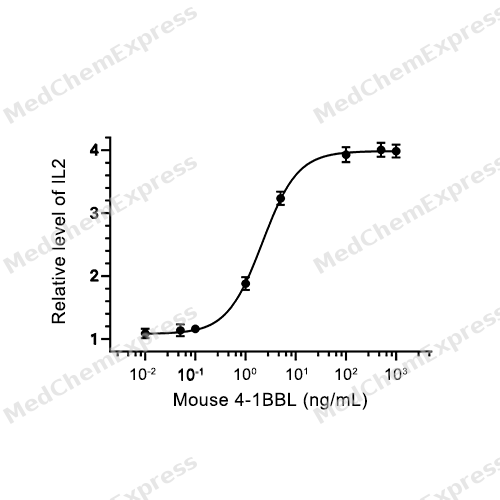
1.Measured by its ability to co-stimulate IL-2 secretion by mouse T cells in the presence of anti-CD3. The ED50 for this effect is 1-10 ng/mL.
2.Measured by its binding ability in a functional ELISA. Immobilized Recombinant Mouse 4-1BBL at 2µg/mL (100 µL/well) can bind biotinylated Mouse 4-1BB. The ED50 for this effect is 0.4068 μg/mL.
MCE Validation Data
-
Purity - SDS-PAGE
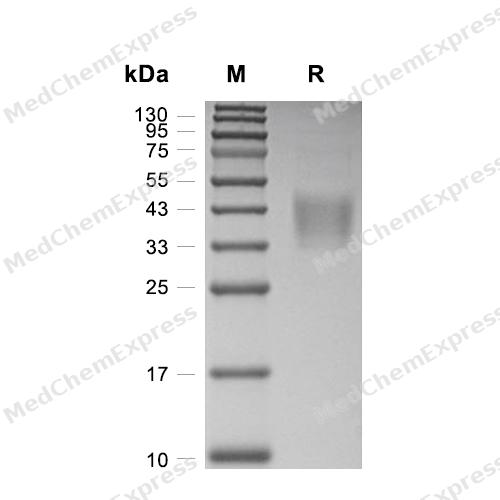
Purity - SDS-PAGE
-
Bioactivity - Cell-Based Assay
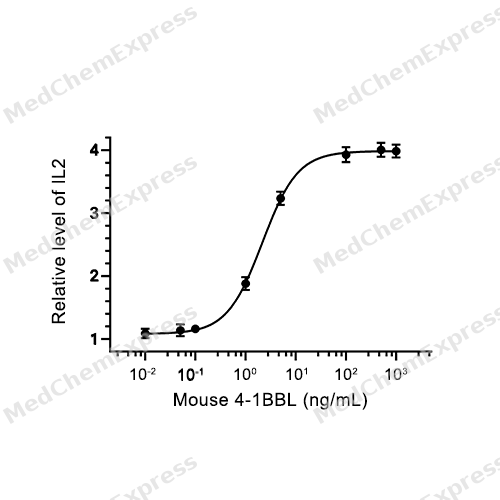
Bioactivity - Cell-Based Assay


Technical Parameters
-
Species Mouse
-
Source HEK293
-
Tag N-10*His
-
Accession
P41274 (R104-E309)
-
Molecular Construction
-
N-term
-
10*His
-
4-1BBL (R104-E309)
Accession # P41274 -
C-term
-
-
Protein Length
Extracellular Domain
-
Synonyms
TNFSF9; Homolog Of Mouse 4-1BB-L; TNF Superfamily Member 9; Receptor 4-1BB Ligand; 4-1BBL; CD137 Ligand; 4-1BB-L; 4-1BB Ligand; CD137L; Tumor Necrosis Factor (Ligand) Superfamily, Member 9, Isoform CRA_a; Tumor Necrosis Factor (Ligand) Superfamily, Member
-
AA Sequence
RTEPRPALTITTSPNLGTRENNADQVTPVSHIGCPNTTQQGSPVFAKLLAKNQASLCNTTLNWHSQDGAGSSYLSQGLRYEEDKKELVVDSPGLYYVFLELKLSPTFTNTGHKVQGWVSLVLQAKPQVDDFDNLALTVELFPCSMENKLVDRSWSQLLLLKAGHRLSVGLRAYLHGAQDAYRDWELSYPNTTSFGLFLVKPDNPWE
-
Predicted Molecular Mass
25.6 kDa
-
Molecular Weight
Approximately 35-40 kDa, based on SDS-PAGE under reducing conditions.
-
Glycosylation
Yes
-
Purity
≥ 90%, as determined by reducing SDS-PAGE.


Product Properties
Lyophilized powder
1.Lyophilized from a 0.22 μm filtered solution of PBS, pH 7.4.
2.Lyophilized from a 0.22 μm filtered solution of 20 mM PB, 150 mM NaCl, pH 7.4.
3.Lyophilized from a 0.22 μm filtered solution of PBS, pH 7.4, 5% trehalose.
4.Lyophilized from a 0.22 μm filtered solution of PBS, pH 7.4, 8% trehalose.
Please refer to the lot-specific COA for specific buffer information.
<1 EU/μg, determined by LAL method.
It is not recommended to reconstitute to a concentration less than 100 μg/mL in ddH2O. For long term storage it is recommended to add a carrier protein (0.1% BSA, 5% HSA, 10% FBS or 5% Trehalose).
Stored at -20°C for 2 years from date of receipt. After reconstitution, it is stable at 4°C for 1 week or -20°C for longer (with carrier protein). It is recommended to freeze aliquots at -20°C or -80°C for extended storage.
Room temperature in continental US; may vary elsewhere.


Documentation
-
Data Sheet (265 KB)
-
SDS (252 KB)
- English - EN (252 KB)
- Français - FR (252 KB)
- Deutsch - DE (252 KB)
- Norwegian - NO (252 KB)
- Español - ES (252 KB)
- Swedish - SV (252 KB)
- Italian - IT (252 KB)
- Korean - KR (252 KB)
- Portuguese - PT (252 KB)
-
Handling Instructions (2659 KB)


References
[1]. Li Y, et al. Limited Cross-Linking of 4-1BB by 4-1BB Ligand and the Agonist Monoclonal Antibody Utomilumab. Cell Rep. 2018 Oct 23;25(4):909-920.e4. [Content Brief]
[2]. Yuan Zhao ,et al. Dispensable Role for 4-1BB and 4-1BBL in Development of Vaccinia Virus-Specific CD8 T Cells. Immunol Lett. 2012 Jan 30;141(2):220-6. [Content Brief]
[3]. Bitra A, et al. Crystal structure of the m4-1BB/4-1BBL complex reveals an unusual dimeric ligand that undergoes structural changes upon 4-1BB receptor binding. J Biol Chem. 2019 Feb 8;294(6):1831-1845. [Content Brief]
[5]. Martinez-Perez AG, et al. 4-1BBL as a Mediator of Cross-Talk between Innate, Adaptive, and Regulatory Immunity against Cancer. Int J Mol Sci. 2021 Jun 9;22(12):6210. [Content Brief]
[6]. Salih HR, et al. Soluble CD137 (4-1BB) ligand is released following leukocyte activation and is found in sera of patients with hematological malignancies. J Immunol. 2001 Oct 1;167(7):4059-66. [Content Brief]

Calculators
Concentration (start) × Volume (start) = Concentration (final) × Volume (final)


 Powered by Bioz

