



ACE2 Protein, Human (HEK293, mFc)
Based on 1 publication(s) in Google Scholar
ACE2 Protein, Human (HEK293, mFc) is a SARS-CoV-2 receptor. Angiotensin-Converting Enzyme 2 efficiently hydrolyses the potent vasoconstrictor angiotensin II to angiotensin. It is a consequence of this action that ACE2 participates in the renin-angiotensin system.
- Species: Human
- Source: HEK293
-
Storage:Stored at -80°C for 1 year from date of receipt. It is stable at -20°C for 3 months after opening. It is recommended to freeze aliquots at -80°C for extended storage. Avoid repeated freeze-thaw cycles.


To place orders, for customer services and technical support, please contact: MedChemExpress USA
Tel: 609-228-6898 E-mail: [email protected] [email protected]


-
 Biological Activity
-
Technical Parameters
-
Product Properties
- Documentation
- References
- Help & FAQs




Biological Activity
Description
ACE2 Protein, Human (HEK293, mFc) is a SARS-CoV-2 receptor. Angiotensin-Converting Enzyme 2 efficiently hydrolyses the potent vasoconstrictor angiotensin II to angiotensin. It is a consequence of this action that ACE2 participates in the renin-angiotensin system.
Background
Angiotensin-Converting Enzyme 2 (ACE2) is a type I integral membrane protein which functions as a carboxypeptidase, cleaving a single hydrophobic/basic residue from the C-terminus of its substrates. ACE2 efficiently hydrolyses the potent vasoconstrictor angiotensin II to angiotensin. It is a consequence of this action that ACE2 participates in the renin-angiotensin system. However, ACE2 also hydrolyses dynorphin A (1–13), apelin-13 and des-Arg9 bradykinin. The role of ACE2 in these peptide systems has yet to be revealed. A physiological role for ACE2 has been implicated in hypertension, cardiac function, heart function and diabetes, and as a receptor of the severe acute respiratory syndrome coronavirus. This paper reviews the biochemistry of ACE2 and discusses key findings such as the elucidation of crystal structures for ACE2 and testicular ACE and the development of ACE2 inhibitors that have now provided a basis for future research on this enzyme.
Verified Bioactivity
Measured by its binding ability in a functional ELISA. Immobilized Human ACE2, at 2 μg/mL (100 μL/well) can bind Biotinylated SARS-CoV-2 S1 protein. The ED50 for this effect is 8.465 ng/mL, corresponding to a specific activity is 1.18×10^5 Unit/mg.
MCE Validation Data
-
Purity - SDS-PAGE
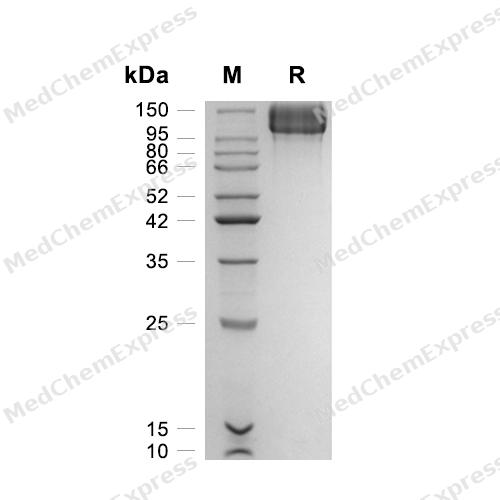
Purity - SDS-PAGE
-
Bioactivity - ELISA
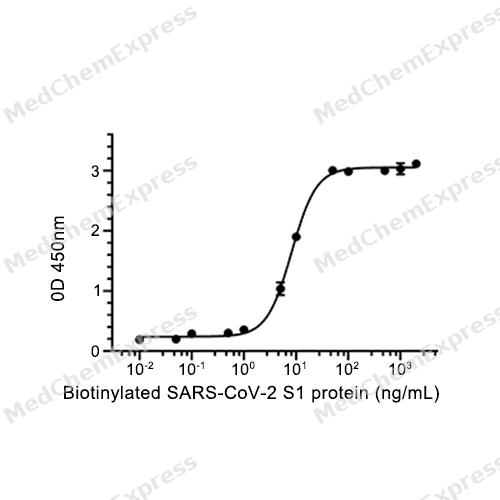
Bioactivity - ELISA

Assay Procedure
Materials
ACE2 Protein, Human (HEK293, mFc) (HY-P7443)
Biotin
Pre-chilled Sterile Water
Washing buffer: 1×PBST
Blocking buffer: PBST with 1% BSA
TMB Chromogenic Solution: Mix Chromogenic Solution A and Chromogenic Solution B at a ratio of 1:1 before use, and prepare freshly as needed
Stop solution: 2 M H2SO4
Procedure
Biotin Labeling
1. Dissolution of Biotin reagent: Take out Biotin from -10~-30℃, immediately dissolve 1 tube of Biotin with 180 μL of cold pure water. Gently pipette to mix well to prepare 10 mM Biotin.
2. Calculate the volume of EZ-LinkTM Sulfo-NHS-LC-LC-Biotin, No-WeighTM Format to be added.
3. Incubate at room temperature in the dark for 45 min.
4. Quantification of labeled protein: Use BCA assay for protein concentration quantification; the concentration of the labeled Biotinylated SARS-CoV-2 S1 is 208 μg/mL.
ELISA Detection
1. Coating: Dilute ACE2 protein to 2 μg/mL with 1×PBS, add 100 μL/well, and incubate overnight at 2-8℃.
2. Plate washing: Wash the plate with washing buffer, 260 μL per well, wash once, and pat dry.
3. Blocking: Use 1×PBST blocking buffer containing 1% BSA, add 150 μL/well, and block at 25℃ with 450 rpm shaking for 4 h.
4. Dilute Biotinylated SARS-CoV-2 S1 to the following concentrations: 0, 0.005, 0.01, 0.05, 0.1, 0.5, 1, 5, 10, 50, 100, 500, 1000, 2000 ng/mL.
5. Add receptor protein: 100 μL/well, incubate at 25℃ with 450 rpm shaking for 2 h.
6. Plate washing: Wash the plate with washing buffer, 260 μL per well, wash 5 times with 1 min retention each time, then pat dry.
7. Add secondary antibody: Dilute the secondary antibody at a ratio of 1:2000, add 100 μL per well, and incubate at 25℃ with 450 rpm shaking for 1 h.
8. Plate washing: Wash the plate with washing buffer, 260 μL/well, wash 3 times with 1 min retention each time, and pat dry.
9. Add TMB chromogenic solution: 100 μL per well, incubate at room temperature in the dark for 15 min.
10. Terminate the reaction: Add 2 M H2SO4, 100 μL/well.
11. Plate reading: Read the absorbance at 450 nm.
12. Use GraphPad Prism software to plot a curve with OD value as the ordinate and Biotinylated SARS-CoV-2 S1 concentration as the abscissa, and calculate the ED50 value.


Publications (1)
-
Journal Impact Factor
-
Most Recent
-
J Med Virol
ACE2 PET to Reveal the Dynamic Patterns of ACE2 Recovery in an Infection Model with Pseudo Corona Virus. [Abstract]2023 Feb;95(2):e28470. PMID: 36606602


Technical Parameters
-
Species Human
-
Source HEK293
-
Tag C-mFc
-
Accession
Q9BYF1-1 (Q18-S740)
-
Molecular Construction
-
N-term
-
ACE2 (Q18-S740)
Accession # Q9BYF1-1 -
mFc
-
C-term
-
-
Protein Length
Extracellular Domain
-
Synonyms
ACE2; Angiotensin I Converting Enzyme 2; Angiotensin Converting Enzyme 2; Angiotensin-Converting Enzyme 2; ACEH; ACE-Related Carboxypeptidase; Angiotensin I Converting Enzyme (Peptidyl-Dipeptidase A) 2; Metalloprotease MPROT15; Angiotensin-Converting Enzy
-
AA Sequence
QSTIEEQAKTFLDKFNHEAEDLFYQSSLASWNYNTNITEENVQNMNNAGDKWSAFLKEQSTLAQMYPLQEIQNLTVKLQLQALQQNGSSVLSEDKSKRLNTILNTMSTIYSTGKVCNPDNPQECLLLEPGLNEIMANSLDYNERLWAWESWRSEVGKQLRPLYEEYVVLKNEMARANHYEDYGDYWRGDYEVNGVDGYDYSRGQLIEDVEHTFEEIKPLYEHLHAYVRAKLMNAYPSYISPIGCLPAHLLGDMWGRFWTNLYSLTVPFGQKPNIDVTDAMVDQAWDAQRIFKEAEKFFVSVGLPNMTQGFWENSMLTDPGNVQKAVCHPTAWDLGKGDFRILMCTKVTMDDFLTAHHEMGHIQYDMAYAAQPFLLRNGANEGFHEAVGEIMSLSAATPKHLKSIGLLSPDFQEDNETEINFLLKQALTIVGTLPFTYMLEKWRWMVFKGEIPKDQWMKKWWEMKREIVGVVEPVPHDETYCDPASLFHVSNDYSFIRYYTRTLYQFQFQEALCQAAKHEGPLHKCDISNSTEAGQKLFNMLRLGKSEPWTLALENVVGAKNMNVRPLLNYFEPLFTWLKDQNKNSFVGWSTDWSPYADQSIKVRISLKSALGDKAYEWNDNEMYLFRSSVAYAMRQYFLKVKNQMILFGEEDVRVANLKPRISFNFFVTAPKNVSDIIPRTEVEKAIRMSRSRINDAFRLNDNSLEFLGIQPTLGPPNQPPVS
-
Molecular Weight
Approximately 110-150 kDa, based on SDS-PAGE under reducing conditions, due to the glycosylation.
-
Glycosylation
Yes
-
Purity
≥ 90%, as determined by reducing SDS-PAGE.


Product Properties
Solution
Supplied as a 0.22 μm filter solution of 20 mM Tris-HCl, 300 mM NaCl, 1 mM ZnCl2, 10% Glycerol, pH 7.4.
Note: For SPR assay, please replace the buffer. Primary amine components (e.g., Tris, imidazole) can affect protein-coupled chips.
<1 EU/μg, determined by LAL method.
Stored at -80°C for 1 year from date of receipt. It is stable at -20°C for 3 months after opening. It is recommended to freeze aliquots at -80°C for extended storage. Avoid repeated freeze-thaw cycles.
Shipping with dry ice.


Documentation
-
Data Sheet (266 KB)
-
SDS (254 KB)
- English - EN (254 KB)
- Français - FR (254 KB)
- Deutsch - DE (254 KB)
- Norwegian - NO (254 KB)
- Español - ES (254 KB)
- Swedish - SV (254 KB)
- Italian - IT (254 KB)
- Korean - KR (254 KB)
- Portuguese - PT (254 KB)
-
Handling Instructions (2659 KB)


References

Calculators
Concentration (start) × Volume (start) = Concentration (final) × Volume (final)


 Powered by Bioz

