



Alkaline Phosphatase/ALPP Protein, Human (HEK293, His, solution)

Based on 1 Customer Validation
Alkaline Phosphatase/ALPP Protein, Human (HEK293, His, solution) is a ubiquitous membrane-bound glycoprotein that catalyzes the hydrolysis of phosphate monoesters at basic pH values.
- Species: Human
- Source: HEK293
-
Storage:Stored at -80°C for 1 year from date of receipt. It is stable at -20°C for 3 months after opening. It is recommended to freeze aliquots at -80°C for extended storage. Avoid repeated freeze-thaw cycles.


To place orders, for customer services and technical support, please contact: MedChemExpress USA
Tel: 609-228-6898 E-mail: [email protected] [email protected]


-
 Biological Activity
-
Technical Parameters
-
Product Properties
- Documentation
- References
- Help & FAQs




Biological Activity
Description
Alkaline Phosphatase/ALPP Protein, Human (HEK293, His, solution) is a ubiquitous membrane-bound glycoprotein that catalyzes the hydrolysis of phosphate monoesters at basic pH values[1].
Background
Alkaline phosphatases [ALP; orthophosphoric monoester phosphohydrolase (alkaline optimum) EC 3.1.3.1] are plasma membrane-bound glycoproteins. These enzymes are widely distributed in nature, including prokaryotes and higher eukaryotes, with the exception of some higher plants. Alkaline phosphatase forms a large family of dimeric enzymes, usually confined to the cell surface hydrolyzes various monophosphate esters at a high pH optimum with release of inorganic phosphate [1].
Verified Bioactivity
Measured by its ability to cleave a fluorogenic substrate, 4-Methylumbelliferyl phosphate (4-MUP). The specific activity is 672399.07 pmol/min/µg, as measured under the described conditions.
MCE Validation Data
-
Purity - SDS-PAGE
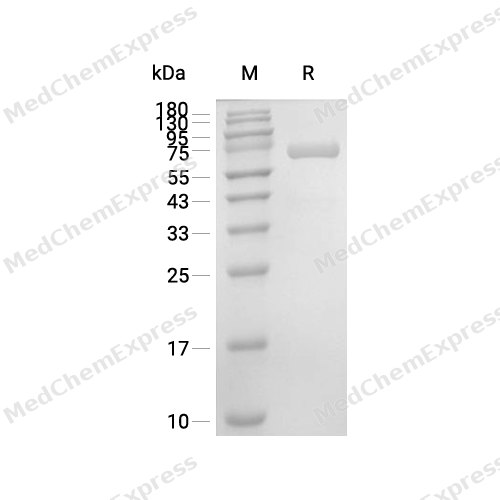
Purity - SDS-PAGE


Technical Parameters
-
Species Human
-
Source HEK293
-
Tag C-6*His
-
Accession
P05187 (I23-D506)
-
Molecular Construction
-
N-term
-
ALPP (I23-D506)
Accession # P05187 -
6*His
-
C-term
-
-
Protein Length
Full Length of Mature Protein
-
Synonyms
ALPP; PLAP-1; Alkaline Phosphatase, Placental; Alkaline Phosphatase, Placental (Regan Isozyme); PLAP; Placental Alkaline Phosphatase; PALP; Alkaline Phosphomonoesterase; Alkaline Phosphatase, Placental Type; Glycerophosphatase; Alkaline Phosphatase Regan
-
AA Sequence
IIPVEEENPDFWNREAAEALGAAKKLQPAQTAAKNLIIFLGDGMGVSTVTAARILKGQKKDKLGPEIPLAMDRFPYVALSKTYNVDKHVPDSGATATAYLCGVKGNFQTIGLSAAARFNQCNTTRGNEVISVMNRAKKAGKSVGVVTTTRVQHASPAGTYAHTVNRNWYSDADVPASARQEGCQDIATQLISNMDIDVILGGGRKYMFRMGTPDPEYPDDYSQGGTRLDGKNLVQEWLAKRQGARYVWNRTELMQASLDPSVTHLMGLFEPGDMKYEIHRDSTLDPSLMEMTEAALRLLSRNPRGFFLFVEGGRIDHGHHESRAYRALTETIMFDDAIERAGQLTSEEDTLSLVTADHSHVFSFGGYPLRGSSIFGLAPGKARDRKAYTVLLYGNGPGYVLKDGARPDVTESESGSPEYRQQSAVPLDEETHAGEDVAVFARGPQAHLVHGVQEQTFIAHVMAFAACLEPYTACDLAPPAGTTD
-
Predicted Molecular Mass
53.7 kDa
-
Molecular Weight
Approximately 60-85 kDa, based on SDS-PAGE under reducing conditions.
-
Glycosylation
Yes
-
Purity
≥ 90%, as determined by reducing SDS-PAGE.


Product Properties
Solution
Supplied as a 0.22 μm filter solution of PBS, pH 7.4.
<1 EU/μg, determined by LAL method.
Stored at -80°C for 1 year from date of receipt. It is stable at -20°C for 3 months after opening. It is recommended to freeze aliquots at -80°C for extended storage. Avoid repeated freeze-thaw cycles.
Shipping with dry ice.


Documentation
-
Data Sheet (264 KB)
-
SDS (252 KB)
- English - EN (252 KB)
- Français - FR (252 KB)
- Deutsch - DE (252 KB)
- Norwegian - NO (252 KB)
- Español - ES (252 KB)
- Swedish - SV (252 KB)
- Italian - IT (252 KB)
- Korean - KR (252 KB)
- Portuguese - PT (252 KB)
-
Handling Instructions (2659 KB)


References

Calculators
Concentration (start) × Volume (start) = Concentration (final) × Volume (final)


 Powered by Bioz

