



BACE2 Protein, Mouse (HEK293, His)
Based on 1 Customer Validation
The BACE2 protein is critically involved in the proteolytic processing of amyloid precursor protein (APP), producing beta-cleaved soluble APP and a cell-associated C-terminal fragment. It cleaves APP at residues 690-691 and 671-672. BACE2 Protein, Mouse (HEK293, His) is the recombinant mouse-derived BACE2 protein, expressed by HEK293 , with C-His labeled tag.
- Species: Mouse
- Source: HEK293
-
Storage:Stored at -20°C for 2 years from date of receipt. After reconstitution, it is stable at 4°C for 1 week or -20°C for longer (with carrier protein). It is recommended to freeze aliquots at -20°C or -80°C for extended storage.


To place orders, for customer services and technical support, please contact: MedChemExpress USA
Tel: 609-228-6898 E-mail: [email protected] [email protected]


-
 Biological Activity
-
Technical Parameters
-
Product Properties
- Documentation
- Help & FAQs




Biological Activity
Description
The BACE2 protein is critically involved in the proteolytic processing of amyloid precursor protein (APP), producing beta-cleaved soluble APP and a cell-associated C-terminal fragment. It cleaves APP at residues 690-691 and 671-672. BACE2 Protein, Mouse (HEK293, His) is the recombinant mouse-derived BACE2 protein, expressed by HEK293 , with C-His labeled tag.
Background
The BACE2 protein assumes a critical role in the proteolytic processing of the amyloid precursor protein (APP), cleaving it between residues 690 and 691. This cleavage event results in the generation and extracellular release of beta-cleaved soluble APP and a corresponding cell-associated C-terminal fragment, later released by gamma-secretase. Additionally, BACE2 has been shown to cleave APP between residues 671 and 672. Beyond its involvement with APP, BACE2 plays a pivotal role in the proteolytic shedding of PMEL during early stages of melanosome biogenesis, cleaving PMEL within the M-beta fragment to release the amyloidogenic PMEL luminal fragment comprising M-alpha and a small portion of M-beta N-terminus. This cleavage step is crucial for the subsequent processing and assembly of PMEL fibrils into amyloid sheets. Furthermore, BACE2 is responsible for the proteolytic processing of CLTRN in pancreatic beta cells, highlighting its diverse functions in cellular processes and contributing to our understanding of its significance in various physiological contexts.
Verified Bioactivity
Measured by its ability to cleave a fluorogenic peptide substrate Mca-KPLGL-Dpa-AR-NH2. The specific activity is 2187.098 pmol/min/µg, as measured under the described conditions.
MCE Validation Data
-
Purity - SDS-PAGE
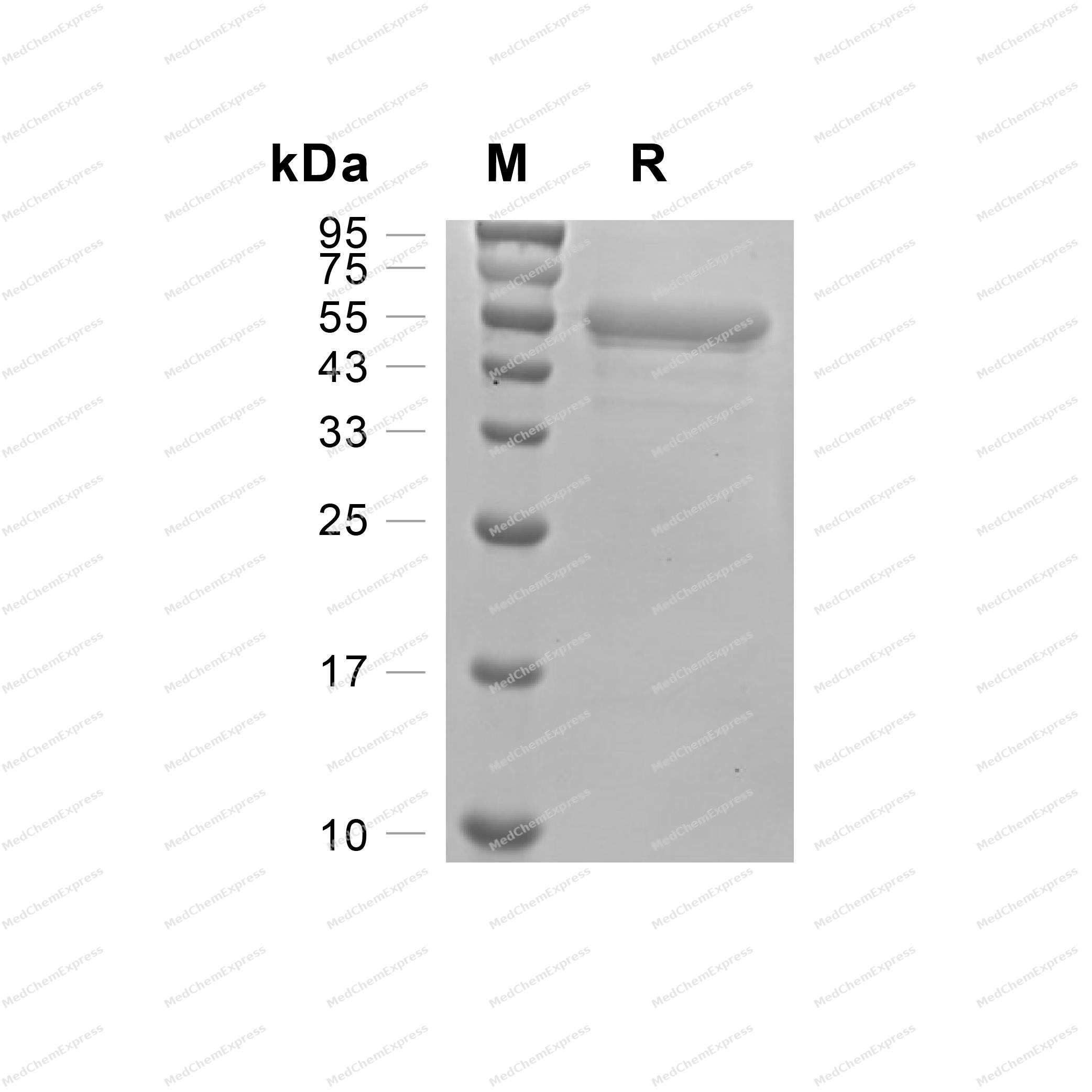
Purity - SDS-PAGE


Technical Parameters
-
Species Mouse
-
Source HEK293
-
Tag C-His
-
Accession
Q9JL18 (A20-P462)
-
Molecular Construction
-
N-term
-
BACE2 (A20-P462)
Accession # Q9JL18 -
His
-
C-term
-
-
Protein Length
Extracellular Domain
-
Synonyms
BACE2; Memapsin-1; Prev. AEPLC; Beta-Site Amyloid Beta A4 Precursor Protein-Cleaving Enzyme 2; ALP56; Beta-Site Amyloid Precursor Protein Cleaving Enzyme 2; ASP1; Down Syndrome Region Aspartic Protease; DRAP; Transmembrane Aspartic Proteinase Asp1; Aspart
-
AA Sequence
AVPALAPAPFTLPLQVAGATNHRASAVPGLGTPELPRADGLALALEPVRATANFLAMVDNLQGDSGRGYYLEMLIGTPPQKVQILVDTGSSNFAVAGAPHSYIDTYFDSESSSTYHSKGFDVTVKYTQGSWTGFVGEDLVTIPKGFNSSFLVNIATIFESENFFLPGIKWNGILGLAYAALAKPSSSLETFFDSLVAQAKIPDIFSMQMCGAGLPVAGSGTNGGSLVLGGIEPSLYKGDIWYTPIKEEWYYQIEILKLEIGGQNLNLDCREYNADKAIVDSGTTLLRLPQKVFDAVVEAVARTSLIPEFSDGFWTGAQLACWTNSETPWAYFPKISIYLRDENASRSFRITILPQLYIQPMMGAGFNYECYRFGISSSTNALVIGATVMEGFYVVFDRAQRRVGFAVSPCAEIEGTTVSEISGPFSTEDIASNCVPAQALNEP
-
Molecular Weight
Approximately 55 kDa, based on SDS-PAGE under reducing conditions, due to the glycosylation.
-
Glycosylation
Yes
-
Purity
≥ 95%, as determined by reducing SDS-PAGE.


Product Properties
Lyophilized powder.
Lyophilized from a 0.22 μm filtered solution of PBS, pH 7.4.
<1 EU/μg, determined by LAL method.
It is not recommended to reconstitute to a concentration less than 100 μg/mL in ddH2O. For long term storage it is recommended to add a carrier protein (0.1% BSA, 5% HSA, 10% FBS or 5% Trehalose).
Stored at -20°C for 2 years from date of receipt. After reconstitution, it is stable at 4°C for 1 week or -20°C for longer (with carrier protein). It is recommended to freeze aliquots at -20°C or -80°C for extended storage.
Room temperature in continental US; may vary elsewhere.


Documentation
-
Data Sheet (238 KB)
-
SDS (251 KB)
- English - EN (251 KB)
- Français - FR (251 KB)
- Deutsch - DE (251 KB)
- Norwegian - NO (251 KB)
- Español - ES (251 KB)
- Swedish - SV (251 KB)
- Italian - IT (251 KB)
- Korean - KR (251 KB)
- Portuguese - PT (251 KB)
-
Handling Instructions (2659 KB)

Calculators
Concentration (start) × Volume (start) = Concentration (final) × Volume (final)


 Powered by Bioz

