



Basigin/CD147 Protein, Mouse (HEK293, His)

Based on 1 Customer Validation
The Basigin/CD147 protein is essential for retinal maturation and development, acting as a NXNL1 receptor to promote the survival of retinal cone photoreceptor cells. Basigin/CD147 Protein, Mouse (HEK293, His) is the recombinant mouse-derived Basigin/CD147 protein, expressed by HEK293 , with C-His labeled tag.
- Species: Mouse
- Source: HEK293
-
Storage:Stored at -80°C for 1 year from date of receipt. It is stable at -20°C for 3 months after opening. It is recommended to freeze aliquots at -80°C for extended storage. Avoid repeated freeze-thaw cycles.


To place orders, for customer services and technical support, please contact: MedChemExpress USA
Tel: 609-228-6898 E-mail: [email protected] [email protected]


-
 Biological Activity
-
Technical Parameters
-
Product Properties
- Documentation
- Help & FAQs




Biological Activity
Description
The Basigin/CD147 protein is essential for retinal maturation and development, acting as a NXNL1 receptor to promote the survival of retinal cone photoreceptor cells. Basigin/CD147 Protein, Mouse (HEK293, His) is the recombinant mouse-derived Basigin/CD147 protein, expressed by HEK293 , with C-His labeled tag.
Background
Basigin/CD147 protein is indispensable for normal retinal maturation and development, acting as a crucial cell surface receptor for NXNL1 and contributing significantly to NXNL1-mediated survival of retinal cone photoreceptors. In collaboration with the glucose transporter SLC16A1/GLUT1 and NXNL1, Basigin/CD147 promotes retinal cone survival by enhancing aerobic glycolysis and facilitating the entry of glucose into photoreceptors. It serves as a signaling receptor for cyclophilins, playing an essential role in PPIA/CYPA and PPIB/CYPB-dependent signaling related to the chemotaxis and adhesion of immune cells. Additionally, Basigin/CD147 is pivotal in targeting the monocarboxylate transporters SLC16A1, SLC16A3, and SLC16A8 to the plasma membrane. Acting as a coreceptor for vascular endothelial growth factor receptor 2 (KDR/VEGFR2) in endothelial cells, it enhances VEGFA-mediated activation and downstream signaling, promoting angiogenesis through EPAS1/HIF2A-mediated up-regulation of VEGFA and KDR/VEGFR2. Moreover, Basigin/CD147 plays a crucial role in spermatogenesis, mediating interactions between germ cells and Sertoli cells and proving essential for the development and differentiation of germ cells into round spermatids.
Verified Bioactivity
Measured by its binding ability in a functional ELISA. Immobilized SARS-COV-2 S RBD (HY-P7431) at 1 μg/mL (100 μL/well) on the plate can bind biotinylated Mouse CD147. The ED50 for this effect is 7.713 μg/mL.
MCE Validation Data
-
Bioactivity - ELISA
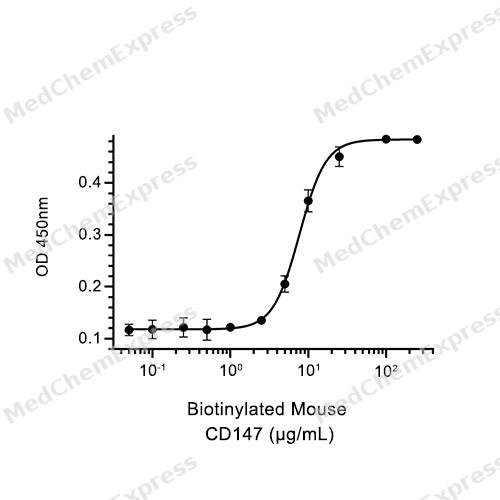
Bioactivity - ELISA


Technical Parameters
-
Species Mouse
-
Source HEK293
-
Tag C-His
-
Accession
P18572-2/NP_001070652.1 (A22-R209)
-
Molecular Construction
-
N-term
-
Basigin (A22-R209)
Accession # P18572-2/NP_001070652.1 -
His
-
C-term
-
-
Protein Length
Partial Extracellular Domain
-
Synonyms
BSG; Leukocyte Activation Antigen M6; Prev. OK; Hepatoma-Associated Antigen; EMMPRIN; OK Blood Group Antigen; Basigin; HAb18G; Tumor Cell-Derived Collagenase Stimulatory Factor; TCSF; Extracellular Matrix Metalloproteinase Inducer; 5F7; EMPRIN; Ok Blood G
-
AA Sequence
AAGTIQTSVQEVNSKTQLTCSLNSSGVDIVGHRWMRGGKVLQEDTLPDLHTKYIVDADDRSGEYSCIFLPEPVGRSEINVEGPPRIKVGKKSEHSSEGELAKLVCKSDASYPPITDWFWFKTSDTGEEEAITNSTEANGKYVVVSTPEKSQLTISNLDVNVDPGTYVCNATNAQGTTRETISLRVRSR
-
Predicted Molecular Mass
30 kDa
-
Molecular Weight
Approximately 30-35 kDa, based on SDS-PAGE under reducing conditions, due to the glycosylation.
-
Glycosylation
Yes
-
Purity
≥ 90%, as determined by reducing SDS-PAGE.


Product Properties
Solution
Supplied as a 0.22 μm filtered solution of PBS, pH 7.4.
<1 EU/μg, determined by LAL method.
Stored at -80°C for 1 year from date of receipt. It is stable at -20°C for 3 months after opening. It is recommended to freeze aliquots at -80°C for extended storage. Avoid repeated freeze-thaw cycles.
Shipping with dry ice.


Documentation
-
Data Sheet (237 KB)
-
SDS (254 KB)
- English - EN (254 KB)
- Français - FR (254 KB)
- Deutsch - DE (254 KB)
- Norwegian - NO (254 KB)
- Español - ES (254 KB)
- Swedish - SV (254 KB)
- Italian - IT (254 KB)
- Korean - KR (254 KB)
- Portuguese - PT (254 KB)
-
Handling Instructions (2659 KB)

Calculators
Concentration (start) × Volume (start) = Concentration (final) × Volume (final)


 Powered by Bioz

