



Semaphorin-4D/SEMA4D Protein, Human (HEK293, His)

Based on 1 Customer Validation
Semaphorin-4D/SEMA4D Protein, Human (HEK293, His) is a protein from the semaphorin family with important roles in the vascular, nervous and immune systems.
- Species: Human
- Source: HEK293
-
Storage:Stored at -20°C for 2 years from date of receipt. After reconstitution, it is stable at 4°C for 1 week or -20°C for longer (with carrier protein). It is recommended to freeze aliquots at -20°C or -80°C for extended storage.


To place orders, for customer services and technical support, please contact: MedChemExpress USA
Tel: 609-228-6898 E-mail: [email protected] [email protected]


-
 Biological Activity
-
Technical Parameters
-
Product Properties
- Documentation
- References
- Help & FAQs




Biological Activity
Description
Semaphorin-4D/SEMA4D Protein, Human (HEK293, His) is a protein from the semaphorin family with important roles in the vascular, nervous and immune systems.
Background
Semaphorin 4D, Sema4D, or CD100 belongs to semaphorin class 4 and is one of the so called “immune semaphorins”. Produced by the majority of hematopoietic cells including B and T lymphocytes, natural killer and myeloid cells, as well as endothelial cells, CD100 exerts its actions by binding to different receptors depending on the cell type and on the organism. In addition to being expressed in the membrane, CD100 is also found in a soluble form (sCD100), generated from membrane CD100 (mCD100) by proteolytic cleavage in an activation-dependent manner[1].
MCE Validation Data
-
Purity - SDS-PAGE
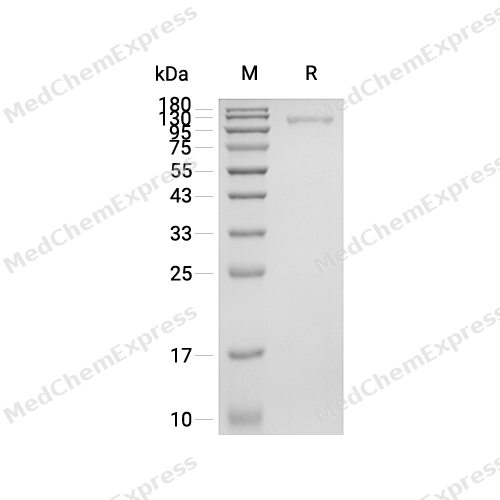
Purity - SDS-PAGE


Technical Parameters
-
Species Human
-
Source HEK293
-
Tag C-6*His
-
Accession
Q92854-1 (M22-R734)
-
Molecular Construction
-
N-term
-
SEMA4D (M22-R734)
Accession # Q92854-1 -
6*His
-
C-term
-
-
Protein Length
Extracellular Domain
-
Synonyms
SEMA4D; BB18; Prev. C9orf164; A8; Prev. SEMAJ; Sema Domain, Immunoglobulin Domain (Ig), Transmembrane Domain (TM) And Short Cytoplasmic Domain, 4D; CD100; Chromosome 9 Open Reading Frame 164; Semaphorin-4D; CD100 Antigen; Coll-4; M-Sema G; Sema Domain, Im
-
AA Sequence
MAFAPIPRITWEHREVHLVQFHEPDIYNYSALLLSEDKDTLYIGAREAVFAVNALNISEKQHEVYWKVSEDKKAKCAEKGKSKQTECLNYIRVLQPLSATSLYVCGTNAFQPACDHLNLTSFKFLGKNEDGKGRCPFDPAHSYTSVMVDGELYSGTSYNFLGSEPIISRNSSHSPLRTEYAIPWLNEPSFVFADVIRKSPDSPDGEDDRVYFFFTEVSVEYEFVFRVLIPRIARVCKGDQGGLRTLQKKWTSFLKARLICSRPDSGLVFNVLRDVFVLRSPGLKVPVFYALFTPQLNNVGLSAVCAYNLSTAEEVFSHGKYMQSTTVEQSHTKWVRYNGPVPKPRPGACIDSEARAANYTSSLNLPDKTLQFVKDHPLMDDSVTPIDNRPRLIKKDVNYTQIVVDRTQALDGTVYDVMFVSTDRGALHKAISLEHAVHIIEETQLFQDFEPVQTLLLSSKKGNRFVYAGSNSGVVQAPLAFCGKHGTCEDCVLARDPYCAWSPPTATCVALHQTESPSRGLIQEMSGDASVCPDKSKGSYRQHFFKHGGTAELKCSQKSNLARVFWKFQNGVLKAESPKYGLMGRKNLLIFNLSEGDSGVYQCLSEERVKNKTVFQVVAKHVLEVKVVPKPVVAPTLSVVQTEGSRIATKVLVASTQGSSPPTPAVQATSSGAITLPPKPAPTGTSCEPKIVINTVPQLHSEKTMYLKSSDNR
-
Predicted Molecular Mass
80.2 kDa
-
Molecular Weight
Approximately 110-112 kDa, based on SDS-PAGE under reducing conditions, due to the glycosylation.
-
Glycosylation
Yes
-
Purity
≥ 95%, as determined by reducing SDS-PAGE.


Product Properties
Lyophilized powder
Lyophilized after extensive dialysis against 20 mM PB, 150 mM NaCl, pH 7.4.
<1 EU/μg, determined by LAL method.
It is not recommended to reconstitute to a concentration less than 100 μg/mL in ddH2O. For long term storage it is recommended to add a carrier protein (0.1% BSA, 5% HSA, 10% FBS or 5% Trehalose).
Stored at -20°C for 2 years from date of receipt. After reconstitution, it is stable at 4°C for 1 week or -20°C for longer (with carrier protein). It is recommended to freeze aliquots at -20°C or -80°C for extended storage.
Room temperature in continental US; may vary elsewhere.


Documentation
-
Data Sheet (265 KB)
-
SDS (251 KB)
- English - EN (251 KB)
- Français - FR (251 KB)
- Deutsch - DE (251 KB)
- Norwegian - NO (251 KB)
- Español - ES (251 KB)
- Swedish - SV (251 KB)
- Italian - IT (251 KB)
- Korean - KR (251 KB)
- Portuguese - PT (251 KB)
-
Handling Instructions (2659 KB)


References

Calculators
Concentration (start) × Volume (start) = Concentration (final) × Volume (final)


 Powered by Bioz

