



CD127/IL-7RA Protein, Mouse (HEK293, His)

Based on 1 Customer Validation
IL-7RA (also known as CD127) is a type 1 membrane glycoprotein folded to bind and mediate the action of IL7 and other alpha helical cytokines. IL-7RA is mainly expressed by cells of the lymphoid lineage. IL-7RA also acts as a receptor for thymic stromal lymphopoietin (TSLP). CD127/IL-7RA Protein, Mouse (HEK293, His) is produced in HEK293 cells with a C-Terminal His-tag..
- Species: Mouse
- Source: HEK293
-
Storage:Stored at -20°C for 2 years from date of receipt. After reconstitution, it is stable at 4°C for 1 week or -20°C for longer (with carrier protein). It is recommended to freeze aliquots at -20°C or -80°C for extended storage.


To place orders, for customer services and technical support, please contact: MedChemExpress USA
Tel: 609-228-6898 E-mail: [email protected] [email protected]


-
 Biological Activity
-
Technical Parameters
-
Product Properties
- Documentation
- References
- Help & FAQs




Biological Activity
Description
IL-7RA (also known as CD127) is a type 1 membrane glycoprotein folded to bind and mediate the action of IL7 and other alpha helical cytokines. IL-7RA is mainly expressed by cells of the lymphoid lineage. IL-7RA also acts as a receptor for thymic stromal lymphopoietin (TSLP). CD127/IL-7RA Protein, Mouse (HEK293, His) is produced in HEK293 cells with a C-Terminal His-tag.[1][2].
Background
IL-7R α-chain (IL-7RA; also known as CD127) is a type 1 membrane glycoprotein folded to bind and mediate the action of IL-7 and other alpha helical cytokines. IL-7RA is almost exclusively expressed by cells of the lymphoid lineage that plays an important role in lymphocyte differentiation, proliferation, and survival. IL-7RA gene is localised on chromosome 5p13.3[1][2].
The amino acid sequence of human IL-7RA protein has low homology between mouse and rat IL-7RA protein. While, human IL-7RA shares 97% aa sequence identity with monkey IL-7RA protein.
IL-7 is classified as a type 1 short-chain cytokine of the hematopoietin family. Physiologic roles of IL-7 involve modulation of T- and B-cell development and T-cell homeostasis. To perform all pleiotropic functions of IL-7 in immune system, IL-7 binds through a transmembrane receptor, which is formed by heterodimerizing of the common cytokine gamma chain (γc; also known as CD132) and IL-7RA. IL-7RA consists of an extracellular domain, transmembrane region and cytoplasmic tail, that recruits kinases for signal transduction. IL-7RA is organized in eight exons, spanning 18 kb of genomic DNA. The protein has a folding typical for the insertion of a helical cytokine, and it is composed of an intracellular domain (195 aa), a transmembrane domain (25 aa), and an extracellular region (220 aa). The latter shares homology with other members of the type I family of cytokine receptors. Close to the transmembrane domain, the extracellular region of IL-7Ra contains a Trp-Ser-X-Trp-Ser (WSXWS) motif involved in proper folding of the protein. Finally, the extracellular region also contains two fibronectin type III-like domains. Soluble or membrane-bound isoforms of IL-7RA are produced according to the alternative splicing of exon 6 in IL7RA gene. IL-7RA also acts as a receptor for thymic stromal lymphopoietin (TSLP)[1][2][3].
IL-7RA associates with γc to form the functional high affinity IL-7 receptor complex. The natural killer T cells require signals from IL-7RA for their development. The common characteristic of all types of severe combined immunodeficiency (SCID) is absence of T-cell-mediated cellular immunity due to a defect in T-cell development. Defects in IL-7RA may be associated with SCID. Meanwhile, single nucleotide polymorphisms in IL7RA gene are involved in the dysregulation of immune homeostasis and susceptibility to multiple sclerosis (MS). IL-7RA is a receptor for TSLP. TSLP indirectly regulates T cell development by modulating dendritic cell activation[1][3].
Verified Bioactivity
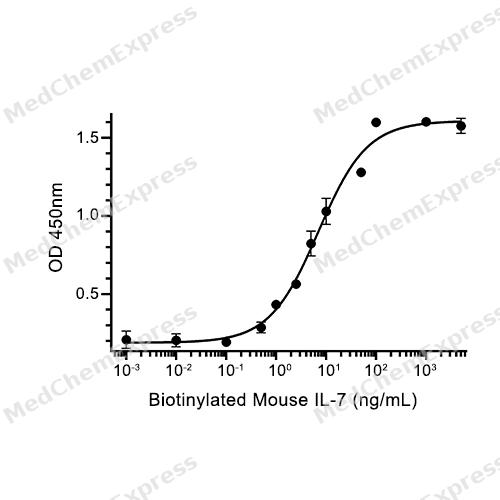
Measured by its binding ability in a functional ELISA. When Mouse IL-7RA is coated at 4 μg/mL (100 μL/well) can bind Mouse IL-7. The ED50 for this effect is 6.958 ng/mL.
MCE Validation Data
-
Purity - SDS-PAGE
Purity - SDS-PAGE
-
Bioactivity - ELISA
Bioactivity - ELISA


Technical Parameters
-
Species Mouse
-
Source HEK293
-
Tag C-6*His
-
Accession
P16872 (E21-D239)
-
Molecular Construction
-
N-term
-
IL-7RA (M1-D239)
Accession # P16872 -
His
-
C-term
-
-
Protein Length
Extracellular Domain
-
Synonyms
IL7R; Soluble Interleukin-7 Receptor; Interleukin 7 Receptor; IL-7 Receptor Subunit Alpha; CDw127; IL-7R Subunit Alpha; Interleukin-7 Receptor Subunit Alpha; CD127 Antigen; IL-7Ralpha; IL-7R-Alpha; IL7Ralpha; Interleukin 7 Receptor Alpha Chain; Lnc-IL7R;
-
AA Sequence
ESGNAQDGDLEDADADDHSFWCHSQLEVDGSQHLLTCAFNDSDINTANLEFQICGALLRVKCLTLNKLQDIYFIKTSEFLLIGSSNICVKLGQKNLTCKNMAINTIVKAEAPSDLKVVYRKEANDFLVTFNAPHLKKKYLKKVKHDVAYRPARGESNWTHVSLFHTRTTIPQRKLRPKAMYEIKVRSIPHNDYFKGFWSEWSPSSTFETPEPKNQGGWD
-
Molecular Weight
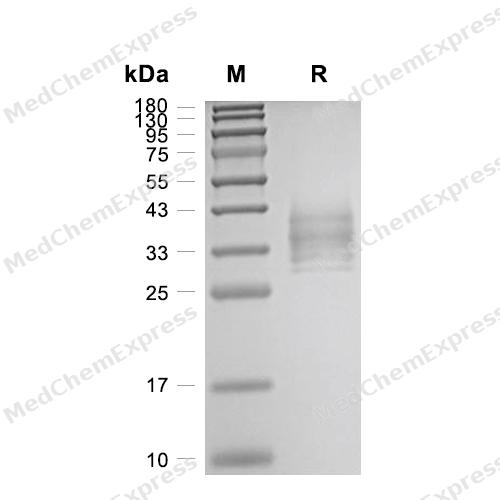
Approximately 34-40 kDa, based on SDS-PAGE under reducing conditions, due to the glycosylation.
-
Glycosylation
Yes
-
Purity
≥ 95%, as determined by reducing SDS-PAGE.


Product Properties
Lyophilized powder.
Lyophilized from a 0.22 μm filtered solution of PBS, pH 6.2, 8% trehalose.
<1 EU/μg, determined by LAL method.
It is not recommended to reconstitute to a concentration less than 100 μg/mL in ddH2O.
Stored at -20°C for 2 years from date of receipt. After reconstitution, it is stable at 4°C for 1 week or -20°C for longer (with carrier protein). It is recommended to freeze aliquots at -20°C or -80°C for extended storage.
Room temperature in continental US; may vary elsewhere.


Documentation
-
Data Sheet (265 KB)
-
SDS (251 KB)
- English - EN (251 KB)
- Français - FR (251 KB)
- Deutsch - DE (251 KB)
- Norwegian - NO (251 KB)
- Español - ES (251 KB)
- Swedish - SV (251 KB)
- Italian - IT (251 KB)
- Korean - KR (251 KB)
- Portuguese - PT (251 KB)
-
Handling Instructions (2659 KB)


References
[1]. Daniel Čierny, et al. Genetic variants in interleukin 7 receptor α chain (IL-7Ra) are associated with multiple sclerosis risk and disability progression in Central European Slovak population. J Neuroimmunol. 2015 May 15;282:80-4. [Content Brief]
[2]. Renata Mazzucchelli, et al. Interleukin-7 receptor expression: intelligent design. Nat Rev Immunol. 2007 Feb;7(2):144-54. [Content Brief]
[3]. Silvia Giliani, et al. Interleukin-7 receptor alpha (IL-7Ralpha) deficiency: cellular and molecular bases. Analysis of clinical, immunological, and molecular features in 16 novel patients. Immunol Rev. 2005 Feb;203:110-26. [Content Brief]

Calculators
Concentration (start) × Volume (start) = Concentration (final) × Volume (final)


 Powered by Bioz

