



CD367/CLEC4A Protein, Human (HEK293, His)

Based on 1 Customer Validation
The CD367/CLEC4A protein is a C-type lectin receptor that prefers to bind mannose and fucose and interacts weakly with GlcNAc in a Ca(2+)-dependent manner. It is critical for immune regulation, undergoing clathrin-dependent endocytosis upon antigen triggering, leading to antigen presentation and cross-priming of CD8+ T cells. CD367/CLEC4A Protein, Human (HEK293, His) is the recombinant human-derived CD367/CLEC4A protein, expressed by HEK293 , with N-His labeled tag.
- Species: Human
- Source: HEK293
-
Storage:Stored at -20°C for 2 years from date of receipt. After reconstitution, it is stable at 4°C for 1 week or -20°C for longer (with carrier protein). It is recommended to freeze aliquots at -20°C or -80°C for extended storage.


To place orders, for customer services and technical support, please contact: MedChemExpress USA
Tel: 609-228-6898 E-mail: [email protected] [email protected]


-
 Biological Activity
-
Technical Parameters
-
Product Properties
- Documentation
- Help & FAQs




Biological Activity
Description
The CD367/CLEC4A protein is a C-type lectin receptor that prefers to bind mannose and fucose and interacts weakly with GlcNAc in a Ca(2+)-dependent manner. It is critical for immune regulation, undergoing clathrin-dependent endocytosis upon antigen triggering, leading to antigen presentation and cross-priming of CD8+ T cells. CD367/CLEC4A Protein, Human (HEK293, His) is the recombinant human-derived CD367/CLEC4A protein, expressed by HEK293 , with N-His labeled tag.
Background
CD367/CLEC4A protein functions as a C-type lectin receptor with a preference for binding carbohydrates mannose and fucose, and a weaker interaction with N-acetylglucosamine (GlcNAc) in a Ca(2+)-dependent manner. This receptor plays a crucial role in regulating immune reactivity and, upon antigen triggering, undergoes internalization through clathrin-dependent endocytosis. Consequently, it delivers its antigenic cargo into the antigen presentation pathway, leading to the cross-priming of CD8(+) T cells. Notably, this cross-presentation and cross-priming are augmented by TLR7 and TLR8 agonists, resulting in increased expansion of CD8(+) T cells and heightened production of IFNG and TNF, while reducing levels of IL4, IL5, and IL13. In plasmacytoid dendritic cells, CD367/CLEC4A inhibits TLR9-mediated IFNA and TNF production. Furthermore, it may be involved in the inhibition of B-cell-receptor-mediated calcium mobilization and protein tyrosine phosphorylation via its ITIM motif (immunoreceptor tyrosine-based inhibitory motifs). In the context of microbial infection, CD367/CLEC4A is implicated in the interaction between HIV-1 virus and dendritic cells, enhancing HIV-1 binding and virus infection through an ITIM motif-associated signal transduction pathway involving phosphatases PTPN6 and PTPN11, SYK, Src kinases, and MAP kinases.
Verified Bioactivity
Measured by its ability of the immobilized protein to support the adhesion of Jurkat human acute T cell leukemia cells. The ED50 for this effect is 1.260 μg/mL, corresponding to a specific activity is 793.651 units/mg
MCE Validation Data
-
Purity - SDS-PAGE
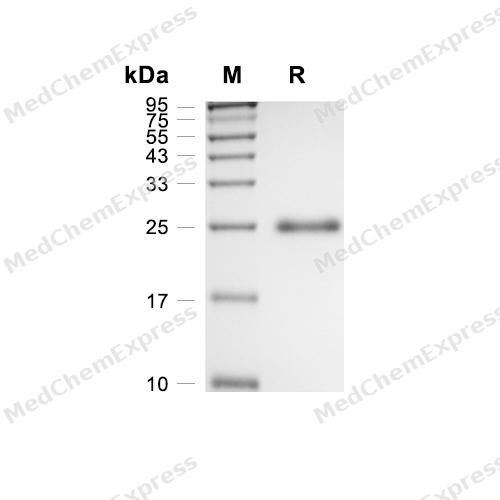
Purity - SDS-PAGE
-
Bioactivity - Cell-Based Assay
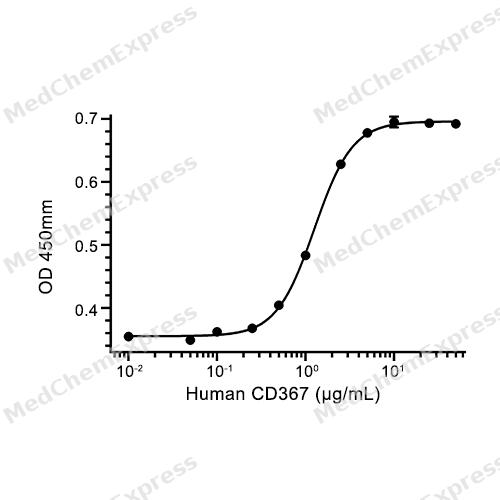
Bioactivity - Cell-Based Assay


Technical Parameters
-
Species Human
-
Source HEK293
-
Tag N-6*His
-
Accession
Q9UMR7-1 (Q70-L237)
-
Molecular Construction
-
N-term
-
His
-
CLEC4A (Q70-L237)
Accession # Q9UMR7-1 -
C-term
-
-
Protein Length
Extracellular Domain
-
Synonyms
CLEC4A; C-Type Lectin Superfamily Member 6; Prev. CLECSF6; Lectin-Like Immunoreceptor; DCIR; C-Type Lectin DDB27; DDB27; LLIR; CD367; C-Type Lectin Domain Family 4, Member A; HDCIR; CD367 Antigen; C-Type (Calcium Dependent, Carbohydrate-Recognition Domain
-
AA Sequence
QKYSQLLEKKTTKELVHTTLECVKKNMPVEETAWSCCPKNWKSFSSNCYFISTESASWQDSEKDCARMEAHLLVINTQEEQDFIFQNLQEESAYFVGLSDPEGQRHWQWVDQTPYNESSTFWHPREPSDPNERCVVLNFRKSPKRWGWNDVNCLGPQRSVCEMMKIHL
-
Molecular Weight
Approximately 28 kDa, based on SDS-PAGE under reducing conditions, due to the glycosylation.
-
Glycosylation
Yes
-
Purity
≥ 95%, as determined by reducing SDS-PAGE.


Product Properties
Lyophilized powder.
Lyophilized from a 0.22 μm filtered solution of PBS, pH 7.4.
<1 EU/μg, determined by LAL method.
It is not recommended to reconstitute to a concentration less than 100 μg/mL in ddH2O. For long term storage it is recommended to add a carrier protein (0.1% BSA, 5% HSA, 10% FBS or 5% Trehalose).
Stored at -20°C for 2 years from date of receipt. After reconstitution, it is stable at 4°C for 1 week or -20°C for longer (with carrier protein). It is recommended to freeze aliquots at -20°C or -80°C for extended storage.
Room temperature in continental US; may vary elsewhere.


Documentation
-
Data Sheet (237 KB)
-
SDS (251 KB)
- English - EN (251 KB)
- Français - FR (251 KB)
- Deutsch - DE (251 KB)
- Norwegian - NO (251 KB)
- Español - ES (251 KB)
- Swedish - SV (251 KB)
- Italian - IT (251 KB)
- Korean - KR (251 KB)
- Portuguese - PT (251 KB)
-
Handling Instructions (2659 KB)

Calculators
Concentration (start) × Volume (start) = Concentration (final) × Volume (final)


 Powered by Bioz

