



CD44 Protein, Mouse (HEK293, His)

Based on 1 Customer Validation
The CD44 protein binds to hyaluronic acid and TGF-β receptors and contributes to cytokine function. CD44 is involved in T cell activation, protein phosphorylation, and Wnt signaling and is strategically located in the plasma membrane and microvilli. CD44 Protein, Mouse (HEK293, His) is the recombinant mouse-derived CD44 protein, expressed by HEK293 , with C-His labeled tag.
- Species: Mouse
- Source: HEK293
-
Storage:Stored at -20°C for 2 years from date of receipt. After reconstitution, it is stable at 4°C for 1 week or -20°C for longer (with carrier protein). It is recommended to freeze aliquots at -20°C or -80°C for extended storage.


To place orders, for customer services and technical support, please contact: MedChemExpress USA
Tel: 609-228-6898 E-mail: [email protected] [email protected]


-
 Biological Activity
-
Technical Parameters
-
Product Properties
- Documentation
- Help & FAQs




Biological Activity
Description
The CD44 protein binds to hyaluronic acid and TGF-β receptors and contributes to cytokine function. CD44 is involved in T cell activation, protein phosphorylation, and Wnt signaling and is strategically located in the plasma membrane and microvilli. CD44 Protein, Mouse (HEK293, His) is the recombinant mouse-derived CD44 protein, expressed by HEK293 , with C-His labeled tag.
Background
CD44 Protein plays a multifaceted role by enabling hyaluronic acid binding activity and type II transforming growth factor beta receptor binding activity, contributing to cytokine binding activity and cytokine receptor activity. Engaged in processes such as negative regulation of T cell activation, positive regulation of protein phosphorylation, and the regulation of intracellular signal transduction, CD44 acts upstream of or within critical processes like the Wnt signaling pathway, morphogenesis of a branching epithelium, and wound healing involved in inflammatory response. The protein is strategically located in the basolateral plasma membrane, external side of the plasma membrane, and microvillus, and it is a component of the macrophage migration inhibitory factor receptor complex. CD44 exhibits broad expression across various structures, including the alimentary system, branchial arch, central nervous system, genitourinary system, and limb. Implicated in diseases such as breast carcinoma, carcinoma, and prostate cancer, CD44 demonstrates broad expression in lung adult (RPKM 13.1), spleen adult (RPKM 8.5), and 23 other tissues, emphasizing its pivotal roles in diverse physiological processes and potential contributions to cancer pathogenesis.
Verified Bioactivity
Measured by its binding ability in a functional ELISA. When rmCD44 is present at 1 μg/mL, the concentration of biotinylated hyaluronan that produces 50% of the optimal binding response is found to be approximately 17.45 ng/mL.
MCE Validation Data
-
Bioactivity - ELISA
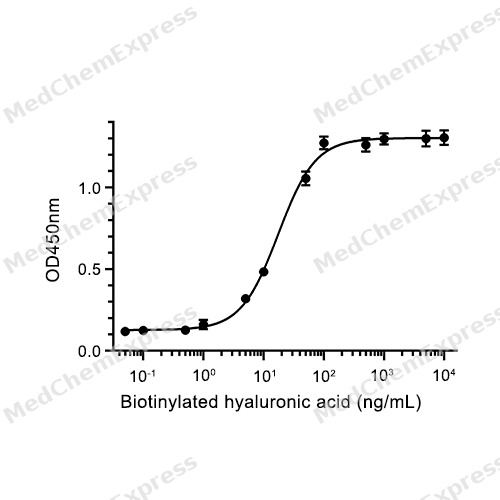
Bioactivity - ELISA


Technical Parameters
-
Species Mouse
-
Source HEK293
-
Tag C-His
-
Accession
NP_001034240.1 (Q25-T224)
-
Molecular Construction
-
N-term
-
CD44 (Q25-T224)
Accession # NP_001034240.1 -
His
-
C-term
-
-
Protein Length
Partial Extracellular Domain
-
Synonyms
CD44; Chondroitin Sulfate Proteoglycan 8; Prev. MDU2; Heparan Sulfate Proteoglycan; Prev. MDU3; Phagocytic Glycoprotein I; Prev. MIC4; Phagocyte Glycoprotein 1; HUTCH-I; In(Lu) Related-P80; CDw44; Soluble CD44; GP90 Lymphocyte Homing/Adhesion Receptor; EC
-
AA Sequence
QIDLNVTCRYAGVFHVEKNGRYSISRTEAADLCQAFNSTLPTMDQMKLALSKGFETCRYGFIEGNVVIPRIHPNAICAANHTGVYILVTSNTSHYDTYCFNASAPPEEDCTSVTDLPNSFDGPVTITIVNRDGTRYSKKGEYRTHQEDIDASNIIDDDVSSGSTIEKSTPESYILHTYLPTEQPTGDQDDSFFIRSTLAT
-
Molecular Weight
Approximately 37-42 kDa, based on SDS-PAGE under reducing conditions, due to the glycosylation.
-
Purity
≥ 95%, as determined by reducing SDS-PAGE.


Product Properties
Lyophilized powder
Lyophilized from a 0.22 μm filtered solution of 20 mM PB, 150 mM NaCl, pH 7.4.
<1 EU/μg, determined by LAL method.
It is not recommended to reconstitute to a concentration less than 100 μg/mL in ddH2O. For long term storage it is recommended to add a carrier protein (0.1% BSA, 5% HSA, 10% FBS or 5% Trehalose).
Stored at -20°C for 2 years from date of receipt. After reconstitution, it is stable at 4°C for 1 week or -20°C for longer (with carrier protein). It is recommended to freeze aliquots at -20°C or -80°C for extended storage.
Room temperature in continental US; may vary elsewhere.


Documentation
-
Data Sheet (237 KB)
-
SDS (251 KB)
- English - EN (251 KB)
- Français - FR (251 KB)
- Deutsch - DE (251 KB)
- Norwegian - NO (251 KB)
- Español - ES (251 KB)
- Swedish - SV (251 KB)
- Italian - IT (251 KB)
- Korean - KR (251 KB)
- Portuguese - PT (251 KB)
-
Handling Instructions (2659 KB)

Calculators
Concentration (start) × Volume (start) = Concentration (final) × Volume (final)


 Powered by Bioz

