



CD79 Protein, Mouse (HEK293, His)

Based on 1 Customer Validation
CD79A cooperates with CD79B to initiate the B cell antigen receptor complex (BCR) signaling cascade upon antigen binding. This results in complex internalization, transport and antigen presentation. CD79 Protein, Mouse (HEK293, His) is a recombinant protein dimer complex containing mouse-derived CD79 protein, expressed by HEK293 , with C-His labeled tag. CD79 Protein, Mouse (HEK293, His), has molecular weight of 23-43 kDa, respectively.
- Species: Mouse
- Source: HEK293
-
Storage:Stored at -20°C for 2 years from date of receipt. After reconstitution, it is stable at 4°C for 1 week or -20°C for longer (with carrier protein). It is recommended to freeze aliquots at -20°C or -80°C for extended storage.


To place orders, for customer services and technical support, please contact: MedChemExpress USA
Tel: 609-228-6898 E-mail: [email protected] [email protected]


-
 Biological Activity
-
Technical Parameters
-
Product Properties
- Documentation
- Help & FAQs




Biological Activity
Description
CD79A cooperates with CD79B to initiate the B cell antigen receptor complex (BCR) signaling cascade upon antigen binding. This results in complex internalization, transport and antigen presentation. CD79 Protein, Mouse (HEK293, His) is a recombinant protein dimer complex containing mouse-derived CD79 protein, expressed by HEK293 , with C-His labeled tag. CD79 Protein, Mouse (HEK293, His), has molecular weight of 23-43 kDa, respectively.
Background
CD79A, in collaboration with CD79B, plays a pivotal role in initiating the signal transduction cascade triggered by antigen binding to the B-cell antigen receptor complex (BCR), resulting in the internalization of the complex, trafficking to late endosomes, and subsequent antigen presentation. This indispensable protein is also crucial for BCR surface expression and the efficient differentiation of pro- and pre-B-cells. CD79A not only stimulates SYK autophosphorylation and activation but also binds to BLNK, facilitating the proximity of BLNK to SYK and enabling the phosphorylation of BLNK. Additionally, it interacts with and enhances the activity of specific Src-family tyrosine kinases, including FYN and LYN. In the context of immature B-cell development, CD79A functions to repress BCR signaling. As a heterodimer of alpha and beta chains, CD79A forms a disulfide-linked complex within the B-cell antigen receptor, where the alpha/beta chain heterodimer non-covalently associates with an antigen-specific membrane-bound surface immunoglobulin composed of two heavy chains and two light chains. The interaction through its phosphorylated ITAM domain with the SH2 domains of SYK stimulates SYK autophosphorylation and activation. Furthermore, when phosphorylated on Tyr-204, CD79A interacts with the SH2 domain of BLNK/SLP65, bringing BLNK into proximity with SYK and facilitating the phosphorylation of BLNK, a critical step for the trafficking of the BCR to late endosomes. CD79A's versatile interactions contribute to the intricate regulation of B-cell signaling and function.
Verified Bioactivity
Measured by its binding ability in a functional ELISA. Immobilized Mouse CD79, at 1μg/mL (100μL/well) can Anti-CD79B antibody. The ED50 for this effect is 63.97 ng/mL.
MCE Validation Data
-
Purity - SDS-PAGE
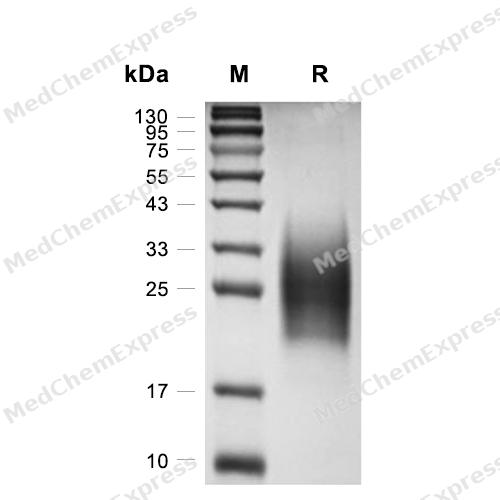
Purity - SDS-PAGE
-
Bioactivity - ELISA
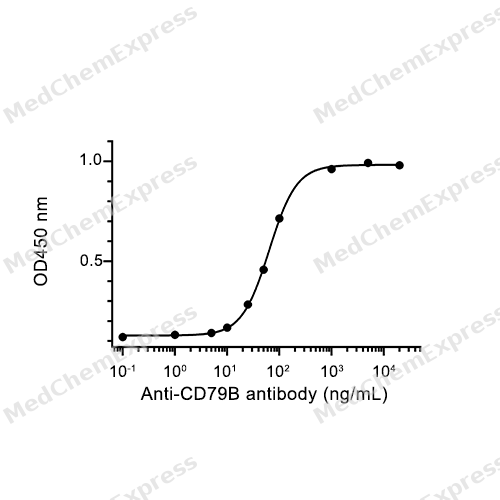
Bioactivity - ELISA


Technical Parameters
-
Species Mouse
-
Source HEK293
-
Tag C-His
-
Synonyms
CD79A; MB-1; Prev. IGA; CD79A Antigen (Immunoglobulin-Associated Alpha); Ig-Alpha; CD79a Molecule, Immunoglobulin-Associated Alpha; B-Cell Antigen Receptor Complex-Associated Protein Alpha Chain; Surface IgM-Associated Protein; MB1; MB-1 Membrane Glycopro
-
Molecular Weight
Approximately 34 kDa & 28 & 24 kDa, based on SDS-PAGE under reducing conditions.
-
Glycosylation
Yes
-
Purity
≥ 95%, as determined by reducing SDS-PAGE.


Product Properties
Lyophilized powder.
Lyophilized from a 0.22 μm filtered solution of PBS, pH 7.4.
<1 EU/μg, determined by LAL method.
It is not recommended to reconstitute to a concentration less than 100 μg/mL in ddH2O. For long term storage it is recommended to add a carrier protein (0.1% BSA, 5% HSA, 10% FBS or 5% Trehalose).
Stored at -20°C for 2 years from date of receipt. After reconstitution, it is stable at 4°C for 1 week or -20°C for longer (with carrier protein). It is recommended to freeze aliquots at -20°C or -80°C for extended storage.
Room temperature in continental US; may vary elsewhere.


Documentation
-
Data Sheet (235 KB)
-
SDS (251 KB)
- English - EN (251 KB)
- Français - FR (251 KB)
- Deutsch - DE (251 KB)
- Norwegian - NO (251 KB)
- Español - ES (251 KB)
- Swedish - SV (251 KB)
- Italian - IT (251 KB)
- Korean - KR (251 KB)
- Portuguese - PT (251 KB)
-
Handling Instructions (2659 KB)

Calculators
Concentration (start) × Volume (start) = Concentration (final) × Volume (final)


 Powered by Bioz

