



CD8 alpha Protein, Mouse (HEK293, His)
Based on 1 Customer Validation
CD8A is an important immune glycoprotein that acts as a coreceptor for class I MHC:peptide complexes, linking T cells to antigens presented by APCs. It interacts with TCR and MHC class I, recruits LCK kinase, and initiates multiple signaling pathways. CD8 alpha Protein, Mouse (HEK293, His) is the recombinant mouse-derived CD8 alpha protein, expressed by HEK293 , with C-His labeled tag.
- Species: Mouse
- Source: HEK293
-
Storage:Stored at -20°C for 2 years from date of receipt. After reconstitution, it is stable at 4°C for 1 week or -20°C for longer (with carrier protein). It is recommended to freeze aliquots at -20°C or -80°C for extended storage.


To place orders, for customer services and technical support, please contact: MedChemExpress USA
Tel: 609-228-6898 E-mail: [email protected] [email protected]


-
 Biological Activity
-
Technical Parameters
-
Product Properties
- Documentation
- Help & FAQs




Biological Activity
Description
CD8A is an important immune glycoprotein that acts as a coreceptor for class I MHC:peptide complexes, linking T cells to antigens presented by APCs. It interacts with TCR and MHC class I, recruits LCK kinase, and initiates multiple signaling pathways. CD8 alpha Protein, Mouse (HEK293, His) is the recombinant mouse-derived CD8 alpha protein, expressed by HEK293 , with C-His labeled tag.
Background
The CD8A, an integral membrane glycoprotein, plays a critical role in the immune response, fulfilling multiple functions in responses against both external and internal threats. In T-cells, it primarily functions as a coreceptor for the MHC class I molecule:peptide complex, interacting simultaneously with the T-cell receptor (TCR) and the MHC class I proteins presented by antigen-presenting cells (APCs). This interaction leads to the recruitment of the Src kinase LCK to the vicinity of the TCR-CD3 complex. LCK, in turn, initiates diverse intracellular signaling pathways, phosphorylating various substrates and ultimately promoting lymphokine production, motility, adhesion, and activation of cytotoxic T-lymphocytes (CTLs). This mechanism enables CTLs to recognize and eliminate infected cells and tumor cells. In NK-cells, the presence of CD8A homodimers at the cell surface provides a survival mechanism allowing the conjugation and lysis of multiple target cells. CD8A homodimer molecules also contribute to the survival and differentiation of activated lymphocytes into memory CD8 T-cells. The CD8A forms disulfide-linked complexes at the cell surface and also homodimers in various cell types, including NK-cells and peripheral blood T-lymphocytes. It interacts with the MHC class I HLA-A/B2M dimer and with LCK in a zinc-dependent manner.
MCE Validation Data
-
Purity - SDS-PAGE
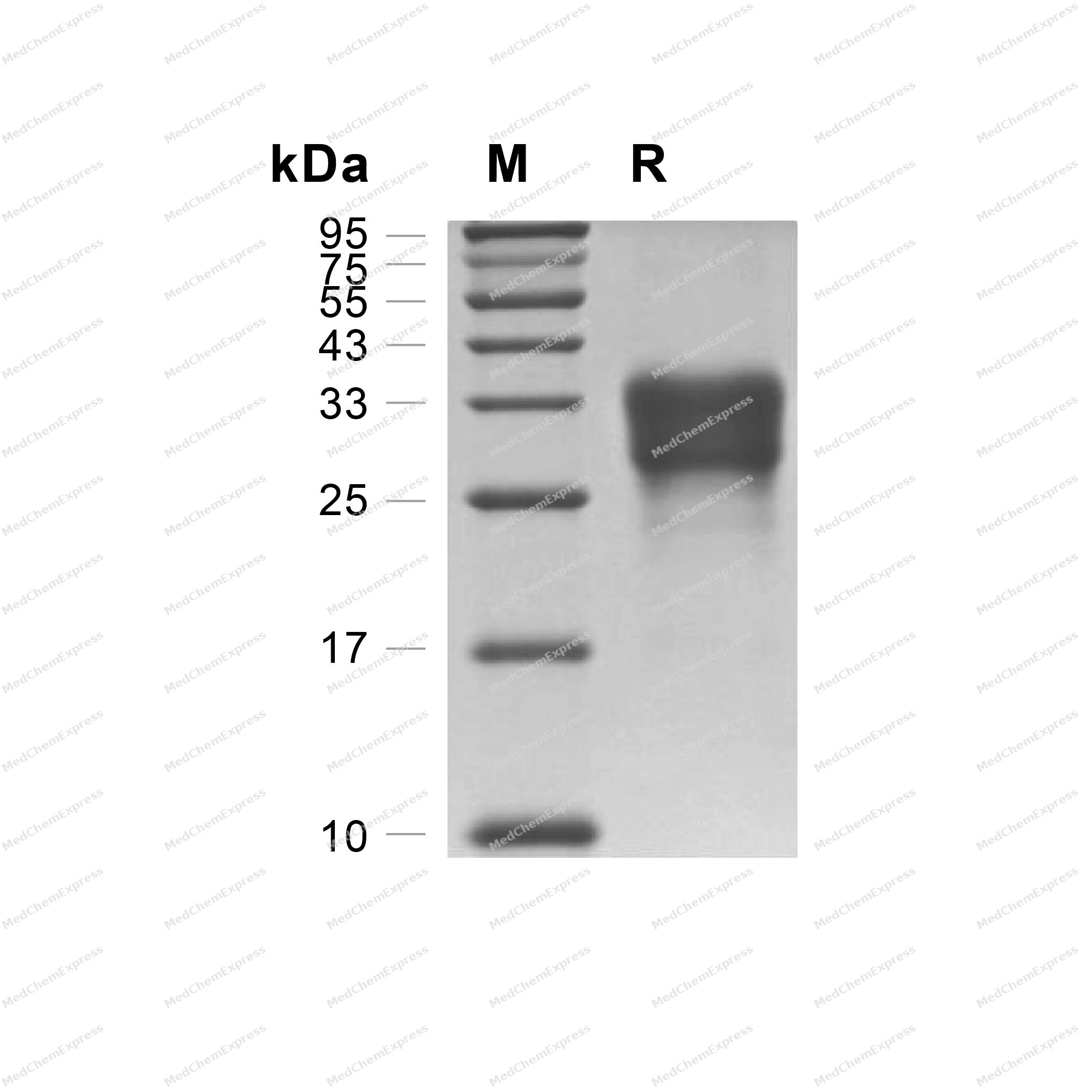
Purity - SDS-PAGE


Technical Parameters
-
Species Mouse
-
Source HEK293
-
Tag C-His
-
Accession
P01731/NP_001074579.1 (K28-Y196)
-
Molecular Construction
-
N-term
-
CD8 alpha (K28-Y196)
Accession # P01731/NP_001074579.1 -
His
-
C-term
-
-
Protein Length
Extracellular Domain
-
Synonyms
CD8A; Leu2 T-Lymphocyte Antigen; Prev. CD8; T-Cell Antigen Leu2; T-Cell Surface Glycoprotein CD8 Alpha Chain; T Cell Co-Receptor; T-Lymphocyte Differentiation Antigen T8/Leu-2; T8 T-Cell Antigen; CD8alpha; CD8a Antigen; P32; IMD116; CD8 Antigen, Alpha Pol
-
AA Sequence
KPQAPELRIFPKKMDAELGQKVDLVCEVLGSVSQGCSWLFQNSSSKLPQPTFVVYMASSHNKITWDEKLNSSKLFSAMRDTNNKYVLTLNKFSKENEGYYFCSVISNSVMYFSSVVPVLQKVNSTTTKPVLRTPSPVHPTGTSQPQRPEDCRPRGSVKGTGLDFACDIY
-
Molecular Weight
Approximately 32-42 kDa, based on SDS-PAGE under reducing conditions, due to the glycosylation.
-
Glycosylation
Yes
-
Purity
≥ 95%, as determined by reducing SDS-PAGE.


Product Properties
Lyophilized powder.
Lyophilized from a 0.2 μm filtered solution of PBS, pH 7.4.
<1 EU/μg, determined by LAL method.
It is not recommended to reconstitute to a concentration less than 100 μg/mL in ddH2O. For long term storage it is recommended to add a carrier protein (0.1% BSA, 5% HSA, 10% FBS or 5% Trehalose).
Stored at -20°C for 2 years from date of receipt. After reconstitution, it is stable at 4°C for 1 week or -20°C for longer (with carrier protein). It is recommended to freeze aliquots at -20°C or -80°C for extended storage.
Room temperature in continental US; may vary elsewhere.


Documentation
-
Data Sheet (237 KB)
-
SDS (251 KB)
- English - EN (251 KB)
- Français - FR (251 KB)
- Deutsch - DE (251 KB)
- Norwegian - NO (251 KB)
- Español - ES (251 KB)
- Swedish - SV (251 KB)
- Italian - IT (251 KB)
- Korean - KR (251 KB)
- Portuguese - PT (251 KB)
-
Handling Instructions (2659 KB)

Calculators
Concentration (start) × Volume (start) = Concentration (final) × Volume (final)


 Powered by Bioz

